Showing posts with label Auckland Council. Show all posts

Monday, July 9, 2012

Auckland's "One Rating System"

I wrote about Watercare a few weeks ago here. This advertisement has been placed frequently in NZ Herald and other news media. There has been discussion in letters and other news comment.

I support volumetric charging for wastewater, because I think the true costs of water infrastructure and its consequence - wastewater infrastructure - need to be better understood by those who use the services, so that they use it more knowingly, and more carefully.

But I do think the tail is wagging the dog here. Watercare has seized the opportunity of carving out its own business space, its own business plan, its own infrastructure development plan, and its own funding plan. Without much attention to the broader public interest.

There's nothing really new in that. From the moment amalgamation was suggested, Watercare was down in Wellington lobbying furiously to separate stormwater from water and wastewater services. (Hard to run stormwater as a business... etc etc). And now it wants to issue monthly bills....

My first letter to NZ Herald went like this:

“One council – one rates bill”. That was a catchphrase used to sell Auckland local government amalgamation.

Now we have a communications deluge - from a Council Controlled Organisation - warning Auckland ratepayers to expect no less than twelve water rate bills each year.

Disingenuously, Watercare announces this measure is in response to “customer feedback”, though I am not aware of any public consultation.

Sending and administering twelve water bills to one million ratepayers will cost ratepayers in excess of $10,000,000 annually. At least.

I understand Watercare has taken this step because that’s how privately run cellphone and electricity utilities operate.

But there’s a difference. Electricity and cellphone customers have a choice of provider. They need and expect monthly usage information. They shop around for the best deals and they can switch providers in a blink.

However there’s no competition for what Watercare provides. Watercare could provide accurate monthly usage analysis to ratepayers – presuming water meters are read frequently enough – through an appropriately secure website.

Watercare should minimize the costs of providing water and wastewater services and act in the public interest.

Many other letters have been published. Watercare's media people responded with a statement which added fuel to the flames, triggering some more robust comment. Including my response:

Watercare's letter justifying its plans to bill ratepayers every month for water services refers to private research showing that customers want monthly billing to better manage finances.

The letter also reports that Watercare achieved regional savings of $100 million last year.

This is a good saving and makes a dent in Auckland Council's annual expenditure of $3 billion. But it does not justify wasting that money on an expensive separate billing system when amalgamation was sold on the basis: One council = One rates bill = Efficiency.

Watercare's letter talks about the true cost of supplying water to Aucklanders and describes itself as a minimum cost operator.

If Watercare and Council were sincere about cost minimisation and genuine about helping ratepayers manage their finances, then there would be just one Council services bill - maybe monthly - listing each council service provided and its cost.

Ratepayers would know at a glance how their rates were being spent, see what each of their services cost, and benefit from further regional savings.

And then on Wednesday, last week, we had this advertisement in NZ Herald. Placed by Auckland Council - probably in damage control - rate bills about to hit the streets. The advert ran on page 13 (NZ Herald, 4 July 2012), while Watercare's ad (the one above) ran on page 22 (don't know how many times that advert has been placed). Watercare's is much bigger, easier to read. Both carry the Auckland Council logo (small in Watercare's case).

What's the poor ratepayer going to make of these public relations exercises? Auckland Council's advert insists that there is "one rating system". I guess you can have "one rating system" and then issue two different rating bills, supported by two completely different advertisements on different pages, without much in the way of obvious connection, and still be speaking the truth.

Or is it just expensive propaganda?

Monday, June 4, 2012

Economic Growth Projects Disasters for NZ Communities

The financial cost of the Christchurch earthquake has been huge and carefully valued, a disaster for many but an opportunity for economists and politicians alike who regard it as New Zealand’s best hope of achieving economic growth targets.

Last week the economics division at National Bank of New Zealand said, "four solid quarterly increases in economic activity have propelled Canterbury to the top of the year-on-year economic growth rankings", ahead of Auckland. The New Zealand Government’s recent budget relies heavily on economic activity in Christchurch to deliver GDP increases it believes are necessary to bring New Zealand’s economy into the black. As if all New Zealand needs is another disaster to keep on track.

Questions need to be asked about economic growth assumptions and about GDP – New Zealand’s commonly used measure of progress and success - because the same strategy is being applied by Councils in towns and cities with disastrous effects.

Kaipara District Council has achieved notoriety because of its proposal to almost double the rates of Mangawhai ratepayers to pay back the huge loan it raised to pay for a controversial sewage scheme.

Ratepayers were forced to abandon well maintained onsite wastewater systems which were generally working soundly, and then connect to the new wastewater network for a modest fee.

The original scheme raised a few eyebrows and might have succeeded. But, under pressure from developers and without consulting ratepayers further, the Council decided to double the land area serviced by the scheme, doubling the cost of the project. Now, because the predicted growth and development did not happen, the sewage scheme debt equates to an additional $20,000/residential ratepayer.

The Kaipara District Council 2009 - 2019 Long Term Council Community Plan gives some insights into how this happened: ‘The Kaipara District Council believes its key role in assisting the local economy to sustain and grow itself is to ensure the appropriate infrastructure is in place…’

While KDC’s investment in a sewage scheme might encourage growth in and around Mangawhai sometime in the future, it is questionable whether it is appropriate to levy the costs of that strategy now on existing ratepayers, by charging them an additional $2000/year - for the next ten years - on top of existing rates.

The investigative report now being condicted by the Office of the Auditor General will make interesting reading. Late last week, the Minister of Local Government- David Carter, announced it will appoint a Review Team to work with Kaipara District Council. This is very late in the day given Council must adopt its new plan and set the rates before the end of this month.

Still. Better late then never, though it will be too late to influence the potentially disastrous economic growth related decisions of Auckland Council.

Auckland Council’s Auckland Plan includes a diverse range of initiatives aimed at delivering a real GDP increase for Auckland of 5% /annum. This rate of growth is described in the Mayoral Forward to the Auckland Plan as “bold”. The services provided by the Council are said to: “support economic development of the region and contribute to the national economy”. The stated objective is to shift Auckland’s economic performance rating from 69th to 61st in OECD city rankings.

Last week Auckland Council media statements drew public attention to the fact that residential rates will increase by a gentle 3.6%, but quietly ignored its Ten Year Plan financial position statements which make for rather unhappy reading.

These show that council debt will balloon from $4.5 billion to $12.5 billion in ten years reaching almost $20,000/residential ratepayer. As bad as Mangawhai which is the worst in New Zealand. That debt will incur interest charges of more than $750 million each year – more than a quarter of the rates revenue for the Auckland region.

Auckland Council plans indicate that a number of big ticket projects would be funded from new loans. The City Centre Rail Loop project cost to ratepayers ranges from $1 billion to $3 billion over the next ten years, depending on whether the Government contributes its half of the cost, and how the project is staged. Auckland has needed this part of the rail network completed for decades. More than can be said about Watercare’s $800 million mega-sewage project that is to be bored under Auckland.

Even without these projects Auckland Council debt would still be $9 billion.

In its budget this year Central Government gave notice of its intention to reduce spending, though it is still borrowing heavily and government debt to GDP ratio is fast approaching 50%. Big ticket motorway projects apparently needed for growth are still provided for.

No such notice came from Auckland Council, despite signs that the growth much of its spending is for, is as illusory as it was in Mangawhai.

New Zealand’s population growth rate has dropped to the magic figure of 0.6% per annum due to emigration to Australia and other factors outside our control. Much of the population growth that Auckland is experiencing is due to internal migration. For example families are shifting to Auckland from Christchurch and other urban centres.

These shifts will cause Auckland’s economy to grow slowly, but they will cause other urban economies to shrink, leaving New Zealand’s overall economic position little changed.

Rather than chasing the tail of economic growth at all costs and incur enormous debt, the time has come to build economic resilience into New Zealand, to spend only what we earn, and to ensure urban living remains affordable for those who live here.

Business Booms at Watercare

The large newspaper advertisements in NZ Herald today, and the stormwater story earlier in the week, are shots across the bow of unsuspecting Auckland public.

The newspaper advertisments described Watercare's new charges for water and wastewater, and for residential and business ratepayers. Of course it has always been deeply ironic that the "One Council, One Bill" rhetoric was never ever going to be true. The re-organisation was always intended to allow Watercare to be a law unto itself, with its own computer system of residential and business ratepayers, and with its own business model and charging system. It is now almost stand-alone.

Watercare has embraced Central Government's business growth model with both hands. Watercare is now well placed to be sold off as a going concern, taking a sizeable chunk of Auckland Council's debt with it, and the promise of some very large, well funded, centralised network infrastructure projects.

The devil here - is behind the detail in Watercare's media release.

There are a few things that need to be aired, that are hard to discern readily in the Council's Ten Year Plan, which is the shop window on what Watercare plans:

1) I support the fact that Watercare can now charge residential ratepayers for their wastewater services on a volumetric basis. This will provide an economic incentive for water consumers to manage their consumption of water.

2) But these changes do not apply to business customers. We see in Watercare's public statement that "existing arrangements will apply...". While these are to some extent volumetric, their main purpose is to allow businesses to tip contaminants and trade wastes into the sewer, where they mix with ordinary sewage, ensuring that the cocktail that finally arrives at Mangere is completely untreatable for re-use. So Watercare is perpetuating an outdated system, which provides little incentive for Auckland business to clean up its act at source, and generates a nice little earner for Watercare. The resulting biosolids are too contaminated to be reused as soil conditioner, and must be landfilled. Hence Watercare's desire to continue its business oriented dumping operation by landfilling the biolsolids at Puketutu. (I have walked on the existing biosolids landfills in Manukau Harbour. These are not happy places.)

3) The Council's Team Year Plan includes the debt level for the Auckland Council Group - ie Council, plus Council Controlled Organisations - including Watercare. The debt level that Council has voted for is close to $13 billion - almost 3x what it is now. It appears that around $3 to $4 billion of that debt is Watercare debt. Part of the increase in that debt will be the proposed $800 million "Central Interceptor" project - the huge pipe/storage system to be dug under Auckland, allowing business as usual activity to occur, and to allow for more of it.

Councillors should not be allowing Watercare to hide this burgeoning centralised network of water and wastewater infrastructure - on the basis that the bills for it reduce Council's own rates bill, and on the basis that "they can blame Watercare...not us".

Watercare's practice is increasingly unsustainable. It is already the biggest user of electricity in Auckland - because of its need for pumping of water and wastewater, and for the electricity intensive, centralised treatment plants that it operates.

The fact that Auckland Council has to deal with stormwater, now that Watercare successfully separated the meter-paid waters, further exacerbates this trend. I await with interest the debate over the stormwater disposal charges that Watercare will levy on the Council, when Council seeks to divert pesky stormwater flows into Watercare's Central Interceptor. Another nice little earner for Watercare.

Auckland Council Rubbishes Innovation

It would be great to see something truly local come out of Auckland Council when it comes to the management of waste.

There were some very positive initiatives underway across the Auckland Region before amalgamation. These were valued by many, and were the start in the long walk to reducing our individual footprints across our region.

 From outside council it's hard to see where the "one size fits all" pressure comes from that seems to force Councillors into making "Regional Decisions" rather than local ones.

 I live in Devonport. A Borough known for innovation: first Nuclear Free Borough; also was first to get Kerb-Side recycling underway in New Zealand (I think). That initiative was partly driven by the fact Devonport had its own tip. Also used by Navy. Back then residents could not "chuck it and forget it". They could see the face of the tip. They could see the impact of their wasteful ways. And it was relatively easy for the Borough Council to roll out a significant "reduce, reuse, recycle" program.

 When I moved here, household rubbish was collected in small biodegradeable paper sacks. This then shifted to medium sized biodegradeable plastic sacks. The message was you paid for what you dumped, but recycling was free. (I know - you paid for it in your rates - but the economic incentive was there.) While I was on North Shore City Council a whole suburb (Bayswater) trialled a kitchen putrescible collection scheme. The object being to reduce to as close to zero as we could the disposal of organic matter into landfill. This was one of several experiments and innovations.

 It is disappointing to see Auckland Council going ahead with what appears to be a one size (bin etc) fits all. This approach may appeal to contractors who can have one size of truck. But taking the long view does require local initiatives and projects to occur - and to build on local initiatives that are already successful and have local buy-in. Otherwise all you are doing is encouraging residents to chuck it and forget it. The environment is big enough to absorb all your rubbish.

Innovation is essential if communities are to play a useful part in cleaning up their acts, and enabling them to participate in local projects which help reduce urban environmental impacts.

Sunday, March 11, 2012

TOR for Port Plans Review

Rumour has it that various players in Ports of Auckland and Council's Investment entity expect to be given the job of reviewing their own plans after Auckland Council's decision this week that Port of Auckland's Expansion Plans should be reviewed.

Like many others I welcome this decision as an appropriate spanner in the works. I imagine that many in Council see it more as a kick for touch, and merely a mid-course adjustment. That is why it is important that the Terms of Reference for the review, as well decisions about the Political Steering Group for the review, and the decision about what organisation actually writes the review are themselves made properly.

There is a fair dose of wishful thinking in the words used in Auckland Council's review motion. For example:
...there will need to be integrated and coordinated capacity development across the Upper North Island to meet future freight demand and avoid a shortfall in port infrastructure capacity...
These words were supported by comments to the effect that Ports of Auckland need to form "partnerships" with other entities like Ports of Tauranga or Northport. However that really is wishful thinking. As Cllr Mike Lee noted in his comments at the meeting, such relationships which might be construed as collusion, are essentially against the law in New Zealand whose legislative environment pits Port against Port, and requires individual Ports to invest heavily and offer discount deals to attract container custom from shipping companies.

Needless to say, Auckland is not the first city to review its port expansion plans. For example Dublin reviewed its port plans in 2007.
The Terms of Reference for this study involved an examination of the role of Dublin Port and its future. The study was in particular tasked to examine the costs and benefits of various scenarios relating to Dublin Port, including:

i. Relocating all or part of Dublin Port’s existing activities to an alternative location(s);
ii. Existing port activities continuing to expand with demand; and
iii. Port activities continuing at current levels with growth being catered for at alternative location(s).
The policy context in Dublin is not the same as Auckland, but it's not a lot different as this summary shows:
In relation to ports policy, the Department of Transport’s Statement of Strategy 2008-2010 summarises the key tenets of ports policy which is “to ensure investment in ports meets port capacity requirements and to facilitate the availability of commercial port services which are effective, competitive and cost efficient”.
The National Development Plan emphasises that the State-owned commercial port companies should fund their operations and infrastructural requirements without recourse to the Exchequer, either from their own resources or by other avenues such as efficiencies, increased charges, disposal of non-core assets, borrowing or private sector investment. The present ports policy is essentially market led and does not attempt to implement an interventionist planned approach.
Interestingly, one of the triggers for the Dublin review was a proposal that the Port of Dublin be expanded through a further reclamation of 21 hectares. The review compares net present values, and present cost-benefit assessments of alternative approaches to creating that extra freight handling capacity. Among the scenarios considered was:
Dublin Port would be retained but capacity would be capped at current levels with other ports developing to meet capacity requirements....
I won't spoil your fun by telling you what was advised because these stories never have quick and tidy endings.

In 2007 the City of Melbourne reviewed its port planning. A Government Commission was required to:
...undertake a review of the impact of port planning on competition in the provision of container stevedoring and related services in Victorian ports.
This follows from the Commonwealth of Australian Governments entering into the Competition and Infrastructure Reform Agreement (CIRA), which, among other things, requires each jurisdiction to undertake a review of port competition and regulation.
I came across a number of similar reviews. The common factor is the issue of competition - the extent it delivers economic efficiency for freight movements - and planning - the extent to which it undermines competition. The Melbourne review covers:
• the Port of Melbourne and, in relation to potential new container service providers, the Port of Hastings.
• container stevedoring, container handling and storage, container transport (road and rail) and intermodal services.

The Commission has been asked to:
• examine whether there are any restrictions on entry or other barriers to competition in the provision of stevedoring and related services in current port planning frameworks
• if it finds that there are restrictions to competitive entry, make an assessment of the costs and benefits of such restrictions
• assess whether the market structure for stevedoring services impacts on competition and the efficiency of container handling, storage, transport and intermodal services, and how the market structure for container stevedoring and related services impacts on: the achievement of the Government’s objectives, particularly the target for rail to have a 30% share of port freight; land-side interface efficiency; and achievement of the Government’s other relevant objectives.
This was a Government triggered review. You can see its emphasis on the theory of competition. It asks questions about how easy it is for a "new entrant" to come into the industry and establish a competing service. You can see that it was also essentially about "stevedoring" which is the loading and unloading of cargo. It appears that at the port of Melbourne there are two major operators: Patrick (Asciano) and DP World, presumably competing with each other. There is only one operator in Auckland's Port. There is no competition there. You can think of stevedoring as just the act of putting a container on a ship, and taking it off, or you can go wider and think in a broader freight logistics sense - and consider freight movement end to end.

This broader sort of thinking is what is needed in Auckland's review. A whole of North Island look - rather than the sort of narrow Ports of Auckland look that could be expected if POAL or its owner - Council Investments Ltd - did the review. It's the big picture review that Auckland needs. Not some head of the pin analysis of wharf side stevedoring.

The review now underway in West Australia is a better example for Auckland I would suggest, based on a quick look. That review is being conducted because: "the State is now entering an environment of rapid economic growth and burgeoning demand for port services, particularly relating to the resources sector it is timely to review the current port governance arrangements....". The review examines:
• the respective roles and responsibilities of Government agencies including the Department of Transport, Department of Treasury and Finance and the Port Authorities to ensure ports are able to deliver effective and efficient outcomes for the State;
• provide recommendations for structural or legislative changes desirable to improve the effectiveness of ports in ensuring that key Government objectives and outcomes are achieved;
• provide guidance in relation to the current processes for port planning and investment including examining the process for capital works approvals, funding models and competition between ports for freight;
Those to be consulting for the review include: All Port Authorities; Ports WA; Department of State Development; Department of Treasury and Finance; Department of Premier and Cabinet; Minister of Transport; and Key industry representatives and stakeholders (which include: Port User Groups; Councils at port sites; Dept Environment & Conservation).

This sort of review would look at the fundamentals. Central Governmment must be aware that port competition is not delivering economic efficiencies. What we are witnessing is market failure on a grand scale. Arguably port infrastructure in New Zealand is as important as road infrastructure. But because we are a small country, with small ports, each port has only one operator, and in reality there is no competition for wharfside stevedoring. Port competition in New Zealand is an ideological construct, it's a myth, that is why we need a fundamental review, with the Ministry of Transport at the table.

Proper Process on Waterfront

Last week was a big week for Auckland's waterfront. And I'm not talking about the strike. Thanks to a huge amount of work from Heart of the City (Alex Swney and Greg McKeown), the Auckland Architects Association (Adam Mercer), and the Devonport Borough Council (Roger Brittenden and Margot McCrae), and many others behind the scenes, the Auckland Council agreed to review the plans it included in its draft Auckland Plan (the Spatial Plan).

The New Zealand Herald also played its part in bringing about this decision, as is evident from the way it reported Council's change of plan.

I was pleased by the fact NZ Herald ran an opinion piece I wrote challenging the Mayor's notion of what constituted proper process on the waterfront, and because this is my blog, I'll quote it here:
Due Process on the Waterfront

Auckland Council’s Mayor has tried to reassure the public that any expansion of Auckland’s port will: “go through proper processes and be fully debated by council and public…” (NZ Herald, Feb 28). Mayor Brown is reported as saying: “…increased container traffic might create demand for new berths and this will be dealt with at the time by the resource consent process.”

I fear that Mayor Brown’s faith in Resource Management Act processes to deal with matters of public interest on Auckland’s waterfront raises questions about his Council’s commitment to planning compliance, and about what proper processes are.

Legislation establishing the Auckland Council required it to prepare and adopt a spatial plan to provide a long term strategy for Auckland. This is a different approach to planning. The spatial plan’s objectives have to refer to the social, economic, environmental and economic realms to align it with the four well-beings referred to in the Local Government Act 2002, and to broaden the purpose of the spatial plan so that it is not simply about growth and development.

Auckland Council has prepared a draft spatial plan which is out for consultation now. Public concern has arisen because Council’s spatial plan documents all incorporate – without question or serious consideration of alternative options - Port expansion plans which assume a 400% growth in container volumes and 18 hectares further development of Waitemata Harbour through reclamation.

Concern has arisen because the Waterfront Development Agency (WDA) which is the Council controlled organisation responsible for preparing Auckland’s Waterfront Masterplan – a central component of the Auckland Spatial Plan - restricted its consideration to exclude Port of Auckland Ltd (POAL) and its expansion plans. The WDA’s Masterplan for Auckland’s waterfront concentrates on the assets that it owns. These exclude Port assets which are ‘managed and operated’ by Auckland Council Investments Ltd (ACIL) – another council controlled organisation. Its statement of intent says ACIL, ‘will endeavour to develop and implement a long-term strategy for POAL which seeks to improve POAL’s productivity.’ It also states that ACIL, ‘will identify and resolve potential conflicts between POAL’s operational requirements and other waterfront activities and plans of strategic significance to the region.’

Mayor Brown is an optimist, and that’s a good thing, but he’s dreaming if he believes that a Waitemata Harbour resource consent process is the right place to resolve the policy conflicts that inevitably exist between this proliferation of organisations, let alone with public interest considerations.

The buck clearly stops with Auckland Council when it comes to the adoption of a spatial plan for Auckland. By law, the Auckland Spatial Plan must, ‘enable coherent and co-ordinated decision making by the Auckland Council and other parties to determine the future location and timing of critical infrastructure.’ If that isn’t clear enough, the law also states that Auckland Council, ‘must identify the existing and future location of critical infrastructure.’

The spatial plan is intended to set a strategic direction for Auckland and its communities that ‘integrates social, economic, environmental, and cultural objectives’. It is about integrated planning. It is not about a proliferation of separate plans - one for the Port, one for the rest of the waterfront, and one for the downtown city. That’s what Auckland had before amalgamation.

And if 20 hectares of new reclamation is not ‘critical infrastructure’ I don’t know what is. The Port Expansion Plans need to be in the spatial plan – or not – after due process. Not put in the ‘too hard’ basket and left for some future Council to deal with by applying for a resource consent.

The Resource Management Act does have its place in Auckland waterfront planning. Many praise the planning work that delivered what the public love and now enjoy down at the Wynyard Quarter. Auckland City Council and Auckland Regional Council sweated blood over plan changes and resource consent applications and public hearings hammering out the planning framework for what we see today.

That was due process, once fundamental and broad brush decisions had been taken about how the land and water spaces would be used.

It respected matters such as heritage and the public interest in, and enjoyment of Auckland’s waterfront.

Unlike the way Auckland Council is handling waterfront development right now. Under Mayor Brown’s leadership, Auckland Council is planning a major change in the use of Queens Wharf (Auckland’s Primary Cruise Ship Terminal), which has a raft of environmental effects (traffic on Quay Street, passengers in buses and taxis, conflicts with public access and ferry traffic, engineering work on a heritage building), apparently without going through due process.

Last week I was advised that no decision had been made to publicly notify any consents for the development of Queens Wharf.

No responsible Council would allow a private developer to do what Auckland Council and its ‘council-controlled organisations’ plan to do with Queens Wharf. Not without a decent set of resource consents and conditions.

It’s good to talk about ‘proper process’, now it’s time to walk the talk on the waterfront.
Behind the scenes there are those who say, "but the Spatial Plan has no statutory force...." almost as an excuse to defend the use of the resource consent process as the best way forward. However, as the Council officer advised the council during its meeting, any resource consent application must "have regard to any other matter the consent authority considers relevant and reasonably necessary to determine the application..."

The Auckland Spatial Plan - which is a statutory requirement - and which has been consulted extensively - might be regarded as having "no statutory force" by some - black letter of the law types. But it must be a relevant matter, otherwise why have one at all?

A major requirement for the idea of a spatial plan is to enable Auckland to plan for what it wants in future. The Resource Management Act has a purpose to avoid adverse effects. We need that. But we also need a plan that sets out a future. And that plan needs to include an agreed plan for the Port. The old Port expansion plans of 1989 need to be reviewed in the light of new thinking in 2012.

Tuesday, February 14, 2012

Recipe for Rate Revolt

Mayor Len Brown wrote the 15th February Strategy and Finance Ctte report entitled: "Rates Transition Management Policy – alternative option". He's the signatory, and he writes: "In discussions with many of you, I have heard the concern that the transition policy as it stands has real limitations. On your behalf I followed up with officers over the Christmas break and their work has identified that relatively minor legislative change would enable more flexibility and, in my view, a fairer approach...."

Most Auckland ratepayers have no knowledge of what their rate bills are likely to be after the super city transition, but the data in the officer report gives an indication which I summarise here. Basically, if there was no transition policy, the method adopted by Auckland Council (for the Draft Long Term Plan), envisages the following changes:


  • 111,863 Auckland ratepayer bills will decrease by more than 10%
  • 80,522 Auckland ratepayer bills will decrease by between 0% and 10%
  • 122,806 Auckland ratepayer bills will increase by between 0% and 10%
  • 79,368 Auckland ratepayer bills will increase by between 10% and 15%
  • 112,239 Auckland ratepayer bills will increase by more than 15%


The main reason this change is happening is because Council has adopted a reasonably pure General Rate capital tax on property value (land value plus improvements). Mayor Brown has stated, "under the new rating system a $400,000 home in Manukau will pay the same rates as a $400,000 home in North Shore..." The scale of the change is such that Council is concerned to spread the impact of its policy change over 2 or 3 years. However, the household whose rate increase is - say - 30%, will be paying 30% more rates than now, eventually. Because of the policy.

But there are questions to be asked over the rightness of the policy. Is it necessarily the best policy to say that every $400,000 house should pay the same rates? It is a sort of egalitarian ideal after all. But are there fishhooks that should be explored and understood. I think so.

Problem one. The problem of choice. Not every household wants, or needs, or can afford the same Council services. You can see this in how Auckland has developed. There are distinct areas, with distinct services, differences in council service levels, and different costs of living. Utopianists may want to iron out those differences. But the price of that uniformity can be the removal of diversity and difference, and the removal of real choice for those who want it, and those who need it - through no fault of their own. Do we really want Auckland's differences to be smoothed over through rate harmonisation to the extent that Auckland turns into Brisbane? Or is it more a Sydney flavour - with all of that diversity and difference - that we want. Beware what you wish for.

Problem two. The problem of a "tax on a tax". Parts of urban Auckland that are 50 years old and older have greater public amenity, and higher quality public amenity than newer parts of Auckland. (More parks and pocket parks, library services, better maintained berms and footpaths and cycleways, community buildings, clubrooms, sportsfields, restored streams, and such like).  These public community assets have a value which is reflected in private property values. They were paid for by rates, year on year, asset by asset, and form an accumulation of community capital. Is it right to charge rates again, on that accumulation of rate value? Perhaps it is. New Zealand may not have adopted a capital gains tax yet, but a pure General Rate is in effect a capital tax on property value. In part it is a tax on a tax.

Problem three. The effect on rents. About half of Auckland households live in rented accommodation. Typically the landlord (who is interested in the long term value of that asset) pays the rates, while the tenant (who is generally interested in shorter term use of the asset and services such as rubbish, wastewater) pays the rent - which covers the landlord's costs. I estimate that about 20 to 30% of rental revenue is expended in council rates. However the rental market has already taken a hit with the removal of depreciation as an allowable loss for tax purposes. I would suggest that most rental property is located in parts of Auckland which will experience the greatest increases in rates. This will translate into inevitable rent increases.

Problem four. General rates versus fixed charges. While the legislation does require Auckland Council to adopt capital value rating (rather than land value or rentable value), it does not restrict the Council in charging a proportion of its revenues from targetted rates and other charges which are fixed, and which are not calculated as a ratio of the capital value of individual properties. In July 2007, a panel reported about Council funding to the then Minister of Local Government. Its letter began:

"Report of the Local Government Rates Inquiry: At the beginning of the Inquiry the Panel undertook to deliver to you by 31 July 2007 a high-quality report based on wide consultation and sound evidence and analysis. We are pleased to deliver our report, which comprehensively addresses the wide range of issues covered by our terms of reference.
Our report identifies many significant issues and proposes many significant changes. We acknowledge many strengths in the existing system of local government funding, but have not adopted a “business as usual” approach. This is a report that creates an agenda for change that needs to be pursued by central government and local government in partnership with other stakeholders...."

It is unclear whether Auckland Council officers or politicians have read this report. Among its main recommendations are the following:

7. The Panel considers rates should remain as the major source of local government revenue but need to be reduced to around 50% of total revenues. As a tax rates have many advantages – efficiency, difficulty of evasion, and low economic deadweight costs – and there is a reasonable relationship between property values and incomes, even though overall rates tend to be somewhat regressive in their impact


57. The Panel favours the promotion of a common system of valuation for rating purposes and strongly favours the capital value system because of the closer relationship of capital values with household incomes.


58. The Panel considers that, in fixing their overall rating policies, councils should have regard both to services consumed and to ability to pay. The changes that it recommends above would likely change the distribution of the burden between commercial and residential ratepayers and between different residential ratepayers.


62. The Panel also recommends that councils make more use of their flexible rating powers so that the rating burden better reflects value in use, rather than potential sale price.


The devil is in the detail when it comes to any form of rating or taxation. There is no silver bullet. However I would suggest Auckland Council spends at least as much time considering flexible rating systems that will reduce the rate change impacts listed above, as it is in trying to lessen the impact by spreading it over a longer time.

Wednesday, December 14, 2011

Parnell Station - Poor Process Continues

Yesterday I made my submission to Auckland Council's "Auckland Plan". Part of it was about Parnell Station, and I used this slide to show the 3 options that used to be on the table. (Both Auckland City Council and Auckland Regional Council reports preferred the Parnell Overbridge site as the best location.) In my last blog on this: Parnell Station - Shakespearean Tragedy I described my experiences trying to inform the "notify-or-non-notify" decision regarding the need to alter the designation of Domain land to provide for the new Super City's decision to opt for the Cheshire Street option for Parnell Station.

However my direct approach to appointed commissioners was not appreciated, so instead I sought, under the Official Information Act, the information that was provided by Super City officers to commissioners, so they could make their "notify-or-non-notify" decision. That information has come, and I had the opportunity to look at it today.


The LA4 part of that information reviews the visual and amenity effects of the change to the designation. That review contains these pictures, which give you an idea of what the lay of the land is like in the area of the Cheshire Street option.

As you can see it's fairly deserted in this gully.....

Looking south (picture to the left here) you can just make out the tunnel in the distance.

Looking East (left of picture) you can see that the line is elevated above the surrounding land which is why the track will have to be lowered by up to 1.75 metres. According to the documents 17,000 cubic metres of earthworks will be required, which is one reason why the project will need to take about 2,500 square metres of the Domain in order to build retaining walls and such like, and to accommodate the necessary realignment of the track (away from the Domain) in order to accommodate the proposed railway platforms.
This image looks North from the same point, ie downhill toward Carlaw Park and the Parnell Overbridge....

This image from Google Earth shows the Super City's preferred option at Cheshire Street. You can see again how squeezed into the gully this option is. In the background you just make out the museum - which will be about a kilometre walk away, uphill, probably quite a nice walk through the bush.

The information provided to commissioners is voluminous in terms of the effects on bush, archaeology, heritage, views and such things should the designation change go ahead. But there is almost no information in terms of the effects of what the designation change will permit - which is that a railway station built at that location will almost certainly preclude the construction of any other more useful station being built in the vicinity.

The information states clearly the statutory context. Which is s.181 of the RMA. This allows a requiring authority to make an application to a territorial authority to alter a designation. (ie: this provides for the Super City to apply to itself to change its own designation.)

Critically, s.181(3)(a)(i) states:
(3) A territorial authority may at any time alter a designation in its district plan if - (a) the alteration - (i) involves no more than a minor change to the effects on the environment associated with the use or proposed use of land...concerned; or....

This is the nub. One effect of the proposed use of the land (a railway station at Cheshire Street), will be that other options for the Parnell Station will be precluded. That is clearly a very significant effect on the Auckland environment.

Though that effect is not explicitly identified in any of the documents that were provided to Commissioners by Super City officers.

The information provided to commissioners by Super City, includes The Tonkin and Taylor Report entitled: Minor Alteration to the Designation: Parnell Enabling Works and dated November 2011.

This report does have a short section headed: "Consideration of Alternatives" which refers to the three options illustrated at the start of this posting. This section states of the Parnell Bridge Option:
The bridge would require modification in order to accommodate the station platforms, and significant track lowering towards Parnell Rail tunnel to achieve the appropriate gradient. However, this location would provide direct connection to Downtown Auckland, the Carlaw Park development and the University of Auckland and AUT.
The Parnell Bridge Option location is illustrated in the Google Earth image shown. You can see how well this location would serve Vector Arena and all of the land uses that are currently developing in the vicinity. This area has the development and transit oriented development potential of a Newmarket.

However the "Assessment of Effects on the Environment" section of the Tonkin & Taylor report makes no mention at all of the negative and precluding effects of building the Parnell Station at Cheshire Street - instead of the Parnell Overbridge option preferred by Auckland City Council and Auckland Regional Council officers. Instead the report describes the Parnell Overbridge option as "not feasible". Tell that to the engineers who rebuilt the Newmarket Viaduct.

It is time that this charade was brought to an end. Before it destroys the credibility of the Council and Auckland's railway network.

And as an end-note, here's a picture of the Parnell Overbridge. Quite a classic structure with its stone pillars. Crying out for a sensitive heritage station on top.

There's hundreds of them round the world. A good place to put a station - doesn't take up land. It's in the airspace, and can be central to the city.

Here's a simple example in China. So you can see it's not rocket science. Highly feasible in fact.


And if it's a heritage finish that is needed - to match the existing character of the Parnell Overbridge - here's a heritage railway station in Berlin. There may even be a way of incorporating the old Newmarket station building into an overhead station on the Parnell Overbridge. Now wouldn't that be a world-class win-win.

Monday, December 5, 2011

Parnell Station - Shakespearean Tragedy

More than a few planners regard the proposed Parnell Railway station - and the process used to secure it - as another Auckland Shakespearean tragedy....

A few weeks ago I gave some background detail.

Last week there was a helpful NZ Herald article explaining the relentless steps being progressed by Auckland Council to get this third-rated option off the starting blocks. It mentioned that a barrister had been retained to determine whether the related need to modify the rail designation should be notified. Apparently land needed to be taken from the Domain to allow for a wider track footprint. And so the designation needed to be modified. So I wrote to the lawyer, David Kirkpatrick as follows:

David,

I see you have been appointed to determine whether the Parnell designation application should be notified. This project has vexed me for the past year - because I am very familiar with it - having watched its birth at ARC. It is a project that is being driven by politicians rather than by planners, and large sections of the community are not aware of what is at risk.


The main planning issues with the proposed location and the planning process include:


- it was regarded as the least successful of 3 Parnell Station options - in terms of being able to trigger a TOD and associated medium density - work was done by both Auckland City Council and Auckland Regional Council staff that confirms this (a crucial timing issue being whether it would be possible to rezone land around the Cheshire St location to ever enable the sort of development that would support a TOD, compared with the other options). (There are ARC and Auckland City Council reports to this effect - which you should have.)

- the project has never been publicly consulted - in terms of location or funding - in terms of the LGA, or in terms of RMA.

- it is being consulted now in the Draft Auckland Plan, but no alternatives have been presented in that consultation. It would be inappropriate to pre-empt that poor consultation by not notifying the designation and thereby keeping the alternatives under wraps.

- it conflicts with the priorities set out for infrastructure development in the Draft Auckland Plan, and thereby is likely to lead to a situation that there will never be a station built in a Parnell location which will best contribute to city development plans. (You can see a link to my submission to the Draft Auckland Plan in that regard - in the blog links below.)


The drive for the proposed location has primarily come from those who wish to protect the existing heritage buildings on that site, and to justify the co-location there of the old wooden Newmarket railway station building. This idea has its supporters.


However in my view these objectives, including the notion that the museum will be easily walkable, are far outweighed by the public interest arguments and strategic planning arguments of locating the Parnell station at one of two alternative locations recommended by Council officers.


You can see more detail on the following blogs:

Regards, Joel Cayford

And almost immediately, I got this email from an Auckland Council official:


Hi Joel,

Your email below has been forwarded to me for a response.
As you are aware from today's Herald article, Mr Kirkpatrick is one of the commissioners delegated with making a decision on the notification of the alteration of the rail designation in Parnell.

You sent the below email to Mr Kirkpatrick this morning. The commissioner concerned did not read your email.

With your vast local government experience you will be aware that the commissioners have been delegated to make this decision and it is one that has no requirement for consultation. Therefore, I believe that your email to the commissioner providing your opinion and information was inappropriate. The decision making process in Council must be robust and not called into question.
I ask that you not contact the commissioners regarding this in the future.
Happy to discuss if you wish.

Regards,

Jason Marris | Hearings Manager
Democracy Services

That was interesting. Put me in my place. That's what you call a non-notified decision. Even though it gets a decent mention in NZ Herald it still means: "if you have a concern, keep it to yourself...."

I particularly like Jason's comment: "The decision making process in Council must be robust and not called into question...." Hear hear and amen to that. Fact is, council's decision-making relating to this particular project is political and personal (not robust) and very questionable.

The tests as to whether a designation should be changed are onerous. I feel that if it is good enough for Council to ensure David Kirkpatrick's independence, then it is good enough for me - and the public - to know what information was provided to David Kirkpatrick - both as to whether the decision should be notified or not, and subsequently, should that happen, whether the designation should be modified.

So I have written under LGOIMA for the information that was provided to David Kirkpatrick, by Auckland Council, and upon which he will have made his recommendations.

Will keep you informed.

Sunday, November 13, 2011

What's POAL Really For?

This table shows how much it costs to ship a 20 foot container from Hamilton, via Ports of Auckland, to a destination outside Sydney. It doesn't include the cost of packing or unpacking the container. (NB: It is difficult to get specific quotes for container shipping costs. These figures are mid-range.)

So. Your packed container - which must weigh less than 20 tonnes - gets picked up by a truck in Hamilton, driven along SH1 to Ports of Auckland for around $700.00. Ports of Auckland puts it on a ship for about $200. Etc.

The percentage of POAL costs in this particular supply chain is tiny - less than 4%.

If the same container was shipped through Ports of Tauranga, which charges slightly more per container than POAL, the overall cost would not be very different. However, if Auckland's Southern Motorway gets more congested, and if reliability of delivery time becomes an issue, then POT quickly becomes more attractive.

The point is, there is very fine cost balance between POT and POAL for sea freight. Auckland has kept ahead by price cuts at the margin. And that is why POAL dividends and profits have been steadily slipping away. However those who own the Ports of Auckland (Auckland Council) talk up its importance hugely:
By value, POAL handles 40% of New Zealand's total imports and 21% of NZ total exports, representing 13% of national GDP, or approximately $24.5 billion of trade...
This on the strength of a 4% share of the transport supply chain, and being a transport link which could readily be provided by NorthPort or Ports of Tauranga.

The blog below this one (wherefore-ports-of-auckland) was my ramble through the economics of Ports and Containerisation. This one sticks to basics, and asks questions that must be answered before Auckland Council agrees to a 20 hectare reclamation into Waitemata Harbour to accommodate Ports of Auckland growth plans.

I was a Councillor on the Auckland Regional Council when ARC purchased the remaining 20% private stake in POAL for $170 million. At the time critics suggested that POAL would need to earn profits of more than $60 million annually to justify the share value. In fact POAL profits and dividends have been rather less than this figure since, dipping below $20million/year. But in 2007 the port company transferred its Tank Farm, or western reclamation, property assets to ARC. These assets were valued at $284 million at the time of transfer in April 2007. Chalkie, of the Independent Newspaper, wrote in 9 October 2008:
"...It was widely thought at the time of the takeover it was this land ARC was really interested in gaining control of rather than the port company itself...."
Which is interesting. My recollection is that the ARC was interested in both aspects. However I became very concerned that the ARC's very first proposals for Tank Farm were that:
development returns should be maximised to fund public transport...
. While I am a strong supporter of public transport, I did not support scarce waterfront land - then in public ownership - being developed to maximum potential. But I digress slightly.

Back to POAL expansion plans over the next few years. These growth plans are predicated on assumptions of a massive increase in container traffic (from the present 890,000 container movements/annum up to around 4,000,000) which are not supported by the literature for shipping, even without taking into account the sharp declines in air freight costs that are being experienced.

My research wherefore-ports-of-auckland also notes the massive investment that would be required to land transport networks (SH1, Freight Rail, Grafton Gulley), if POAL growth plans went ahead in totality. Yet as far as I can tell, these transport improvements have low priority as far as Auckland Council is concerned.

So. Why allow the Port to expand, without investing in transport connections?

There seems to be only one answer. That is, to produce more waterfront CBD land for property development, and to make Ports of Auckland Ltd more valuable should a proportion of its shares be sold (to free up capital for investment in transport for example).

Auckland Council only needs to grant POAL Resource Consent for reclamation out to the PMA (Ports Management Area) line in the Waitemata Harbour. The economics are attractive. I am advised it costs about $1000/square metre using cleanfill/concrete to create new land through reclamation, and equivalent Central City land has capital valuations around $7000/square metre. Assuming a margin of $5000/square metre, a 20 hectare reclamation would add a cool $1,000,000,000 to the POAL balance sheet....

So. POAL growth plans could be seen as an opportunity for Auckland Council to profit from property development, rather than a serious engagement with imports and exports.

Only a local authority could get away with this in New Zealand.

Sunday, October 16, 2011

Wynyard Quarter Playground Con Job


This picture features prominently in the Auckland Council Waterfront Development Plan. I think it was taken from the top of one of the cement silos. Great picture. Symbolises all that the public have come to love about the Wynyard Quarter. It is called Silo Park after all. So it feels like a park, the section with seating and cildren's playground and wide open spaces. It feels like a park because no-one's near enough to ask you for money. But....

As Heart of the City have highlighted in their public campaign: it's a con. The very popular open spaces that make up the children's playground and other delightful public spaces today are planned for buildings tomorrow. Not public spaces....

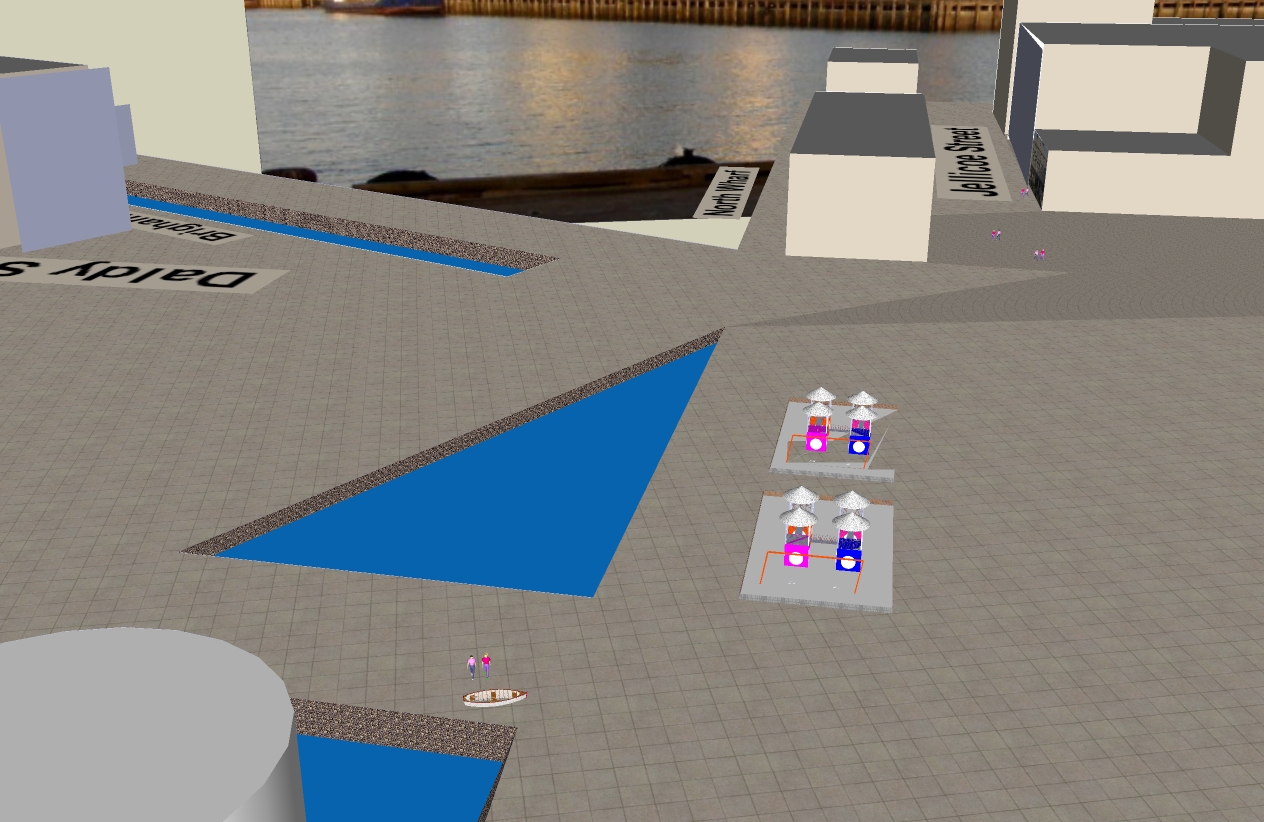
I produced this image from a computer model of the proposed Wynyard Quarter development. I made it while serving as an ARC Councillor a few years ago to get a better picture of what was planned. I've put a children's playground in here - around about where it is today. You will see there is a lot of empty space in the graphic - like you see today. You can see the two buildings that have been built on North Wharf on either side of the NetShed (which is hidden between them). You can also see Sanford's fish restaurant which is beside the modelled ASB tower building that's going up now...

All that's changed in this graphic is that I've taken away the children's playground from the model. I've taken it away because it won't be there when the development that has been planned goes ahead. The next few images show what is planned for this part of Wynyard Quarter over the next decade or so....

So here's the "mixed use" building planned for the site of the children's playground and the sandy area. The building will be about 5 stories high....


By the way, in the bottom left of the image you can see the top of a cement silo. Which is around about where the Waterfront Development Plan photo was taken from...

Anothern five storey building is planned along the Jellicoe Street alignment. It will run close to the silos as you can see in this picture. It will complete the northern wall of buildings along the northern side of Jellicoe Street.

Two buildings have been added here. A five storey mixed use building on the left side of the Sanford's Restaurant is provided for in the plans. This building will be almost as high as the section of the ASB building on the other side (RHS) of Sanfords. You can get an idea from this image how tiny the Sanfords building will look compared to its new modern neighbours. (I wasn't the only one worried by the lack of heritage respect.)


The other new building is the "cheese wedge" to the left, along Wynyard Wharf. This is planned to be 5 stories high and is intended to be a residential development block.

This image shows the rest of the planned development along the southern edge of Jellicoe. Building heights range from 5 to 8 (I think) stories high. Mostly mixed use. Some activation at Jellicoe Street level.


This image gives an idea of the urban canyon design that is planned for Jellicoe Street. (Love the open space feel it now has - while you can.)

This image shows the rest of the planned development approximately in alignment with the gantry structure that has been erected. These buildings are planned to house a mix of commercial and light industrial uses and will be built on sites presently occupied by some of the storage tanks.

TEXT

This image gives an impression of what you will see from a lower elevation, looking along Jellicoe at about the 3rd storey. (NB: At the end of Jellicoe there is the walking bridge which is not shown in this graphic.)


The purpose of my computer generated impression is to convey a sense of the urban design that is actually planned for Jellicoe when all of the anticipated building development is complete. It is not a park at all. A far cry from what you see now, and from the misleading impression in the photographs used in the Waterfront Development Plan. Why? You might think. Well. The Waterfront Development Plan as it stands is like a coffee table prospectus for future investors in Wynyard Quarter. They will love the pictures of smiling people. Future customers for their future developments. It's a brochure for investors rather than genuine consultation.

I think the kind of public confusion that these images cause, can lead to a false sense of comfort, a false feeling that - at last - Council is taking seriously public calls for quality waterfront public space.


It is also why I am concerned that the same sort of private development overcrowding will occur elsewhere on Auckland's waterfront (as it did on Princes Wharf). I had hoped for a more honest communication from Waterfront Development Agency. It does not augur well for what is planned behind closed doors for Queens Wharf.

Friday, September 23, 2011

Auckland Plan - Users Guide

The Auckland Council has published 4 plans and invites submissions from citizens. These must be in by October 25th. Through NZ Herald, Deputy Mayor Hulse worries there might be more than 3000 submissions and they might not be able to be heard. Apparently - in law - any citizen who wants to be heard can request to be heard, and Council must meet that need. Cllr Hulse is seeking advice about this.... it's a worry...


Unfortunately, the documents are massive.

  • The Draft Auckland Plan alone is 250 pages long.

  • The Draft Economic Development Strategy is over 100 pages.

  • The Draft City Centre Masterplan is around 200 pages.

  • The Draft Waterfront Plan is estimated to be around 300 pages.


  • That's around 800 pages total. I've looked briefly at the Auckland Plan and it's a dense read. You can get printed copies, and you can download files from the Council website. But as Brian Rudman reports today in his NZ Herald column, these files are huge and even caused his computer to hang.

    So. It's a big ask. Rudman's advice is to download the questionnaires and enter your feedback into them. That's not a bad idea. You can meaningfully submit without reading 800 pages.

    Click here to go to that webpage. It has links to the plans, and links to submission forms.

    But you probably miss the real objectives behind these plans.

    My two decades of experience of Auckland "Long Term Planning" suggests that it is not really about long term planning at all. It is really about short term projects and short term thinking. Auckland local government institutions - despite their history - have a remarkably short term focus. Apart from motorways. But then those were planned by Central Government's Ministry of Works years ago. Even the North Shore Busway was planned as mitigation for a motorway project, by Transit, the nation's motorway provider.

    What happens in Auckland "long term planning" is that it all crystallises in those pages at the back where actual projects get listed. The ones at the top get built. The rest don't. It's pretty easy really.

    Why do we think short term - especially in Auckland? I'd like to introduce some new thinking here. National cultures can be described according to the analysis of Geert Hofstede. These ideas were first based on a large research project into national culture differences across subsidiaries of a multinational corporation (IBM) in 64 countries. Studies identified and validated four independent dimensions of national culture differences, with a fifth dimension added later.

    A good link about these ideas is here.

    The cultural dimensions are:

    • Power Distance
    • Individualism
    • Masculinity
    • Uncertainty Avoidance
    • Long-Term Orientation

    I won't go into detail here, but just summarise the key cultural differences between New Zealand, Japan and Sweden. I should point out that these assessments are averages. They are not immutable. They change over time. They can be recognised and compensated for - in planning terms. But they shouldn't necessarily be given into. Especially if planners recognise the problem caused by doing as we have always done (A: You get what you've always got....).

    So. Comparisons. See the table. Hofstede’s Power Distance Index measures the extent to which the less powerful members of organizations and institutions (like the family) accept and expect that power is distributed unequally. This represents inequality (more versus less), but defined from below, not from above. It suggests that a society’s level of inequality is endorsed by the followers as much as by the leaders. NZ's score indicates a low acceptance that power be distributed unequally. Which you'd expect.

    Individualism is the one side versus its opposite, collectivism, that is the degree to which individuals are integrated into groups. On the individualist side we find societies in which the ties between individuals are loose: everyone is expected to look after him/herself and his/her immediate family. On the collectivist side, we find societies in which people from birth onwards are integrated into strong, cohesive in-groups, often extended families (with uncles, aunts and grandparents) which continue protecting them in exchange for unquestioning loyalty. NZ's score is high. Influenced by a mix of free market entrepreneurialism, and the happy anarchy that many NZers have.

    Masculinity versus its opposite, femininity refers to the distribution of roles between the genders which is another fundamental issue for any society to which a range of solutions are found. The IBM studies revealed that (a) women’s values differ less among societies than men’s values; (b) men’s values from one country to another contain a dimension from very assertive and competitive and maximally different from women’s values on the one side, to modest and caring and similar to women’s values on the other. The assertive pole has been called ‘masculine’ and the modest, caring pole ‘feminine’. This is one of the interesting ones for NZ to look at - not so much the difference between NZ and Japan, but the difference between NZ and Sweden - one of the caring Nordic countries. Read in NZ planning - look out for male bullying.

    Uncertainty avoidance deals with a society’s tolerance for uncertainty and ambiguity; it ultimately refers to man’s search for Truth. It indicates to what extent a culture programs its members to feel either uncomfortable or comfortable in unstructured situations. Unstructured situations are novel, unknown, surprising, and different from usual. Uncertainty avoiding cultures try to minimize the possibility of such situations by strict laws and rules, safety and security measures, and on the philosophical and religious level by a belief in absolute Truth; ‘there can only be one Truth and we have it’. Again, NZ is much less tolerant of uncertainty and ambiguity than Sweden. Read: NZ unhappy with uncertainty in planning (though the process of planning is uncertain by its nature, though not of its findings in the end).

    Long-Term Orientation is the fifth dimension of Hofstede which was added after the original four to try to distinguish the difference in thinking between the East and West. From the original IBM studies, this difference was something that could not be deduced. Therefore, Hofstede created a Chinese value survey which was distributed across 23 countries. From these results, and with an understanding of the influence of the teaching of Confucius on the East, long term vs. short term orientation became the fifth cultural dimension.

    Below are some characteristics of the two opposing sides of this dimension:

    Long term orientation:
    -persistence
    -ordering relationships by status and observing this order
    -thrift
    -having a sense of shame

    Short term orientation:
    -personal steadiness and stability
    -protecting your ‘face’
    -respect or tradition
    -reciprocation of greetings, favors, and gifts

    While NZ scores on a par with Sweden, what makes this an interesting cultural aspect of NZ institutional behaviour, especially how local Government institutions behave, is its relationship with Masculinity and Uncertainty Avoidance.

    Could it explain why Auckland Local Government is characterised by male bullying (high masculinity score), pet projects (reciprocation of favours and gifts), blaming others (protecting your 'face'), no genuine consultation (discomfort with uncertainty)? Food for thought.

    Politicians and others with an inside track in this major Auckland Council planning exercise make sure their projects - their pet projects - are in there somewhere. Near the top preferably. Doesn't really matter about the long term vision. It will never happen. Just make sure my project happens.

    My experience of Auckland local government politics reinforces this. Want to know what happens immediately after most council elections? Generally the mayor meets with councillors - one on one - and asks them, "what do you really want to deliver in the next three years. For your area. What project is really important to you...?"

    And councillors, once they get over the realisation that this is how it's done, answer the question. The mayor makes a list. Knows what to do.

    These projects have nothing to do with long term planning. They are usually ill-thought-out and populist. maybe you think I'm being a bit cynical. Long term planning is paralysis by analysis and we'll never build anything. Might as well build something.

    That's how we get Cruise Ship terminals right to the end of Queens Wharf that will stuff the waterfront up for the public long term. It's how we get the crazy idea that Warkworth should be an intensively developed satellite town - part of the sustainable growth strategy. It's how we get a railway station at the least justified option at Parnell. It's how we get a ferry service to Takapuna.....

    To name a few pet projects that have crept onto these 800 pages, and been prioristed, without adequate justification. Proper justification would demonstrate how those particular projects contribute to the delivery of long term goals AND demonstrate in a robust manner that of all other options that exist, the chosen project is the best use of public money.

    I would like the submission process and timetable to be a time when people discover or uncover these pet projects lurking in the fine print of these glossy publications, and out them. So that they can be exposed and be subject to the submissions they deserve. Long term planning should not be manipulated by turning it into a vehicle to deliver pet projects and populist promises.

    Come on Auckland Council. Look in the mirror and learn from past behaviour. Auckland neither wants nor needs an action reply of past planning practices.
    Showing posts with label Auckland Council. Show all posts
    Showing posts with label Auckland Council. Show all posts

    Monday, July 9, 2012

    Auckland's "One Rating System"

    I wrote about Watercare a few weeks ago here. This advertisement has been placed frequently in NZ Herald and other news media. There has been discussion in letters and other news comment.

    I support volumetric charging for wastewater, because I think the true costs of water infrastructure and its consequence - wastewater infrastructure - need to be better understood by those who use the services, so that they use it more knowingly, and more carefully.

    But I do think the tail is wagging the dog here. Watercare has seized the opportunity of carving out its own business space, its own business plan, its own infrastructure development plan, and its own funding plan. Without much attention to the broader public interest.

    There's nothing really new in that. From the moment amalgamation was suggested, Watercare was down in Wellington lobbying furiously to separate stormwater from water and wastewater services. (Hard to run stormwater as a business... etc etc). And now it wants to issue monthly bills....

    My first letter to NZ Herald went like this:

    “One council – one rates bill”. That was a catchphrase used to sell Auckland local government amalgamation.

    Now we have a communications deluge - from a Council Controlled Organisation - warning Auckland ratepayers to expect no less than twelve water rate bills each year.

    Disingenuously, Watercare announces this measure is in response to “customer feedback”, though I am not aware of any public consultation.

    Sending and administering twelve water bills to one million ratepayers will cost ratepayers in excess of $10,000,000 annually. At least.

    I understand Watercare has taken this step because that’s how privately run cellphone and electricity utilities operate.

    But there’s a difference. Electricity and cellphone customers have a choice of provider. They need and expect monthly usage information. They shop around for the best deals and they can switch providers in a blink.

    However there’s no competition for what Watercare provides. Watercare could provide accurate monthly usage analysis to ratepayers – presuming water meters are read frequently enough – through an appropriately secure website.

    Watercare should minimize the costs of providing water and wastewater services and act in the public interest.

    Many other letters have been published. Watercare's media people responded with a statement which added fuel to the flames, triggering some more robust comment. Including my response:

    Watercare's letter justifying its plans to bill ratepayers every month for water services refers to private research showing that customers want monthly billing to better manage finances.

    The letter also reports that Watercare achieved regional savings of $100 million last year.

    This is a good saving and makes a dent in Auckland Council's annual expenditure of $3 billion. But it does not justify wasting that money on an expensive separate billing system when amalgamation was sold on the basis: One council = One rates bill = Efficiency.

    Watercare's letter talks about the true cost of supplying water to Aucklanders and describes itself as a minimum cost operator.

    If Watercare and Council were sincere about cost minimisation and genuine about helping ratepayers manage their finances, then there would be just one Council services bill - maybe monthly - listing each council service provided and its cost.

    Ratepayers would know at a glance how their rates were being spent, see what each of their services cost, and benefit from further regional savings.

    And then on Wednesday, last week, we had this advertisement in NZ Herald. Placed by Auckland Council - probably in damage control - rate bills about to hit the streets. The advert ran on page 13 (NZ Herald, 4 July 2012), while Watercare's ad (the one above) ran on page 22 (don't know how many times that advert has been placed). Watercare's is much bigger, easier to read. Both carry the Auckland Council logo (small in Watercare's case).

    What's the poor ratepayer going to make of these public relations exercises? Auckland Council's advert insists that there is "one rating system". I guess you can have "one rating system" and then issue two different rating bills, supported by two completely different advertisements on different pages, without much in the way of obvious connection, and still be speaking the truth.

    Or is it just expensive propaganda?

    Monday, June 4, 2012

    Economic Growth Projects Disasters for NZ Communities

    The financial cost of the Christchurch earthquake has been huge and carefully valued, a disaster for many but an opportunity for economists and politicians alike who regard it as New Zealand’s best hope of achieving economic growth targets.

    Last week the economics division at National Bank of New Zealand said, "four solid quarterly increases in economic activity have propelled Canterbury to the top of the year-on-year economic growth rankings", ahead of Auckland. The New Zealand Government’s recent budget relies heavily on economic activity in Christchurch to deliver GDP increases it believes are necessary to bring New Zealand’s economy into the black. As if all New Zealand needs is another disaster to keep on track.

    Questions need to be asked about economic growth assumptions and about GDP – New Zealand’s commonly used measure of progress and success - because the same strategy is being applied by Councils in towns and cities with disastrous effects.

    Kaipara District Council has achieved notoriety because of its proposal to almost double the rates of Mangawhai ratepayers to pay back the huge loan it raised to pay for a controversial sewage scheme.

    Ratepayers were forced to abandon well maintained onsite wastewater systems which were generally working soundly, and then connect to the new wastewater network for a modest fee.

    The original scheme raised a few eyebrows and might have succeeded. But, under pressure from developers and without consulting ratepayers further, the Council decided to double the land area serviced by the scheme, doubling the cost of the project. Now, because the predicted growth and development did not happen, the sewage scheme debt equates to an additional $20,000/residential ratepayer.

    The Kaipara District Council 2009 - 2019 Long Term Council Community Plan gives some insights into how this happened: ‘The Kaipara District Council believes its key role in assisting the local economy to sustain and grow itself is to ensure the appropriate infrastructure is in place…’

    While KDC’s investment in a sewage scheme might encourage growth in and around Mangawhai sometime in the future, it is questionable whether it is appropriate to levy the costs of that strategy now on existing ratepayers, by charging them an additional $2000/year - for the next ten years - on top of existing rates.

    The investigative report now being condicted by the Office of the Auditor General will make interesting reading. Late last week, the Minister of Local Government- David Carter, announced it will appoint a Review Team to work with Kaipara District Council. This is very late in the day given Council must adopt its new plan and set the rates before the end of this month.

    Still. Better late then never, though it will be too late to influence the potentially disastrous economic growth related decisions of Auckland Council.

    Auckland Council’s Auckland Plan includes a diverse range of initiatives aimed at delivering a real GDP increase for Auckland of 5% /annum. This rate of growth is described in the Mayoral Forward to the Auckland Plan as “bold”. The services provided by the Council are said to: “support economic development of the region and contribute to the national economy”. The stated objective is to shift Auckland’s economic performance rating from 69th to 61st in OECD city rankings.

    Last week Auckland Council media statements drew public attention to the fact that residential rates will increase by a gentle 3.6%, but quietly ignored its Ten Year Plan financial position statements which make for rather unhappy reading.

    These show that council debt will balloon from $4.5 billion to $12.5 billion in ten years reaching almost $20,000/residential ratepayer. As bad as Mangawhai which is the worst in New Zealand. That debt will incur interest charges of more than $750 million each year – more than a quarter of the rates revenue for the Auckland region.

    Auckland Council plans indicate that a number of big ticket projects would be funded from new loans. The City Centre Rail Loop project cost to ratepayers ranges from $1 billion to $3 billion over the next ten years, depending on whether the Government contributes its half of the cost, and how the project is staged. Auckland has needed this part of the rail network completed for decades. More than can be said about Watercare’s $800 million mega-sewage project that is to be bored under Auckland.

    Even without these projects Auckland Council debt would still be $9 billion.

    In its budget this year Central Government gave notice of its intention to reduce spending, though it is still borrowing heavily and government debt to GDP ratio is fast approaching 50%. Big ticket motorway projects apparently needed for growth are still provided for.

    No such notice came from Auckland Council, despite signs that the growth much of its spending is for, is as illusory as it was in Mangawhai.

    New Zealand’s population growth rate has dropped to the magic figure of 0.6% per annum due to emigration to Australia and other factors outside our control. Much of the population growth that Auckland is experiencing is due to internal migration. For example families are shifting to Auckland from Christchurch and other urban centres.

    These shifts will cause Auckland’s economy to grow slowly, but they will cause other urban economies to shrink, leaving New Zealand’s overall economic position little changed.

    Rather than chasing the tail of economic growth at all costs and incur enormous debt, the time has come to build economic resilience into New Zealand, to spend only what we earn, and to ensure urban living remains affordable for those who live here.

    Business Booms at Watercare

    The large newspaper advertisements in NZ Herald today, and the stormwater story earlier in the week, are shots across the bow of unsuspecting Auckland public.

    The newspaper advertisments described Watercare's new charges for water and wastewater, and for residential and business ratepayers. Of course it has always been deeply ironic that the "One Council, One Bill" rhetoric was never ever going to be true. The re-organisation was always intended to allow Watercare to be a law unto itself, with its own computer system of residential and business ratepayers, and with its own business model and charging system. It is now almost stand-alone.

    Watercare has embraced Central Government's business growth model with both hands. Watercare is now well placed to be sold off as a going concern, taking a sizeable chunk of Auckland Council's debt with it, and the promise of some very large, well funded, centralised network infrastructure projects.

    The devil here - is behind the detail in Watercare's media release.

    There are a few things that need to be aired, that are hard to discern readily in the Council's Ten Year Plan, which is the shop window on what Watercare plans:

    1) I support the fact that Watercare can now charge residential ratepayers for their wastewater services on a volumetric basis. This will provide an economic incentive for water consumers to manage their consumption of water.

    2) But these changes do not apply to business customers. We see in Watercare's public statement that "existing arrangements will apply...". While these are to some extent volumetric, their main purpose is to allow businesses to tip contaminants and trade wastes into the sewer, where they mix with ordinary sewage, ensuring that the cocktail that finally arrives at Mangere is completely untreatable for re-use. So Watercare is perpetuating an outdated system, which provides little incentive for Auckland business to clean up its act at source, and generates a nice little earner for Watercare. The resulting biosolids are too contaminated to be reused as soil conditioner, and must be landfilled. Hence Watercare's desire to continue its business oriented dumping operation by landfilling the biolsolids at Puketutu. (I have walked on the existing biosolids landfills in Manukau Harbour. These are not happy places.)

    3) The Council's Team Year Plan includes the debt level for the Auckland Council Group - ie Council, plus Council Controlled Organisations - including Watercare. The debt level that Council has voted for is close to $13 billion - almost 3x what it is now. It appears that around $3 to $4 billion of that debt is Watercare debt. Part of the increase in that debt will be the proposed $800 million "Central Interceptor" project - the huge pipe/storage system to be dug under Auckland, allowing business as usual activity to occur, and to allow for more of it.

    Councillors should not be allowing Watercare to hide this burgeoning centralised network of water and wastewater infrastructure - on the basis that the bills for it reduce Council's own rates bill, and on the basis that "they can blame Watercare...not us".

    Watercare's practice is increasingly unsustainable. It is already the biggest user of electricity in Auckland - because of its need for pumping of water and wastewater, and for the electricity intensive, centralised treatment plants that it operates.

    The fact that Auckland Council has to deal with stormwater, now that Watercare successfully separated the meter-paid waters, further exacerbates this trend. I await with interest the debate over the stormwater disposal charges that Watercare will levy on the Council, when Council seeks to divert pesky stormwater flows into Watercare's Central Interceptor. Another nice little earner for Watercare.

    Auckland Council Rubbishes Innovation

    It would be great to see something truly local come out of Auckland Council when it comes to the management of waste.

    There were some very positive initiatives underway across the Auckland Region before amalgamation. These were valued by many, and were the start in the long walk to reducing our individual footprints across our region.

     From outside council it's hard to see where the "one size fits all" pressure comes from that seems to force Councillors into making "Regional Decisions" rather than local ones.

     I live in Devonport. A Borough known for innovation: first Nuclear Free Borough; also was first to get Kerb-Side recycling underway in New Zealand (I think). That initiative was partly driven by the fact Devonport had its own tip. Also used by Navy. Back then residents could not "chuck it and forget it". They could see the face of the tip. They could see the impact of their wasteful ways. And it was relatively easy for the Borough Council to roll out a significant "reduce, reuse, recycle" program.

     When I moved here, household rubbish was collected in small biodegradeable paper sacks. This then shifted to medium sized biodegradeable plastic sacks. The message was you paid for what you dumped, but recycling was free. (I know - you paid for it in your rates - but the economic incentive was there.) While I was on North Shore City Council a whole suburb (Bayswater) trialled a kitchen putrescible collection scheme. The object being to reduce to as close to zero as we could the disposal of organic matter into landfill. This was one of several experiments and innovations.

     It is disappointing to see Auckland Council going ahead with what appears to be a one size (bin etc) fits all. This approach may appeal to contractors who can have one size of truck. But taking the long view does require local initiatives and projects to occur - and to build on local initiatives that are already successful and have local buy-in. Otherwise all you are doing is encouraging residents to chuck it and forget it. The environment is big enough to absorb all your rubbish.

    Innovation is essential if communities are to play a useful part in cleaning up their acts, and enabling them to participate in local projects which help reduce urban environmental impacts.

    Sunday, March 11, 2012

    TOR for Port Plans Review

    Rumour has it that various players in Ports of Auckland and Council's Investment entity expect to be given the job of reviewing their own plans after Auckland Council's decision this week that Port of Auckland's Expansion Plans should be reviewed.

    Like many others I welcome this decision as an appropriate spanner in the works. I imagine that many in Council see it more as a kick for touch, and merely a mid-course adjustment. That is why it is important that the Terms of Reference for the review, as well decisions about the Political Steering Group for the review, and the decision about what organisation actually writes the review are themselves made properly.

    There is a fair dose of wishful thinking in the words used in Auckland Council's review motion. For example:
    ...there will need to be integrated and coordinated capacity development across the Upper North Island to meet future freight demand and avoid a shortfall in port infrastructure capacity...
    These words were supported by comments to the effect that Ports of Auckland need to form "partnerships" with other entities like Ports of Tauranga or Northport. However that really is wishful thinking. As Cllr Mike Lee noted in his comments at the meeting, such relationships which might be construed as collusion, are essentially against the law in New Zealand whose legislative environment pits Port against Port, and requires individual Ports to invest heavily and offer discount deals to attract container custom from shipping companies.

    Needless to say, Auckland is not the first city to review its port expansion plans. For example Dublin reviewed its port plans in 2007.
    The Terms of Reference for this study involved an examination of the role of Dublin Port and its future. The study was in particular tasked to examine the costs and benefits of various scenarios relating to Dublin Port, including:

    i. Relocating all or part of Dublin Port’s existing activities to an alternative location(s);
    ii. Existing port activities continuing to expand with demand; and
    iii. Port activities continuing at current levels with growth being catered for at alternative location(s).
    The policy context in Dublin is not the same as Auckland, but it's not a lot different as this summary shows:
    In relation to ports policy, the Department of Transport’s Statement of Strategy 2008-2010 summarises the key tenets of ports policy which is “to ensure investment in ports meets port capacity requirements and to facilitate the availability of commercial port services which are effective, competitive and cost efficient”.
    The National Development Plan emphasises that the State-owned commercial port companies should fund their operations and infrastructural requirements without recourse to the Exchequer, either from their own resources or by other avenues such as efficiencies, increased charges, disposal of non-core assets, borrowing or private sector investment. The present ports policy is essentially market led and does not attempt to implement an interventionist planned approach.
    Interestingly, one of the triggers for the Dublin review was a proposal that the Port of Dublin be expanded through a further reclamation of 21 hectares. The review compares net present values, and present cost-benefit assessments of alternative approaches to creating that extra freight handling capacity. Among the scenarios considered was:
    Dublin Port would be retained but capacity would be capped at current levels with other ports developing to meet capacity requirements....
    I won't spoil your fun by telling you what was advised because these stories never have quick and tidy endings.

    In 2007 the City of Melbourne reviewed its port planning. A Government Commission was required to:
    ...undertake a review of the impact of port planning on competition in the provision of container stevedoring and related services in Victorian ports.
    This follows from the Commonwealth of Australian Governments entering into the Competition and Infrastructure Reform Agreement (CIRA), which, among other things, requires each jurisdiction to undertake a review of port competition and regulation.
    I came across a number of similar reviews. The common factor is the issue of competition - the extent it delivers economic efficiency for freight movements - and planning - the extent to which it undermines competition. The Melbourne review covers:
    • the Port of Melbourne and, in relation to potential new container service providers, the Port of Hastings.
    • container stevedoring, container handling and storage, container transport (road and rail) and intermodal services.

    The Commission has been asked to:
    • examine whether there are any restrictions on entry or other barriers to competition in the provision of stevedoring and related services in current port planning frameworks
    • if it finds that there are restrictions to competitive entry, make an assessment of the costs and benefits of such restrictions
    • assess whether the market structure for stevedoring services impacts on competition and the efficiency of container handling, storage, transport and intermodal services, and how the market structure for container stevedoring and related services impacts on: the achievement of the Government’s objectives, particularly the target for rail to have a 30% share of port freight; land-side interface efficiency; and achievement of the Government’s other relevant objectives.
    This was a Government triggered review. You can see its emphasis on the theory of competition. It asks questions about how easy it is for a "new entrant" to come into the industry and establish a competing service. You can see that it was also essentially about "stevedoring" which is the loading and unloading of cargo. It appears that at the port of Melbourne there are two major operators: Patrick (Asciano) and DP World, presumably competing with each other. There is only one operator in Auckland's Port. There is no competition there. You can think of stevedoring as just the act of putting a container on a ship, and taking it off, or you can go wider and think in a broader freight logistics sense - and consider freight movement end to end.

    This broader sort of thinking is what is needed in Auckland's review. A whole of North Island look - rather than the sort of narrow Ports of Auckland look that could be expected if POAL or its owner - Council Investments Ltd - did the review. It's the big picture review that Auckland needs. Not some head of the pin analysis of wharf side stevedoring.

    The review now underway in West Australia is a better example for Auckland I would suggest, based on a quick look. That review is being conducted because: "the State is now entering an environment of rapid economic growth and burgeoning demand for port services, particularly relating to the resources sector it is timely to review the current port governance arrangements....". The review examines:
    • the respective roles and responsibilities of Government agencies including the Department of Transport, Department of Treasury and Finance and the Port Authorities to ensure ports are able to deliver effective and efficient outcomes for the State;
    • provide recommendations for structural or legislative changes desirable to improve the effectiveness of ports in ensuring that key Government objectives and outcomes are achieved;
    • provide guidance in relation to the current processes for port planning and investment including examining the process for capital works approvals, funding models and competition between ports for freight;
    Those to be consulting for the review include: All Port Authorities; Ports WA; Department of State Development; Department of Treasury and Finance; Department of Premier and Cabinet; Minister of Transport; and Key industry representatives and stakeholders (which include: Port User Groups; Councils at port sites; Dept Environment & Conservation).

    This sort of review would look at the fundamentals. Central Governmment must be aware that port competition is not delivering economic efficiencies. What we are witnessing is market failure on a grand scale. Arguably port infrastructure in New Zealand is as important as road infrastructure. But because we are a small country, with small ports, each port has only one operator, and in reality there is no competition for wharfside stevedoring. Port competition in New Zealand is an ideological construct, it's a myth, that is why we need a fundamental review, with the Ministry of Transport at the table.

    Proper Process on Waterfront

    Last week was a big week for Auckland's waterfront. And I'm not talking about the strike. Thanks to a huge amount of work from Heart of the City (Alex Swney and Greg McKeown), the Auckland Architects Association (Adam Mercer), and the Devonport Borough Council (Roger Brittenden and Margot McCrae), and many others behind the scenes, the Auckland Council agreed to review the plans it included in its draft Auckland Plan (the Spatial Plan).

    The New Zealand Herald also played its part in bringing about this decision, as is evident from the way it reported Council's change of plan.

    I was pleased by the fact NZ Herald ran an opinion piece I wrote challenging the Mayor's notion of what constituted proper process on the waterfront, and because this is my blog, I'll quote it here:
    Due Process on the Waterfront

    Auckland Council’s Mayor has tried to reassure the public that any expansion of Auckland’s port will: “go through proper processes and be fully debated by council and public…” (NZ Herald, Feb 28). Mayor Brown is reported as saying: “…increased container traffic might create demand for new berths and this will be dealt with at the time by the resource consent process.”

    I fear that Mayor Brown’s faith in Resource Management Act processes to deal with matters of public interest on Auckland’s waterfront raises questions about his Council’s commitment to planning compliance, and about what proper processes are.

    Legislation establishing the Auckland Council required it to prepare and adopt a spatial plan to provide a long term strategy for Auckland. This is a different approach to planning. The spatial plan’s objectives have to refer to the social, economic, environmental and economic realms to align it with the four well-beings referred to in the Local Government Act 2002, and to broaden the purpose of the spatial plan so that it is not simply about growth and development.

    Auckland Council has prepared a draft spatial plan which is out for consultation now. Public concern has arisen because Council’s spatial plan documents all incorporate – without question or serious consideration of alternative options - Port expansion plans which assume a 400% growth in container volumes and 18 hectares further development of Waitemata Harbour through reclamation.

    Concern has arisen because the Waterfront Development Agency (WDA) which is the Council controlled organisation responsible for preparing Auckland’s Waterfront Masterplan – a central component of the Auckland Spatial Plan - restricted its consideration to exclude Port of Auckland Ltd (POAL) and its expansion plans. The WDA’s Masterplan for Auckland’s waterfront concentrates on the assets that it owns. These exclude Port assets which are ‘managed and operated’ by Auckland Council Investments Ltd (ACIL) – another council controlled organisation. Its statement of intent says ACIL, ‘will endeavour to develop and implement a long-term strategy for POAL which seeks to improve POAL’s productivity.’ It also states that ACIL, ‘will identify and resolve potential conflicts between POAL’s operational requirements and other waterfront activities and plans of strategic significance to the region.’

    Mayor Brown is an optimist, and that’s a good thing, but he’s dreaming if he believes that a Waitemata Harbour resource consent process is the right place to resolve the policy conflicts that inevitably exist between this proliferation of organisations, let alone with public interest considerations.

    The buck clearly stops with Auckland Council when it comes to the adoption of a spatial plan for Auckland. By law, the Auckland Spatial Plan must, ‘enable coherent and co-ordinated decision making by the Auckland Council and other parties to determine the future location and timing of critical infrastructure.’ If that isn’t clear enough, the law also states that Auckland Council, ‘must identify the existing and future location of critical infrastructure.’

    The spatial plan is intended to set a strategic direction for Auckland and its communities that ‘integrates social, economic, environmental, and cultural objectives’. It is about integrated planning. It is not about a proliferation of separate plans - one for the Port, one for the rest of the waterfront, and one for the downtown city. That’s what Auckland had before amalgamation.

    And if 20 hectares of new reclamation is not ‘critical infrastructure’ I don’t know what is. The Port Expansion Plans need to be in the spatial plan – or not – after due process. Not put in the ‘too hard’ basket and left for some future Council to deal with by applying for a resource consent.

    The Resource Management Act does have its place in Auckland waterfront planning. Many praise the planning work that delivered what the public love and now enjoy down at the Wynyard Quarter. Auckland City Council and Auckland Regional Council sweated blood over plan changes and resource consent applications and public hearings hammering out the planning framework for what we see today.

    That was due process, once fundamental and broad brush decisions had been taken about how the land and water spaces would be used.

    It respected matters such as heritage and the public interest in, and enjoyment of Auckland’s waterfront.

    Unlike the way Auckland Council is handling waterfront development right now. Under Mayor Brown’s leadership, Auckland Council is planning a major change in the use of Queens Wharf (Auckland’s Primary Cruise Ship Terminal), which has a raft of environmental effects (traffic on Quay Street, passengers in buses and taxis, conflicts with public access and ferry traffic, engineering work on a heritage building), apparently without going through due process.

    Last week I was advised that no decision had been made to publicly notify any consents for the development of Queens Wharf.

    No responsible Council would allow a private developer to do what Auckland Council and its ‘council-controlled organisations’ plan to do with Queens Wharf. Not without a decent set of resource consents and conditions.

    It’s good to talk about ‘proper process’, now it’s time to walk the talk on the waterfront.
    Behind the scenes there are those who say, "but the Spatial Plan has no statutory force...." almost as an excuse to defend the use of the resource consent process as the best way forward. However, as the Council officer advised the council during its meeting, any resource consent application must "have regard to any other matter the consent authority considers relevant and reasonably necessary to determine the application..."

    The Auckland Spatial Plan - which is a statutory requirement - and which has been consulted extensively - might be regarded as having "no statutory force" by some - black letter of the law types. But it must be a relevant matter, otherwise why have one at all?

    A major requirement for the idea of a spatial plan is to enable Auckland to plan for what it wants in future. The Resource Management Act has a purpose to avoid adverse effects. We need that. But we also need a plan that sets out a future. And that plan needs to include an agreed plan for the Port. The old Port expansion plans of 1989 need to be reviewed in the light of new thinking in 2012.

    Tuesday, February 14, 2012

    Recipe for Rate Revolt

    Mayor Len Brown wrote the 15th February Strategy and Finance Ctte report entitled: "Rates Transition Management Policy – alternative option". He's the signatory, and he writes: "In discussions with many of you, I have heard the concern that the transition policy as it stands has real limitations. On your behalf I followed up with officers over the Christmas break and their work has identified that relatively minor legislative change would enable more flexibility and, in my view, a fairer approach...."

    Most Auckland ratepayers have no knowledge of what their rate bills are likely to be after the super city transition, but the data in the officer report gives an indication which I summarise here. Basically, if there was no transition policy, the method adopted by Auckland Council (for the Draft Long Term Plan), envisages the following changes:


    • 111,863 Auckland ratepayer bills will decrease by more than 10%
    • 80,522 Auckland ratepayer bills will decrease by between 0% and 10%
    • 122,806 Auckland ratepayer bills will increase by between 0% and 10%
    • 79,368 Auckland ratepayer bills will increase by between 10% and 15%
    • 112,239 Auckland ratepayer bills will increase by more than 15%


    The main reason this change is happening is because Council has adopted a reasonably pure General Rate capital tax on property value (land value plus improvements). Mayor Brown has stated, "under the new rating system a $400,000 home in Manukau will pay the same rates as a $400,000 home in North Shore..." The scale of the change is such that Council is concerned to spread the impact of its policy change over 2 or 3 years. However, the household whose rate increase is - say - 30%, will be paying 30% more rates than now, eventually. Because of the policy.

    But there are questions to be asked over the rightness of the policy. Is it necessarily the best policy to say that every $400,000 house should pay the same rates? It is a sort of egalitarian ideal after all. But are there fishhooks that should be explored and understood. I think so.

    Problem one. The problem of choice. Not every household wants, or needs, or can afford the same Council services. You can see this in how Auckland has developed. There are distinct areas, with distinct services, differences in council service levels, and different costs of living. Utopianists may want to iron out those differences. But the price of that uniformity can be the removal of diversity and difference, and the removal of real choice for those who want it, and those who need it - through no fault of their own. Do we really want Auckland's differences to be smoothed over through rate harmonisation to the extent that Auckland turns into Brisbane? Or is it more a Sydney flavour - with all of that diversity and difference - that we want. Beware what you wish for.

    Problem two. The problem of a "tax on a tax". Parts of urban Auckland that are 50 years old and older have greater public amenity, and higher quality public amenity than newer parts of Auckland. (More parks and pocket parks, library services, better maintained berms and footpaths and cycleways, community buildings, clubrooms, sportsfields, restored streams, and such like).  These public community assets have a value which is reflected in private property values. They were paid for by rates, year on year, asset by asset, and form an accumulation of community capital. Is it right to charge rates again, on that accumulation of rate value? Perhaps it is. New Zealand may not have adopted a capital gains tax yet, but a pure General Rate is in effect a capital tax on property value. In part it is a tax on a tax.

    Problem three. The effect on rents. About half of Auckland households live in rented accommodation. Typically the landlord (who is interested in the long term value of that asset) pays the rates, while the tenant (who is generally interested in shorter term use of the asset and services such as rubbish, wastewater) pays the rent - which covers the landlord's costs. I estimate that about 20 to 30% of rental revenue is expended in council rates. However the rental market has already taken a hit with the removal of depreciation as an allowable loss for tax purposes. I would suggest that most rental property is located in parts of Auckland which will experience the greatest increases in rates. This will translate into inevitable rent increases.

    Problem four. General rates versus fixed charges. While the legislation does require Auckland Council to adopt capital value rating (rather than land value or rentable value), it does not restrict the Council in charging a proportion of its revenues from targetted rates and other charges which are fixed, and which are not calculated as a ratio of the capital value of individual properties. In July 2007, a panel reported about Council funding to the then Minister of Local Government. Its letter began:

    "Report of the Local Government Rates Inquiry: At the beginning of the Inquiry the Panel undertook to deliver to you by 31 July 2007 a high-quality report based on wide consultation and sound evidence and analysis. We are pleased to deliver our report, which comprehensively addresses the wide range of issues covered by our terms of reference.
    Our report identifies many significant issues and proposes many significant changes. We acknowledge many strengths in the existing system of local government funding, but have not adopted a “business as usual” approach. This is a report that creates an agenda for change that needs to be pursued by central government and local government in partnership with other stakeholders...."

    It is unclear whether Auckland Council officers or politicians have read this report. Among its main recommendations are the following:

    7. The Panel considers rates should remain as the major source of local government revenue but need to be reduced to around 50% of total revenues. As a tax rates have many advantages – efficiency, difficulty of evasion, and low economic deadweight costs – and there is a reasonable relationship between property values and incomes, even though overall rates tend to be somewhat regressive in their impact


    57. The Panel favours the promotion of a common system of valuation for rating purposes and strongly favours the capital value system because of the closer relationship of capital values with household incomes.


    58. The Panel considers that, in fixing their overall rating policies, councils should have regard both to services consumed and to ability to pay. The changes that it recommends above would likely change the distribution of the burden between commercial and residential ratepayers and between different residential ratepayers.


    62. The Panel also recommends that councils make more use of their flexible rating powers so that the rating burden better reflects value in use, rather than potential sale price.


    The devil is in the detail when it comes to any form of rating or taxation. There is no silver bullet. However I would suggest Auckland Council spends at least as much time considering flexible rating systems that will reduce the rate change impacts listed above, as it is in trying to lessen the impact by spreading it over a longer time.

    Wednesday, December 14, 2011

    Parnell Station - Poor Process Continues

    Yesterday I made my submission to Auckland Council's "Auckland Plan". Part of it was about Parnell Station, and I used this slide to show the 3 options that used to be on the table. (Both Auckland City Council and Auckland Regional Council reports preferred the Parnell Overbridge site as the best location.) In my last blog on this: Parnell Station - Shakespearean Tragedy I described my experiences trying to inform the "notify-or-non-notify" decision regarding the need to alter the designation of Domain land to provide for the new Super City's decision to opt for the Cheshire Street option for Parnell Station.

    However my direct approach to appointed commissioners was not appreciated, so instead I sought, under the Official Information Act, the information that was provided by Super City officers to commissioners, so they could make their "notify-or-non-notify" decision. That information has come, and I had the opportunity to look at it today.


    The LA4 part of that information reviews the visual and amenity effects of the change to the designation. That review contains these pictures, which give you an idea of what the lay of the land is like in the area of the Cheshire Street option.

    As you can see it's fairly deserted in this gully.....

    Looking south (picture to the left here) you can just make out the tunnel in the distance.

    Looking East (left of picture) you can see that the line is elevated above the surrounding land which is why the track will have to be lowered by up to 1.75 metres. According to the documents 17,000 cubic metres of earthworks will be required, which is one reason why the project will need to take about 2,500 square metres of the Domain in order to build retaining walls and such like, and to accommodate the necessary realignment of the track (away from the Domain) in order to accommodate the proposed railway platforms.
    This image looks North from the same point, ie downhill toward Carlaw Park and the Parnell Overbridge....

    This image from Google Earth shows the Super City's preferred option at Cheshire Street. You can see again how squeezed into the gully this option is. In the background you just make out the museum - which will be about a kilometre walk away, uphill, probably quite a nice walk through the bush.

    The information provided to commissioners is voluminous in terms of the effects on bush, archaeology, heritage, views and such things should the designation change go ahead. But there is almost no information in terms of the effects of what the designation change will permit - which is that a railway station built at that location will almost certainly preclude the construction of any other more useful station being built in the vicinity.

    The information states clearly the statutory context. Which is s.181 of the RMA. This allows a requiring authority to make an application to a territorial authority to alter a designation. (ie: this provides for the Super City to apply to itself to change its own designation.)

    Critically, s.181(3)(a)(i) states:
    (3) A territorial authority may at any time alter a designation in its district plan if - (a) the alteration - (i) involves no more than a minor change to the effects on the environment associated with the use or proposed use of land...concerned; or....

    This is the nub. One effect of the proposed use of the land (a railway station at Cheshire Street), will be that other options for the Parnell Station will be precluded. That is clearly a very significant effect on the Auckland environment.

    Though that effect is not explicitly identified in any of the documents that were provided to Commissioners by Super City officers.

    The information provided to commissioners by Super City, includes The Tonkin and Taylor Report entitled: Minor Alteration to the Designation: Parnell Enabling Works and dated November 2011.

    This report does have a short section headed: "Consideration of Alternatives" which refers to the three options illustrated at the start of this posting. This section states of the Parnell Bridge Option:
    The bridge would require modification in order to accommodate the station platforms, and significant track lowering towards Parnell Rail tunnel to achieve the appropriate gradient. However, this location would provide direct connection to Downtown Auckland, the Carlaw Park development and the University of Auckland and AUT.
    The Parnell Bridge Option location is illustrated in the Google Earth image shown. You can see how well this location would serve Vector Arena and all of the land uses that are currently developing in the vicinity. This area has the development and transit oriented development potential of a Newmarket.

    However the "Assessment of Effects on the Environment" section of the Tonkin & Taylor report makes no mention at all of the negative and precluding effects of building the Parnell Station at Cheshire Street - instead of the Parnell Overbridge option preferred by Auckland City Council and Auckland Regional Council officers. Instead the report describes the Parnell Overbridge option as "not feasible". Tell that to the engineers who rebuilt the Newmarket Viaduct.

    It is time that this charade was brought to an end. Before it destroys the credibility of the Council and Auckland's railway network.

    And as an end-note, here's a picture of the Parnell Overbridge. Quite a classic structure with its stone pillars. Crying out for a sensitive heritage station on top.

    There's hundreds of them round the world. A good place to put a station - doesn't take up land. It's in the airspace, and can be central to the city.

    Here's a simple example in China. So you can see it's not rocket science. Highly feasible in fact.


    And if it's a heritage finish that is needed - to match the existing character of the Parnell Overbridge - here's a heritage railway station in Berlin. There may even be a way of incorporating the old Newmarket station building into an overhead station on the Parnell Overbridge. Now wouldn't that be a world-class win-win.

    Monday, December 5, 2011

    Parnell Station - Shakespearean Tragedy

    More than a few planners regard the proposed Parnell Railway station - and the process used to secure it - as another Auckland Shakespearean tragedy....

    A few weeks ago I gave some background detail.

    Last week there was a helpful NZ Herald article explaining the relentless steps being progressed by Auckland Council to get this third-rated option off the starting blocks. It mentioned that a barrister had been retained to determine whether the related need to modify the rail designation should be notified. Apparently land needed to be taken from the Domain to allow for a wider track footprint. And so the designation needed to be modified. So I wrote to the lawyer, David Kirkpatrick as follows:

    David,

    I see you have been appointed to determine whether the Parnell designation application should be notified. This project has vexed me for the past year - because I am very familiar with it - having watched its birth at ARC. It is a project that is being driven by politicians rather than by planners, and large sections of the community are not aware of what is at risk.


    The main planning issues with the proposed location and the planning process include:


    - it was regarded as the least successful of 3 Parnell Station options - in terms of being able to trigger a TOD and associated medium density - work was done by both Auckland City Council and Auckland Regional Council staff that confirms this (a crucial timing issue being whether it would be possible to rezone land around the Cheshire St location to ever enable the sort of development that would support a TOD, compared with the other options). (There are ARC and Auckland City Council reports to this effect - which you should have.)

    - the project has never been publicly consulted - in terms of location or funding - in terms of the LGA, or in terms of RMA.

    - it is being consulted now in the Draft Auckland Plan, but no alternatives have been presented in that consultation. It would be inappropriate to pre-empt that poor consultation by not notifying the designation and thereby keeping the alternatives under wraps.

    - it conflicts with the priorities set out for infrastructure development in the Draft Auckland Plan, and thereby is likely to lead to a situation that there will never be a station built in a Parnell location which will best contribute to city development plans. (You can see a link to my submission to the Draft Auckland Plan in that regard - in the blog links below.)


    The drive for the proposed location has primarily come from those who wish to protect the existing heritage buildings on that site, and to justify the co-location there of the old wooden Newmarket railway station building. This idea has its supporters.


    However in my view these objectives, including the notion that the museum will be easily walkable, are far outweighed by the public interest arguments and strategic planning arguments of locating the Parnell station at one of two alternative locations recommended by Council officers.


    You can see more detail on the following blogs:

    Regards, Joel Cayford

    And almost immediately, I got this email from an Auckland Council official:


    Hi Joel,

    Your email below has been forwarded to me for a response.
    As you are aware from today's Herald article, Mr Kirkpatrick is one of the commissioners delegated with making a decision on the notification of the alteration of the rail designation in Parnell.

    You sent the below email to Mr Kirkpatrick this morning. The commissioner concerned did not read your email.

    With your vast local government experience you will be aware that the commissioners have been delegated to make this decision and it is one that has no requirement for consultation. Therefore, I believe that your email to the commissioner providing your opinion and information was inappropriate. The decision making process in Council must be robust and not called into question.
    I ask that you not contact the commissioners regarding this in the future.
    Happy to discuss if you wish.

    Regards,

    Jason Marris | Hearings Manager
    Democracy Services

    That was interesting. Put me in my place. That's what you call a non-notified decision. Even though it gets a decent mention in NZ Herald it still means: "if you have a concern, keep it to yourself...."

    I particularly like Jason's comment: "The decision making process in Council must be robust and not called into question...." Hear hear and amen to that. Fact is, council's decision-making relating to this particular project is political and personal (not robust) and very questionable.

    The tests as to whether a designation should be changed are onerous. I feel that if it is good enough for Council to ensure David Kirkpatrick's independence, then it is good enough for me - and the public - to know what information was provided to David Kirkpatrick - both as to whether the decision should be notified or not, and subsequently, should that happen, whether the designation should be modified.

    So I have written under LGOIMA for the information that was provided to David Kirkpatrick, by Auckland Council, and upon which he will have made his recommendations.

    Will keep you informed.

    Sunday, November 13, 2011

    What's POAL Really For?

    This table shows how much it costs to ship a 20 foot container from Hamilton, via Ports of Auckland, to a destination outside Sydney. It doesn't include the cost of packing or unpacking the container. (NB: It is difficult to get specific quotes for container shipping costs. These figures are mid-range.)

    So. Your packed container - which must weigh less than 20 tonnes - gets picked up by a truck in Hamilton, driven along SH1 to Ports of Auckland for around $700.00. Ports of Auckland puts it on a ship for about $200. Etc.

    The percentage of POAL costs in this particular supply chain is tiny - less than 4%.

    If the same container was shipped through Ports of Tauranga, which charges slightly more per container than POAL, the overall cost would not be very different. However, if Auckland's Southern Motorway gets more congested, and if reliability of delivery time becomes an issue, then POT quickly becomes more attractive.

    The point is, there is very fine cost balance between POT and POAL for sea freight. Auckland has kept ahead by price cuts at the margin. And that is why POAL dividends and profits have been steadily slipping away. However those who own the Ports of Auckland (Auckland Council) talk up its importance hugely:
    By value, POAL handles 40% of New Zealand's total imports and 21% of NZ total exports, representing 13% of national GDP, or approximately $24.5 billion of trade...
    This on the strength of a 4% share of the transport supply chain, and being a transport link which could readily be provided by NorthPort or Ports of Tauranga.

    The blog below this one (wherefore-ports-of-auckland) was my ramble through the economics of Ports and Containerisation. This one sticks to basics, and asks questions that must be answered before Auckland Council agrees to a 20 hectare reclamation into Waitemata Harbour to accommodate Ports of Auckland growth plans.

    I was a Councillor on the Auckland Regional Council when ARC purchased the remaining 20% private stake in POAL for $170 million. At the time critics suggested that POAL would need to earn profits of more than $60 million annually to justify the share value. In fact POAL profits and dividends have been rather less than this figure since, dipping below $20million/year. But in 2007 the port company transferred its Tank Farm, or western reclamation, property assets to ARC. These assets were valued at $284 million at the time of transfer in April 2007. Chalkie, of the Independent Newspaper, wrote in 9 October 2008:
    "...It was widely thought at the time of the takeover it was this land ARC was really interested in gaining control of rather than the port company itself...."
    Which is interesting. My recollection is that the ARC was interested in both aspects. However I became very concerned that the ARC's very first proposals for Tank Farm were that:
    development returns should be maximised to fund public transport...
    . While I am a strong supporter of public transport, I did not support scarce waterfront land - then in public ownership - being developed to maximum potential. But I digress slightly.

    Back to POAL expansion plans over the next few years. These growth plans are predicated on assumptions of a massive increase in container traffic (from the present 890,000 container movements/annum up to around 4,000,000) which are not supported by the literature for shipping, even without taking into account the sharp declines in air freight costs that are being experienced.

    My research wherefore-ports-of-auckland also notes the massive investment that would be required to land transport networks (SH1, Freight Rail, Grafton Gulley), if POAL growth plans went ahead in totality. Yet as far as I can tell, these transport improvements have low priority as far as Auckland Council is concerned.

    So. Why allow the Port to expand, without investing in transport connections?

    There seems to be only one answer. That is, to produce more waterfront CBD land for property development, and to make Ports of Auckland Ltd more valuable should a proportion of its shares be sold (to free up capital for investment in transport for example).

    Auckland Council only needs to grant POAL Resource Consent for reclamation out to the PMA (Ports Management Area) line in the Waitemata Harbour. The economics are attractive. I am advised it costs about $1000/square metre using cleanfill/concrete to create new land through reclamation, and equivalent Central City land has capital valuations around $7000/square metre. Assuming a margin of $5000/square metre, a 20 hectare reclamation would add a cool $1,000,000,000 to the POAL balance sheet....

    So. POAL growth plans could be seen as an opportunity for Auckland Council to profit from property development, rather than a serious engagement with imports and exports.

    Only a local authority could get away with this in New Zealand.

    Sunday, October 16, 2011

    Wynyard Quarter Playground Con Job


    This picture features prominently in the Auckland Council Waterfront Development Plan. I think it was taken from the top of one of the cement silos. Great picture. Symbolises all that the public have come to love about the Wynyard Quarter. It is called Silo Park after all. So it feels like a park, the section with seating and cildren's playground and wide open spaces. It feels like a park because no-one's near enough to ask you for money. But....

    As Heart of the City have highlighted in their public campaign: it's a con. The very popular open spaces that make up the children's playground and other delightful public spaces today are planned for buildings tomorrow. Not public spaces....

    I produced this image from a computer model of the proposed Wynyard Quarter development. I made it while serving as an ARC Councillor a few years ago to get a better picture of what was planned. I've put a children's playground in here - around about where it is today. You will see there is a lot of empty space in the graphic - like you see today. You can see the two buildings that have been built on North Wharf on either side of the NetShed (which is hidden between them). You can also see Sanford's fish restaurant which is beside the modelled ASB tower building that's going up now...

    All that's changed in this graphic is that I've taken away the children's playground from the model. I've taken it away because it won't be there when the development that has been planned goes ahead. The next few images show what is planned for this part of Wynyard Quarter over the next decade or so....

    So here's the "mixed use" building planned for the site of the children's playground and the sandy area. The building will be about 5 stories high....


    By the way, in the bottom left of the image you can see the top of a cement silo. Which is around about where the Waterfront Development Plan photo was taken from...

    Anothern five storey building is planned along the Jellicoe Street alignment. It will run close to the silos as you can see in this picture. It will complete the northern wall of buildings along the northern side of Jellicoe Street.

    Two buildings have been added here. A five storey mixed use building on the left side of the Sanford's Restaurant is provided for in the plans. This building will be almost as high as the section of the ASB building on the other side (RHS) of Sanfords. You can get an idea from this image how tiny the Sanfords building will look compared to its new modern neighbours. (I wasn't the only one worried by the lack of heritage respect.)


    The other new building is the "cheese wedge" to the left, along Wynyard Wharf. This is planned to be 5 stories high and is intended to be a residential development block.

    This image shows the rest of the planned development along the southern edge of Jellicoe. Building heights range from 5 to 8 (I think) stories high. Mostly mixed use. Some activation at Jellicoe Street level.


    This image gives an idea of the urban canyon design that is planned for Jellicoe Street. (Love the open space feel it now has - while you can.)

    This image shows the rest of the planned development approximately in alignment with the gantry structure that has been erected. These buildings are planned to house a mix of commercial and light industrial uses and will be built on sites presently occupied by some of the storage tanks.

    TEXT

    This image gives an impression of what you will see from a lower elevation, looking along Jellicoe at about the 3rd storey. (NB: At the end of Jellicoe there is the walking bridge which is not shown in this graphic.)


    The purpose of my computer generated impression is to convey a sense of the urban design that is actually planned for Jellicoe when all of the anticipated building development is complete. It is not a park at all. A far cry from what you see now, and from the misleading impression in the photographs used in the Waterfront Development Plan. Why? You might think. Well. The Waterfront Development Plan as it stands is like a coffee table prospectus for future investors in Wynyard Quarter. They will love the pictures of smiling people. Future customers for their future developments. It's a brochure for investors rather than genuine consultation.

    I think the kind of public confusion that these images cause, can lead to a false sense of comfort, a false feeling that - at last - Council is taking seriously public calls for quality waterfront public space.


    It is also why I am concerned that the same sort of private development overcrowding will occur elsewhere on Auckland's waterfront (as it did on Princes Wharf). I had hoped for a more honest communication from Waterfront Development Agency. It does not augur well for what is planned behind closed doors for Queens Wharf.

    Friday, September 23, 2011

    Auckland Plan - Users Guide

    The Auckland Council has published 4 plans and invites submissions from citizens. These must be in by October 25th. Through NZ Herald, Deputy Mayor Hulse worries there might be more than 3000 submissions and they might not be able to be heard. Apparently - in law - any citizen who wants to be heard can request to be heard, and Council must meet that need. Cllr Hulse is seeking advice about this.... it's a worry...


    Unfortunately, the documents are massive.

  • The Draft Auckland Plan alone is 250 pages long.

  • The Draft Economic Development Strategy is over 100 pages.

  • The Draft City Centre Masterplan is around 200 pages.

  • The Draft Waterfront Plan is estimated to be around 300 pages.


  • That's around 800 pages total. I've looked briefly at the Auckland Plan and it's a dense read. You can get printed copies, and you can download files from the Council website. But as Brian Rudman reports today in his NZ Herald column, these files are huge and even caused his computer to hang.

    So. It's a big ask. Rudman's advice is to download the questionnaires and enter your feedback into them. That's not a bad idea. You can meaningfully submit without reading 800 pages.

    Click here to go to that webpage. It has links to the plans, and links to submission forms.

    But you probably miss the real objectives behind these plans.

    My two decades of experience of Auckland "Long Term Planning" suggests that it is not really about long term planning at all. It is really about short term projects and short term thinking. Auckland local government institutions - despite their history - have a remarkably short term focus. Apart from motorways. But then those were planned by Central Government's Ministry of Works years ago. Even the North Shore Busway was planned as mitigation for a motorway project, by Transit, the nation's motorway provider.

    What happens in Auckland "long term planning" is that it all crystallises in those pages at the back where actual projects get listed. The ones at the top get built. The rest don't. It's pretty easy really.

    Why do we think short term - especially in Auckland? I'd like to introduce some new thinking here. National cultures can be described according to the analysis of Geert Hofstede. These ideas were first based on a large research project into national culture differences across subsidiaries of a multinational corporation (IBM) in 64 countries. Studies identified and validated four independent dimensions of national culture differences, with a fifth dimension added later.

    A good link about these ideas is here.

    The cultural dimensions are:

    • Power Distance
    • Individualism
    • Masculinity
    • Uncertainty Avoidance
    • Long-Term Orientation

    I won't go into detail here, but just summarise the key cultural differences between New Zealand, Japan and Sweden. I should point out that these assessments are averages. They are not immutable. They change over time. They can be recognised and compensated for - in planning terms. But they shouldn't necessarily be given into. Especially if planners recognise the problem caused by doing as we have always done (A: You get what you've always got....).

    So. Comparisons. See the table. Hofstede’s Power Distance Index measures the extent to which the less powerful members of organizations and institutions (like the family) accept and expect that power is distributed unequally. This represents inequality (more versus less), but defined from below, not from above. It suggests that a society’s level of inequality is endorsed by the followers as much as by the leaders. NZ's score indicates a low acceptance that power be distributed unequally. Which you'd expect.

    Individualism is the one side versus its opposite, collectivism, that is the degree to which individuals are integrated into groups. On the individualist side we find societies in which the ties between individuals are loose: everyone is expected to look after him/herself and his/her immediate family. On the collectivist side, we find societies in which people from birth onwards are integrated into strong, cohesive in-groups, often extended families (with uncles, aunts and grandparents) which continue protecting them in exchange for unquestioning loyalty. NZ's score is high. Influenced by a mix of free market entrepreneurialism, and the happy anarchy that many NZers have.

    Masculinity versus its opposite, femininity refers to the distribution of roles between the genders which is another fundamental issue for any society to which a range of solutions are found. The IBM studies revealed that (a) women’s values differ less among societies than men’s values; (b) men’s values from one country to another contain a dimension from very assertive and competitive and maximally different from women’s values on the one side, to modest and caring and similar to women’s values on the other. The assertive pole has been called ‘masculine’ and the modest, caring pole ‘feminine’. This is one of the interesting ones for NZ to look at - not so much the difference between NZ and Japan, but the difference between NZ and Sweden - one of the caring Nordic countries. Read in NZ planning - look out for male bullying.

    Uncertainty avoidance deals with a society’s tolerance for uncertainty and ambiguity; it ultimately refers to man’s search for Truth. It indicates to what extent a culture programs its members to feel either uncomfortable or comfortable in unstructured situations. Unstructured situations are novel, unknown, surprising, and different from usual. Uncertainty avoiding cultures try to minimize the possibility of such situations by strict laws and rules, safety and security measures, and on the philosophical and religious level by a belief in absolute Truth; ‘there can only be one Truth and we have it’. Again, NZ is much less tolerant of uncertainty and ambiguity than Sweden. Read: NZ unhappy with uncertainty in planning (though the process of planning is uncertain by its nature, though not of its findings in the end).

    Long-Term Orientation is the fifth dimension of Hofstede which was added after the original four to try to distinguish the difference in thinking between the East and West. From the original IBM studies, this difference was something that could not be deduced. Therefore, Hofstede created a Chinese value survey which was distributed across 23 countries. From these results, and with an understanding of the influence of the teaching of Confucius on the East, long term vs. short term orientation became the fifth cultural dimension.

    Below are some characteristics of the two opposing sides of this dimension:

    Long term orientation:
    -persistence
    -ordering relationships by status and observing this order
    -thrift
    -having a sense of shame

    Short term orientation:
    -personal steadiness and stability
    -protecting your ‘face’
    -respect or tradition
    -reciprocation of greetings, favors, and gifts

    While NZ scores on a par with Sweden, what makes this an interesting cultural aspect of NZ institutional behaviour, especially how local Government institutions behave, is its relationship with Masculinity and Uncertainty Avoidance.

    Could it explain why Auckland Local Government is characterised by male bullying (high masculinity score), pet projects (reciprocation of favours and gifts), blaming others (protecting your 'face'), no genuine consultation (discomfort with uncertainty)? Food for thought.

    Politicians and others with an inside track in this major Auckland Council planning exercise make sure their projects - their pet projects - are in there somewhere. Near the top preferably. Doesn't really matter about the long term vision. It will never happen. Just make sure my project happens.

    My experience of Auckland local government politics reinforces this. Want to know what happens immediately after most council elections? Generally the mayor meets with councillors - one on one - and asks them, "what do you really want to deliver in the next three years. For your area. What project is really important to you...?"

    And councillors, once they get over the realisation that this is how it's done, answer the question. The mayor makes a list. Knows what to do.

    These projects have nothing to do with long term planning. They are usually ill-thought-out and populist. maybe you think I'm being a bit cynical. Long term planning is paralysis by analysis and we'll never build anything. Might as well build something.

    That's how we get Cruise Ship terminals right to the end of Queens Wharf that will stuff the waterfront up for the public long term. It's how we get the crazy idea that Warkworth should be an intensively developed satellite town - part of the sustainable growth strategy. It's how we get a railway station at the least justified option at Parnell. It's how we get a ferry service to Takapuna.....

    To name a few pet projects that have crept onto these 800 pages, and been prioristed, without adequate justification. Proper justification would demonstrate how those particular projects contribute to the delivery of long term goals AND demonstrate in a robust manner that of all other options that exist, the chosen project is the best use of public money.

    I would like the submission process and timetable to be a time when people discover or uncover these pet projects lurking in the fine print of these glossy publications, and out them. So that they can be exposed and be subject to the submissions they deserve. Long term planning should not be manipulated by turning it into a vehicle to deliver pet projects and populist promises.

    Come on Auckland Council. Look in the mirror and learn from past behaviour. Auckland neither wants nor needs an action reply of past planning practices.