Tuesday, September 6, 2011

Parnell Station Jumps the Queue

Auckland Council recently unveiled aspects of its planning work. Generally it looks good, but it is peppered with classic Auckland ad-hockery (not sure if that's a word, but you'll get my drift. This blog and two others below (Waterfront Conflict and MUL Buster) explain why I think this.
The draft Auckland City Centre Masterplan reveals the possibilities for the future of Auckland’s city centre through a 20-year vision.

It identifies eight ‘place-based’ transformational moves intended to:

* Develop the ‘Engine Room’ that is the core CBD and celebrate the waterfront opportunities.
* Enable growth around the City Rail Link stations.
* Create a better-defined network of green spaces through street-based ‘green carpets’.
* Celebrate the unique characteristics and attributes of the urban villages, quarters and precincts, and create better connections between them.
* Transform the public transport and offer the city centre a more pleasant place to walk around.
* Add greater depth and choice to the city centre retail, visitor, cultural and residential offer so as to ensure that Auckland’s City Centre becomes a destination, not just a gateway.
* Develop a compelling value proposition and climate for individuals, corporate citizens and business to invest in their city centre.

All good.

The Council has adopted "...eight moves to transform the city..." These are "key moves" to transform the performance of the Auckland city centre.
These moves are as follows:

1. Uniting the waterfront and the city centre – The north-south stitch
2. Connecting the western edge of the city to the centre ‐ The East‐west Stitch
3. Queen Street Valley CBD and retail district ‐ The Engine Room
4. Nurturing an innovation and learning cradle
5. New public transport stations and urban redevelopment opportunities at K Road, Newton and Aotea Quarter - Growth around the City Rail Link
6. Connecting Victoria Park, Albert Park and the Domain as part of a blue - green park network The Green Link
7. Connecting the city and the fringe – City to the villages
8. Revitalising the waterfront water city
I look closely at the waterfront one of these in the postings below (Waterfront Conflict and MUL Buster - which is the bigger regional Auckland Plan). It's not clear what's what in these plans. They overlap. Use different words, goals and outcomes. We'll be kept on our toes. I hope the Councillors are on theirs...

What I want talk about a little in this posting is transformation step 5. One of the reports that Council has considered relates to "The Engine Room" - a rather post-industrial term for the Auckland CBD (far too business oriented I think. Successful central city areas are known for muuch more than business. Culture for a start... which isn't only about business).

Anyway. When you get into that report it also explores the need for new stations on the proposed city loop (transformation step 5), we suddenly find - at page 61:
...In addition to the 3 new City Rail Link growth node areas, a Parnell station is to be reopened to better connect the eastern side of the city fringe to the city centre. It will also enable growth and access to the medical research centres and university in the Park Road area....


Here's a picture of the site which I've borrowed from the site of the group that has been lobbying for a station there. (http://www.parnell.net.nz/Station/Lobbying.htm)

While the Auckland Regional Council supported the idea of a station there, and the Auckland City Council noted that: "...is not materially inconsistent with the Future Planning Framework's Newmarket/Parnell area plan..." this hardly constitutes a mandate or requirement on Auckland Council to suddenly begin work on a station there now.

If the Council finds itself wallowing in cash to improve the rail network, the highest priority must be unblocking the various rail crossings on Auckland's rail network which will continue to act as bottlenecks on the capacity of the network - especially once it is electrified. (There is a myth that Auckland rail is the same as Perth rail. It's a myth because Perth rail was largely grade separated from the roading network. Auckland's was built on the cheap with a huge number of road crossings at grade.)

These crossings are bottlenecks. They need to be removed. Until they are, investment in electrification and new rolling stock will be prevented from delivering the promised benefits. Building ad hoc new stations is - I think - an irresponsible use of public money now.

My recollection of the debate at Auckland Regional Council is that it was largely driven by the desire to protect the heritage buildngs. That's a good project. The buildings have merit. But it shouldn't be driving Auckland's rail development strategy.

Far more rigour is required before this project should be supported by Auckland Council for funding. Someone even mentioned to me that work on regrading the corridor - so that the station could be built - is scheduled for Christmas! Who is making these decisions? Is this genuine consultation?

This project reminds me of a very poor Auckland Regional Council political decision. One taken against officer advice. And that was the ill-fated Helensville Rail service which had to withdrawn because it was so slow and poorly patronised.

The wording in Auckland planning documents around this Parnell station project is disturbing. It talks about "reopening" the Parnell station. But there was never one at the spot. The line is sloping and a station is unsafe there. It is also a myth that it will be widely used by students at Auckland University. Sure some might use it, but the climb is significant.

I know. I bike it and walk it several times a week.

With the City Rail link project on hold at the moment, there appears to be a cunning plan for the Parnell Station to jump all the queues and get what funding there is. Wrong project. Wrong process.

I'd like to know what does Auckland Transport think about this? And by Auckland Transport I mean its skilled staff. Where is the mandate from the Auckland Transport Statement of Intent that justifies this project?

Filling Christchurch Gaps

I was in Christchurch over the weekend and biked around to see how everything looked and what was happening. The number of empty sites is what strikes you. The empty spaces. So many prime sites to choose from...

They are a problem for any thriving area. This is a corner property in the Merivale Shopping area on Papanui Road. A challenge for the town planners and property owners...

Everywhere there are political hoardings. The election has well and truly begun in Christchurch. Demolition sites are the preferred places for election placards. Bit tacky I thought...

Here's another corner site, on the Eastern side of the city. The building has been demolished, the site cleared, but someone's put paving stones and gravel down, and it has become a little corner park...

Amazing what you can do with a park bench and a food cooler full of books. The inspiration I understand is: www.gapfiller.org.nz

This sign was unsettling. Given the mass destruction of massive (read: stone, read: brick)buildings, it is somewhat head-in-sand to push for more of the same... Or maybe there will never be another earthquake... come on...

Auckland Plan to Bust MUL

It's getting interesting as Auckland Council opens the Kimono a little and we get to peek inside...

But I'm not sure I like some of what I see, or maybe I'm just confused by it.

Auckland Council has been considering the Auckland CBD Masterplan (which - by the way, I think should be moving to something more like "Central Activity District", rather than "Engine Room"... how post-industrial....). This seems to have been an opportunity to release tit-bits about the Waterfront Masterplan as well as bits and pieces from the Auckland Plan.

Amongst which is The Southern Initiative. Unclear exactly what this is, but apparently it will tackle social and economic disadvantage and need.

And then in the next breath we learn there are 7 growth areas, aas well as the CBD area, and these are prioritised this way:


It would be great to see a bit of a rationale for this prioritisation. On first glance it's like a bit of something for everybody - rather than a genuine prioritisation.

But the bit that's a real worry is the inclusion of Pukekohe and Warkworth. These are both outside the MUL. I can't speak much of Pukekohe - but I do know a little about Warkworth. Not only is it outside the MUL - the Metropolitan Urban Limit - it is beyond the end of Alpurt B2 - the new Northern motorway. In fact it's slap bang on the proposed route of Minister of Transport's "holiday highway".

If I was him I'd be pinching myself a little. "what's going on here, don't tell me theat Auckland Council is giving me another reason to support the motorway extension..."

Because that's what a growth strategy for Warkworth will require. Roads. Transport. It's like Auckland Council knowingly intends pricking its own MUL strategy.

I could understand a growth strategy for Orewa, or even Silverdale. Both on good state highways, and even got the Northern Busway running up there now.

But not Warkworth.

Haven't we learned from Helensville? There the Auckland Regional Council experimented with rail. Did that promote growth up there? Don't think so. Misconceived. Just as Warkworth is misconceived.

Auckland Waterfront Plan Conflict

Transformational Move 8 -
Revitalising the Waterfront -
Water City...

This is the heading for the part of the Auckland CBD MasterPlan draft (voted on by Auckland Council at its Future Vision Ctte meeying on August 31st) that deals with the waterfront.

Interesting that this is given advance airing on this agenda. Before the Waterfront Development Agency has said much publicly. Or released its own draft plan. A sign perhaps that Auckland Council is tightening its control of its CCOs. Apart from Watercare.... Not necessarily a sign of conflict. But certainly a sign of control...

I have looked through the various documents to discern the Council's logic and vision for Queens Wharf. And this is what I have found out so far, in the proposed plans, which are being put out for public consultation later this month:

That Queens Wharf is to become part of what is termed the "cruise hub" terminal for New Zealand for the "next 15 years".... This will require "the redevelopment of Shed 10, supported by the Cloud structure together with a secondary terminal at Princes Wharf". Apparently this: "cruise terminal project (2012-2018) will deliver a world-class, multi-cruise terminal on Queens Wharf..."
Comment: The fine print here suggests that the Cloud will stay for 15 years. The fine print also indicates it is planned that the Queens Wharf cruise terminal is planned for at least 2 cruise ships at a time (multi-ship). While the words "cruise hub" don't say "hubbing terminal", that is the clear inference.

Both of these plans seriously threaten the public use of, and access to, Queens Wharf. I find them completely out of place on a people's waterfront.

The numbers used to support this use of Queens Wharf are hard to find. But one is quoted in the report to councillors. It states: "each year 2.5 million visitors arrive in Auckland by air or cruise ship...the challenge is to make them stay longer...".
Comment: We know Auckland is a tourist gateway. And it's good to retain the tourism dollar in Auckland. But Auckland is also home to 1.5 million locals. And it would be good to retain some of their visitor dollars in Auckland also - and one way to do that - as we are belatedly discovering at Wynyard Quarter - is provide high quality, full of activities, waterfront public spaces and places.

But if you really believed Auckland's economic salvation from the visitor economy was tourists, and if you get really picky, even naive, you might think it's better to drop those unsuspecting tourists as close to Queens Street as you can get them. Queens Wharf is closer than Auckland International Airport after all. But how many passengers are we talking about here, and how much do they spend while they are here - compared to Auckland's 1.5 million residents for example?

If you take a guess, and estimate 60 cruise ship visits with 1000 passengers each, and they seem to stay for 36 hours on average, that boils down to 90,000 visitor days a year. From cruise ship visits. And that's why the Council's quoted figure of "2.5 million" cruise ship and jet plane visitors each year is so misleading. Why? Well let me explain. For example, according to ShareChat's website on the performance of Auckland International airport, "Overall inbound tourism for the twelve months ended February 28 was up 2.5% to 2.5 million". Doesn't leave much room for cruise ship visitors does it? You can see from those two figures that the proportion of visitors coming by cruise ship is tiny - infinitesimal in fact. So this hardly justifies sacrificing a second central city wharf to their activities.

All Auckland would be doing would be providing free-parking for Carnival Australia CEO Ann Sherry's cruise ships. At great cost to Aucklanders.

And then there are the various visions and goals and outcomes in the CBD Masterplan. It appears that the Waterfront Development Agency have set four goals in its statement of intent, which it appears is being put out for consultation, but buried in the detail of Auckland Council's CBD Master Plan. The WDA wants this:

* A public waterfront: A place for all Aucklanders and visitors to Auckland, a destination that is recognised for its outstanding design and architecture, natural environmental quality, public spaces, facilities and events; a place where we can express our cultural heritage and history, and celebrate our great achievements as a city and nation.
* A working waterfront: a place for marine industries and businesses, local and international port activities; an attractor of further high value business investment and activity, the location that supports authentic and gritty waterfront activities that must locate here.
* A growing waterfront: The critical location of sustainable urban transformation and renewal in Auckland, where we must demonstrate international best practice and innovation; achieve a significant lift in Auckland’s and NZ’s productivity; the most liveable of New Zealand’s central city urban communities; a vibrant mix of residents, business and employees, visitors, and activities.
* A connected waterfront: A place where people are highly connected locally and with the inner city, to the rest of Auckland and New Zealand; that is highly accessible and safe for pedestrians, cyclists, and passengers, with telecommunications that support connectivity.

Comment: I quite liked these. Well. Apart from the "A growing waterfront" one. Strange words. Calls to mind a doubling of POAL reclamation. You know. Heaps more containers. It's about growth. rather than development. So not really good for the "S" word. The sustainability word. But I love the top one. That's about a public waterfront first (for all Aucklanders and visitors to Auckland - fantastic - love those words), and a working waterfront second.

But what's really interesting is that Auckland Council has taken these goals, and used them to assess its "cruise hub" plan for Queens Wharf. They come to this conclusion:


Man oh man. Auckland Councillors actually voted for this. They seriously believe that a multi-ship hubbing cruise ship terminal on Queens Wharf is going to: "enhance public access to, and enjoyment of, Queens Wharf...", and thereby deliver on the Waterfront Development Agency's vision. Think again guys.

And again. Have you done the cost benefit analysis? Have you really weighed the social costs against the economic benefits (remember the tiny numbers) so that you put your hands up and say, yes, we genuinely believe, that a multi-ship hubbing cruise ship terminal on Queens Wharf: "enhances the waterfront as a visitor and waterfront destination, resulting in economic benefits..."

Because that's what you voted for. You voted to double, maybe even triple, central cruise-ship parking places in the heart of Auckland. Thankfully you are consulting over it. Wonder what the WDA thinks about this?

What is it about cruise ships?

Talk about being taken for a ride.

Sunday, August 21, 2011

Wynyard Quarter Attracts & Detracts

Talk about people places.... Take a bow Auckland.... Take a bow Auckland Regional Council, Auckland City Council, and Sea + City. You take credit for the years of decisions, allocations, and planning that underpin the public legacy we can all enjoy at Wynyard Quarter.

The place attracts and caters for young people. Youth who might only be seen on the waterfront for an event at the Vector Arena. Wynyard Quarter attracts Auckland's youth. The tip of the iceberg of the latent demand that exists in the resident population of 1.4 million people for a public place like this.

They share the playground with kids of all ages. A place to hang out. In the public eye. Informal surveillance. Safe. This photo was taken from the gantry view platform. Inspired I guess. Everybody wants an elevated view of places that attract people. Great for photos and for perspective.

This Chinese delegation from Xinjiang enjoyed their visit. This informal - but somehow formal - seating is inspired. And as the trees grow providing welcome shade across this area, it will attract those who want to sit and watch the world go by. The piano was regularly used...

The WindTree scultpture provided the backdrop for any number of photos, as did the trams looping the Wynyard Loop.

The choice of food and eatery is extensive, from a pot of chips at Sanfords to more exotic fare. Spoiled for choice. Great to have a waterfront place that does not feel like lager alley. Feels safe. Good family fare. Everybody's here (the public toilets are still unfinished though. Very important for young and old. Key to success. Just having one in the container sculpture may not meet requirements...)

Swing from food to walk to swing.

Then there are the fishing boats and the sea gulls. These are the places to sit, take photos, have a snack, and generally chill out. But wait. Something's not quite right. Pan a bit right....

What are all these cars doing here? Not a parking warden in sight. Certainly no sign saying no parking. And none permitting it. More than a few students have remarked to me about the way car parking is already damaging the public experience on Wynyard Quarter. The better the day - the more the informal car-parking is damaging the experience....

The great pictures are cluttered by cars. Sure this is a working waterfront. On my way here, as I biked to and from the ferry, I couldn't help but notice the security guards: "please get off your bike sir..." And of course I did. So where are they when you really need them? Where's one asking, "no parking here sir - unless you need to unload for a fishing boat..." Or something like that.

The wonderful Heritage Net Shed frontage was also stacked with cars. For ages. No evidence of loading or unloading. Someone told me that everyone's being a bit relaxed while things get going. Not a good idea. Bad parking habits get locked in very quickly. The planning for this place was that around - only - 10% of all trips in and out would be by car. The rest by other means. The great design as at risk of being compromised by those in charge of implementation. That's Auckland Council. You need to fix this now.

And here's another place where cars park all day. Unticketed. This is a great public space, an open space, a place for walking and informal being. Not a place for cars. Move them on. Put a couple of security guards here.

They might look cute in the garage, and they might be safe parked here, close to work, so I can keep a watch, and not walk too far. This is the sort of attitude that has completely buggered Princes Wharf for the public. These parking patterns must be nipped in the bud.


This is a shared space. But it's not a space that needs to be shared with parked cars. That was never part of the plan.

These are mostly contractor vehicles. This is the argument that will be made in support of car-parking. The thin end of the wedge. In fact we all know that Wynyard Quarter will be a building site for at least a decade. At the same time it will be a fishing port. And a people's place. Parking - for visitors, contractors, and workers alike - must be robustly controlled. Look in the top left of this picture for example. Empty space. How about a bit of parking space there for contractor vehicles? Get this sorted Auckland Council. Don't wait till after RWC.

I don't want to end on a sour note. Wynyard Quarter is off to a great and popular start. We can be proud of this achievement. So here's a challenge for the new Auckland Council and its new Waterfront Development Agency. I challenge you to do the same - or better - on Queens Wharf. That will be your waterfront legacy.

Unitary Plan Pros & Cons

She did a good job. Penny Pirrit. Manager Regional and Local Planning for Auckland Council. Presenting Auckland Council's current ideas about consolidating all of Auckland's RMA planning documents into one plan, one Unitary Plan, at the University of Auckland "Fast Forward 2011" lecture on August 17th.

In this posting I will report from my notes of the lecture, interspersed with a few comments and questions that occurred to me as the lecture unfolded....

The lecture began with the Mayor's Vision - that Auckland become the world's "most liveable city".

Comment: I decided I'd look up "liveable" in Google. One of those words that drive me nuts because I don't know what they mean. Try it. Google first of all asks you if you mean "loveable". When I insisted on liveable, it gave me this meaning: "fit or suitable to live in or with" and added: "Familiarity information: LIVEABLE used as an adjective is very rare...."

This isn't the graphic that came up in Penny's presentation, but it more or less is. The planning structure has the Auckland Plan at the top - as I understand it that is essentially the Spatial Plan required by legislation. The Implementation Plans include such things as the Regional Transport Plan. To the right is the LTCCP or Long Term Plan required by the Local Government Act. The subject of this lecture was the Unitary Plan which is the term used to describe what will happen to Auckland's current set of Resource Management Act (RMA) planning documents - which include the 7 District Plans (prepared by Franklin, Papakura, Manukau, Auckland, Waitakere, North Shore, Rodney Councils) and the Auckland Regional Policy Statement. I presume they also include plans like the Air, Land and Water Plan.

We were advised there would be 3 scales of integrated planning, making up the Auckland Plan. There would be the Auckland Spatial Plan at the top of this hierarchy of documents, then Area Plans, then Precinct Plans.

Comment: The definition of the regional Spatial Plan is clearly geographic - rather than issue led. As such it is of the type of Spatial Plan favoured in Europe a decade or so ago.
Penny advised there will be 21 Area Plans - one for each Local Board area. These would be integrated land use and infrastructure plans for each Board area, and be "place-based". Interestingly it appears that the plans already prepared by Auckland City Council for Auckland Isthmus will not be redone, "because they were recently completed..."

This part of the presentation was accompanied by a predictable picture of how high the pile of RMA planning documents stands (about 2 metres high), and commentary to the effect that some of the plans were past were past their use-by dates (some are past their review-by dates - for example North Shore City Council).
Comment: This did make me wonder about the stormwater and wastewater network discharge consent work that has been done by Councils, and also the Integrated Catchment Management Plans. Where will all that fit?
It appears Auckland council has considered a range of approaches to preparing the Unitary Plan. various options were considered. Apparently Council wants, "the whole kahuna". That everything should be put into one RMA plan. Though it appears that the Gulf Islands RMA plans will be excluded "because they are recent". Another Auckland exception. The goal is to notify the draft Unitary Plan in the early part of 2013.

Penny explained that that it is anticipated that the Auckland Plan will be finished early in 2012, and that there would be pressure to implement it through plan changes and private plan changes, unless Auckland Council can get the Unitary Plan finished qucikly enough...

Comment: Man oh man. Quick intake of breath here. For the Auckland Plan to cut the mustard it really needs to be based upon the 21 Area Plans. Is there a cat's chance in hell of getting those done in the next 6 months, to build the Auckland Plan upon? Unlikely. More likely is the Auckland Plan will be done first, and later, much later, it will be divided up into 21 Local Board Plans. The Auckland Plan alone is a very big ask for a new organisation....
We were advised there were three big challenges to getting the Unitary Plan done: the RMA itself, the 3 year political cycle, and expectations.

The RMA issues were interesting.

The RMA is not about outcomes, it is about effects.
The Unitary Plan needs to be about positives, not just about negatives.
Penny explained that the Unitary Plan needed to be defensible. Her guidance is that the RMA needs to be "set aside" in order for the new Auckland Council to be able to produce a defensible plan. Identify areas of the Unitary Plan that disagree with the RMA. And then negotiate with Government and MfE to change the RMA.
Comment: Wow. Big call. About time. Not sure what Dr Smith will make of this though.
Penny advocated strongly "we need to stick our neck out, take the risk, and what we do might need to be tested in the Environment Court..."
Comment: This is another big call. It's a bit like what Auckland Regional Council needed to do in defending the MUL, the Metropolitan Urban Limit, as a method that was appropriate in terms of the RMA in enabling integrated management of natural resources...
We were advised that Auckland Council has already put submissions in to Central Government to remove RMA appeal rights to plan changes, and new plans - because those changes represent strategic statements of the Council.
Another big call. I can't imagine various land owners agreeing to this. They will want to protect their property rights till the cows come home. But I agree. How can a Council control natural resource use, when it's going to be dragged into the Environment Court where some notion of "balance" and a "judge's weighing of issues" can put at risk a broader call."

The next part of Penny's presentation was a bit irritating. And Penny did say her tongue was a little in her cheek as she spoke to us. There are four lots of expectations:

1) Developers want certainty
2) The community wants involvement in all applications - except their own
3) Interest groups are quite prepared to waive private property rights in the public interest, and "are the hardest groups to deal with"
4) Designers who want flexibility in process to do what they think is best and not be fettered by rules...
Comment: Where do you go with this Penny? It has always been this way. And as the public learns more and expects more, then more involvement and participation will be required. It's one of the reasons for those parts of the RMA. Which are steadily being eroded - by the way. Land use planning has been, and always will be, a contest. Whether it is between short term and long term interests, whether it's private property rights vs the common good, whether it's central government forcing the hand of local communities. You cannot short-cut these processes - unless you want revolt...
And we know the political cycle is short, making it hard to take councillors along.

Penny then went on to talk about another layer of Unitary Plan working issues:

- certainty vs flexibility (includes process vs outcome, rules vs criteria)
- level of intervention (lessons from the past, doing it right for the right reasons)
- integration of regional and district (RMA reqs, remove duplication, ensure env protection)

At this point Penny digressed a little and stated that "the market approach does not work", in the context of learning from the past.
Comment: I agree. The market is mainly interested in making a profit. There are plenty of examples of market failure in RMA planning. But how do you rate the chances of Central Government changing the RMA to provide for more Council certainty and intervention in land use planning and resource management?
And there are more issues:

- affordable development (over 300,000 homes are needed, these need to be safe, warm, healthy and affordable, "whether they are designed by an architect is irrelevant to many...."
- public good vs private rights (impact on private rights, heritage and character debate, what sort of tools are needed to relieve burden on private interests carrying public interest)
- capacity to deliver (Penny's view: we must deliver a planning process that can be delivered without undue cost. She was very critical of those who are arguing that the Unitary Plan review must be "design led...")
Comment: I agree here. What does "design-led" actually mean anyway? It's another example of no-speak. A bit like sloppy use of words like "sustainability", "amenity", and even "planning".... if planning means everything then perhaps it means nothing... Why do I say this? Ok: Every leaky home was designed. Architecture is a design-led process. Some wonderfully design-led homes are leaking homes. What went wrong? The hopes behind the words "design-led" are another example of hope over experience. Here we need concrete experience to lead the unitary plan work. Not some undefined design.

Penny ended with a list of principles for the Unitary Plan. The Unitary Plan needs to:

1) give effect to the Auckland Plan;
2) be innovative;
3) be user friendly;
4) be outcome focussed;
5) have minimum repetition;
6) use illustrations and diagrams;
7) ensure planning gain outweighs planning pain.
Comment: The main question I was left with: "Is simple necessarily good? and for whom?". I feel that the pressure to harmonise (remove duplication) risks bland planning ironing over diversity in urban landscapes. As if one size fits all. That's what we see in Brisbane after 80 years or so of uniform regional planning. I can understand why councillors might yearn for simplicity - the whole kahuna - but there's a big risk here of throwing the baby out with the bathwater. Think where the calls are coming from for simplicity and unformity. Think what's broke and fix that. Don't repeat the whole mistake of regional amalgamation (where we lost a lot) and do the same again with District Plans. In my experience the devil is in the detail in land use planning. Many fine-grained rules are there to protect the living quality of different residential and commercial environments in different parts of the region.

If you really want a "liveable city", think of that definition of the Mayor's vision: fit or suitable to live in....

That is what those plans and rules were built over time to protect. Don't destroy them just because they seem complicated. Life is complicated. And it doesn't get easier by throwing out the rule book.

Saturday, August 6, 2011

Auckland Waterfront Fantastic

I went down to the Waterfront this morning for an opening celebration. There was a Maori Pouwhiri at sunrise. Waka. Classic boats lined the wharves. And so did the people. The public spaces and places down here are a revelation. Auckland has done itself proud. Go there. Walk around. And enjoy....


Tuesday, September 6, 2011

Parnell Station Jumps the Queue

Auckland Council recently unveiled aspects of its planning work. Generally it looks good, but it is peppered with classic Auckland ad-hockery (not sure if that's a word, but you'll get my drift. This blog and two others below (Waterfront Conflict and MUL Buster) explain why I think this.
The draft Auckland City Centre Masterplan reveals the possibilities for the future of Auckland’s city centre through a 20-year vision.

It identifies eight ‘place-based’ transformational moves intended to:

* Develop the ‘Engine Room’ that is the core CBD and celebrate the waterfront opportunities.
* Enable growth around the City Rail Link stations.
* Create a better-defined network of green spaces through street-based ‘green carpets’.
* Celebrate the unique characteristics and attributes of the urban villages, quarters and precincts, and create better connections between them.
* Transform the public transport and offer the city centre a more pleasant place to walk around.
* Add greater depth and choice to the city centre retail, visitor, cultural and residential offer so as to ensure that Auckland’s City Centre becomes a destination, not just a gateway.
* Develop a compelling value proposition and climate for individuals, corporate citizens and business to invest in their city centre.

All good.

The Council has adopted "...eight moves to transform the city..." These are "key moves" to transform the performance of the Auckland city centre.
These moves are as follows:

1. Uniting the waterfront and the city centre – The north-south stitch
2. Connecting the western edge of the city to the centre ‐ The East‐west Stitch
3. Queen Street Valley CBD and retail district ‐ The Engine Room
4. Nurturing an innovation and learning cradle
5. New public transport stations and urban redevelopment opportunities at K Road, Newton and Aotea Quarter - Growth around the City Rail Link
6. Connecting Victoria Park, Albert Park and the Domain as part of a blue - green park network The Green Link
7. Connecting the city and the fringe – City to the villages
8. Revitalising the waterfront water city
I look closely at the waterfront one of these in the postings below (Waterfront Conflict and MUL Buster - which is the bigger regional Auckland Plan). It's not clear what's what in these plans. They overlap. Use different words, goals and outcomes. We'll be kept on our toes. I hope the Councillors are on theirs...

What I want talk about a little in this posting is transformation step 5. One of the reports that Council has considered relates to "The Engine Room" - a rather post-industrial term for the Auckland CBD (far too business oriented I think. Successful central city areas are known for muuch more than business. Culture for a start... which isn't only about business).

Anyway. When you get into that report it also explores the need for new stations on the proposed city loop (transformation step 5), we suddenly find - at page 61:
...In addition to the 3 new City Rail Link growth node areas, a Parnell station is to be reopened to better connect the eastern side of the city fringe to the city centre. It will also enable growth and access to the medical research centres and university in the Park Road area....


Here's a picture of the site which I've borrowed from the site of the group that has been lobbying for a station there. (http://www.parnell.net.nz/Station/Lobbying.htm)

While the Auckland Regional Council supported the idea of a station there, and the Auckland City Council noted that: "...is not materially inconsistent with the Future Planning Framework's Newmarket/Parnell area plan..." this hardly constitutes a mandate or requirement on Auckland Council to suddenly begin work on a station there now.

If the Council finds itself wallowing in cash to improve the rail network, the highest priority must be unblocking the various rail crossings on Auckland's rail network which will continue to act as bottlenecks on the capacity of the network - especially once it is electrified. (There is a myth that Auckland rail is the same as Perth rail. It's a myth because Perth rail was largely grade separated from the roading network. Auckland's was built on the cheap with a huge number of road crossings at grade.)

These crossings are bottlenecks. They need to be removed. Until they are, investment in electrification and new rolling stock will be prevented from delivering the promised benefits. Building ad hoc new stations is - I think - an irresponsible use of public money now.

My recollection of the debate at Auckland Regional Council is that it was largely driven by the desire to protect the heritage buildngs. That's a good project. The buildings have merit. But it shouldn't be driving Auckland's rail development strategy.

Far more rigour is required before this project should be supported by Auckland Council for funding. Someone even mentioned to me that work on regrading the corridor - so that the station could be built - is scheduled for Christmas! Who is making these decisions? Is this genuine consultation?

This project reminds me of a very poor Auckland Regional Council political decision. One taken against officer advice. And that was the ill-fated Helensville Rail service which had to withdrawn because it was so slow and poorly patronised.

The wording in Auckland planning documents around this Parnell station project is disturbing. It talks about "reopening" the Parnell station. But there was never one at the spot. The line is sloping and a station is unsafe there. It is also a myth that it will be widely used by students at Auckland University. Sure some might use it, but the climb is significant.

I know. I bike it and walk it several times a week.

With the City Rail link project on hold at the moment, there appears to be a cunning plan for the Parnell Station to jump all the queues and get what funding there is. Wrong project. Wrong process.

I'd like to know what does Auckland Transport think about this? And by Auckland Transport I mean its skilled staff. Where is the mandate from the Auckland Transport Statement of Intent that justifies this project?

Filling Christchurch Gaps

I was in Christchurch over the weekend and biked around to see how everything looked and what was happening. The number of empty sites is what strikes you. The empty spaces. So many prime sites to choose from...

They are a problem for any thriving area. This is a corner property in the Merivale Shopping area on Papanui Road. A challenge for the town planners and property owners...

Everywhere there are political hoardings. The election has well and truly begun in Christchurch. Demolition sites are the preferred places for election placards. Bit tacky I thought...

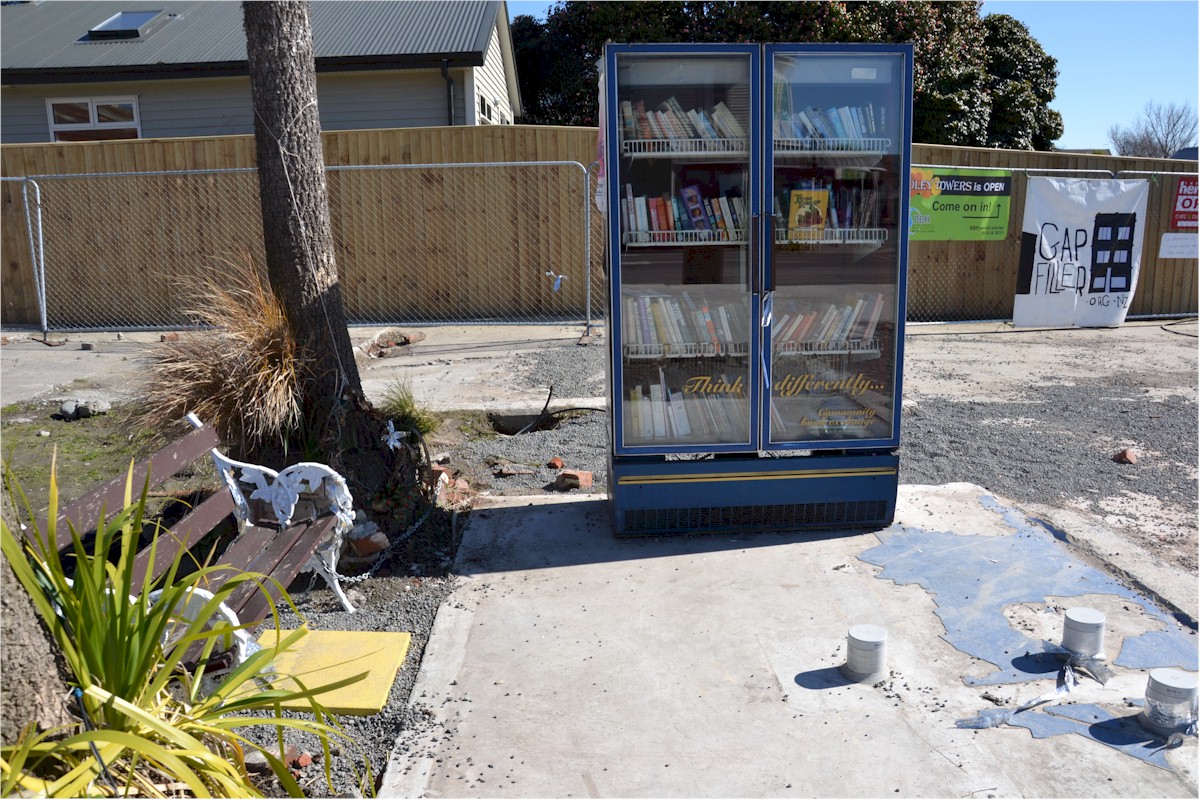
Here's another corner site, on the Eastern side of the city. The building has been demolished, the site cleared, but someone's put paving stones and gravel down, and it has become a little corner park...

Amazing what you can do with a park bench and a food cooler full of books. The inspiration I understand is: www.gapfiller.org.nz

This sign was unsettling. Given the mass destruction of massive (read: stone, read: brick)buildings, it is somewhat head-in-sand to push for more of the same... Or maybe there will never be another earthquake... come on...

Auckland Plan to Bust MUL

It's getting interesting as Auckland Council opens the Kimono a little and we get to peek inside...

But I'm not sure I like some of what I see, or maybe I'm just confused by it.

Auckland Council has been considering the Auckland CBD Masterplan (which - by the way, I think should be moving to something more like "Central Activity District", rather than "Engine Room"... how post-industrial....). This seems to have been an opportunity to release tit-bits about the Waterfront Masterplan as well as bits and pieces from the Auckland Plan.

Amongst which is The Southern Initiative. Unclear exactly what this is, but apparently it will tackle social and economic disadvantage and need.

And then in the next breath we learn there are 7 growth areas, aas well as the CBD area, and these are prioritised this way:


It would be great to see a bit of a rationale for this prioritisation. On first glance it's like a bit of something for everybody - rather than a genuine prioritisation.

But the bit that's a real worry is the inclusion of Pukekohe and Warkworth. These are both outside the MUL. I can't speak much of Pukekohe - but I do know a little about Warkworth. Not only is it outside the MUL - the Metropolitan Urban Limit - it is beyond the end of Alpurt B2 - the new Northern motorway. In fact it's slap bang on the proposed route of Minister of Transport's "holiday highway".

If I was him I'd be pinching myself a little. "what's going on here, don't tell me theat Auckland Council is giving me another reason to support the motorway extension..."

Because that's what a growth strategy for Warkworth will require. Roads. Transport. It's like Auckland Council knowingly intends pricking its own MUL strategy.

I could understand a growth strategy for Orewa, or even Silverdale. Both on good state highways, and even got the Northern Busway running up there now.

But not Warkworth.

Haven't we learned from Helensville? There the Auckland Regional Council experimented with rail. Did that promote growth up there? Don't think so. Misconceived. Just as Warkworth is misconceived.

Auckland Waterfront Plan Conflict

Transformational Move 8 -
Revitalising the Waterfront -
Water City...

This is the heading for the part of the Auckland CBD MasterPlan draft (voted on by Auckland Council at its Future Vision Ctte meeying on August 31st) that deals with the waterfront.

Interesting that this is given advance airing on this agenda. Before the Waterfront Development Agency has said much publicly. Or released its own draft plan. A sign perhaps that Auckland Council is tightening its control of its CCOs. Apart from Watercare.... Not necessarily a sign of conflict. But certainly a sign of control...

I have looked through the various documents to discern the Council's logic and vision for Queens Wharf. And this is what I have found out so far, in the proposed plans, which are being put out for public consultation later this month:

That Queens Wharf is to become part of what is termed the "cruise hub" terminal for New Zealand for the "next 15 years".... This will require "the redevelopment of Shed 10, supported by the Cloud structure together with a secondary terminal at Princes Wharf". Apparently this: "cruise terminal project (2012-2018) will deliver a world-class, multi-cruise terminal on Queens Wharf..."
Comment: The fine print here suggests that the Cloud will stay for 15 years. The fine print also indicates it is planned that the Queens Wharf cruise terminal is planned for at least 2 cruise ships at a time (multi-ship). While the words "cruise hub" don't say "hubbing terminal", that is the clear inference.

Both of these plans seriously threaten the public use of, and access to, Queens Wharf. I find them completely out of place on a people's waterfront.

The numbers used to support this use of Queens Wharf are hard to find. But one is quoted in the report to councillors. It states: "each year 2.5 million visitors arrive in Auckland by air or cruise ship...the challenge is to make them stay longer...".
Comment: We know Auckland is a tourist gateway. And it's good to retain the tourism dollar in Auckland. But Auckland is also home to 1.5 million locals. And it would be good to retain some of their visitor dollars in Auckland also - and one way to do that - as we are belatedly discovering at Wynyard Quarter - is provide high quality, full of activities, waterfront public spaces and places.

But if you really believed Auckland's economic salvation from the visitor economy was tourists, and if you get really picky, even naive, you might think it's better to drop those unsuspecting tourists as close to Queens Street as you can get them. Queens Wharf is closer than Auckland International Airport after all. But how many passengers are we talking about here, and how much do they spend while they are here - compared to Auckland's 1.5 million residents for example?

If you take a guess, and estimate 60 cruise ship visits with 1000 passengers each, and they seem to stay for 36 hours on average, that boils down to 90,000 visitor days a year. From cruise ship visits. And that's why the Council's quoted figure of "2.5 million" cruise ship and jet plane visitors each year is so misleading. Why? Well let me explain. For example, according to ShareChat's website on the performance of Auckland International airport, "Overall inbound tourism for the twelve months ended February 28 was up 2.5% to 2.5 million". Doesn't leave much room for cruise ship visitors does it? You can see from those two figures that the proportion of visitors coming by cruise ship is tiny - infinitesimal in fact. So this hardly justifies sacrificing a second central city wharf to their activities.

All Auckland would be doing would be providing free-parking for Carnival Australia CEO Ann Sherry's cruise ships. At great cost to Aucklanders.

And then there are the various visions and goals and outcomes in the CBD Masterplan. It appears that the Waterfront Development Agency have set four goals in its statement of intent, which it appears is being put out for consultation, but buried in the detail of Auckland Council's CBD Master Plan. The WDA wants this:

* A public waterfront: A place for all Aucklanders and visitors to Auckland, a destination that is recognised for its outstanding design and architecture, natural environmental quality, public spaces, facilities and events; a place where we can express our cultural heritage and history, and celebrate our great achievements as a city and nation.
* A working waterfront: a place for marine industries and businesses, local and international port activities; an attractor of further high value business investment and activity, the location that supports authentic and gritty waterfront activities that must locate here.
* A growing waterfront: The critical location of sustainable urban transformation and renewal in Auckland, where we must demonstrate international best practice and innovation; achieve a significant lift in Auckland’s and NZ’s productivity; the most liveable of New Zealand’s central city urban communities; a vibrant mix of residents, business and employees, visitors, and activities.
* A connected waterfront: A place where people are highly connected locally and with the inner city, to the rest of Auckland and New Zealand; that is highly accessible and safe for pedestrians, cyclists, and passengers, with telecommunications that support connectivity.

Comment: I quite liked these. Well. Apart from the "A growing waterfront" one. Strange words. Calls to mind a doubling of POAL reclamation. You know. Heaps more containers. It's about growth. rather than development. So not really good for the "S" word. The sustainability word. But I love the top one. That's about a public waterfront first (for all Aucklanders and visitors to Auckland - fantastic - love those words), and a working waterfront second.

But what's really interesting is that Auckland Council has taken these goals, and used them to assess its "cruise hub" plan for Queens Wharf. They come to this conclusion:


Man oh man. Auckland Councillors actually voted for this. They seriously believe that a multi-ship hubbing cruise ship terminal on Queens Wharf is going to: "enhance public access to, and enjoyment of, Queens Wharf...", and thereby deliver on the Waterfront Development Agency's vision. Think again guys.

And again. Have you done the cost benefit analysis? Have you really weighed the social costs against the economic benefits (remember the tiny numbers) so that you put your hands up and say, yes, we genuinely believe, that a multi-ship hubbing cruise ship terminal on Queens Wharf: "enhances the waterfront as a visitor and waterfront destination, resulting in economic benefits..."

Because that's what you voted for. You voted to double, maybe even triple, central cruise-ship parking places in the heart of Auckland. Thankfully you are consulting over it. Wonder what the WDA thinks about this?

What is it about cruise ships?

Talk about being taken for a ride.

Sunday, August 21, 2011

Wynyard Quarter Attracts & Detracts

Talk about people places.... Take a bow Auckland.... Take a bow Auckland Regional Council, Auckland City Council, and Sea + City. You take credit for the years of decisions, allocations, and planning that underpin the public legacy we can all enjoy at Wynyard Quarter.

The place attracts and caters for young people. Youth who might only be seen on the waterfront for an event at the Vector Arena. Wynyard Quarter attracts Auckland's youth. The tip of the iceberg of the latent demand that exists in the resident population of 1.4 million people for a public place like this.

They share the playground with kids of all ages. A place to hang out. In the public eye. Informal surveillance. Safe. This photo was taken from the gantry view platform. Inspired I guess. Everybody wants an elevated view of places that attract people. Great for photos and for perspective.

This Chinese delegation from Xinjiang enjoyed their visit. This informal - but somehow formal - seating is inspired. And as the trees grow providing welcome shade across this area, it will attract those who want to sit and watch the world go by. The piano was regularly used...

The WindTree scultpture provided the backdrop for any number of photos, as did the trams looping the Wynyard Loop.

The choice of food and eatery is extensive, from a pot of chips at Sanfords to more exotic fare. Spoiled for choice. Great to have a waterfront place that does not feel like lager alley. Feels safe. Good family fare. Everybody's here (the public toilets are still unfinished though. Very important for young and old. Key to success. Just having one in the container sculpture may not meet requirements...)

Swing from food to walk to swing.

Then there are the fishing boats and the sea gulls. These are the places to sit, take photos, have a snack, and generally chill out. But wait. Something's not quite right. Pan a bit right....

What are all these cars doing here? Not a parking warden in sight. Certainly no sign saying no parking. And none permitting it. More than a few students have remarked to me about the way car parking is already damaging the public experience on Wynyard Quarter. The better the day - the more the informal car-parking is damaging the experience....

The great pictures are cluttered by cars. Sure this is a working waterfront. On my way here, as I biked to and from the ferry, I couldn't help but notice the security guards: "please get off your bike sir..." And of course I did. So where are they when you really need them? Where's one asking, "no parking here sir - unless you need to unload for a fishing boat..." Or something like that.

The wonderful Heritage Net Shed frontage was also stacked with cars. For ages. No evidence of loading or unloading. Someone told me that everyone's being a bit relaxed while things get going. Not a good idea. Bad parking habits get locked in very quickly. The planning for this place was that around - only - 10% of all trips in and out would be by car. The rest by other means. The great design as at risk of being compromised by those in charge of implementation. That's Auckland Council. You need to fix this now.

And here's another place where cars park all day. Unticketed. This is a great public space, an open space, a place for walking and informal being. Not a place for cars. Move them on. Put a couple of security guards here.

They might look cute in the garage, and they might be safe parked here, close to work, so I can keep a watch, and not walk too far. This is the sort of attitude that has completely buggered Princes Wharf for the public. These parking patterns must be nipped in the bud.


This is a shared space. But it's not a space that needs to be shared with parked cars. That was never part of the plan.

These are mostly contractor vehicles. This is the argument that will be made in support of car-parking. The thin end of the wedge. In fact we all know that Wynyard Quarter will be a building site for at least a decade. At the same time it will be a fishing port. And a people's place. Parking - for visitors, contractors, and workers alike - must be robustly controlled. Look in the top left of this picture for example. Empty space. How about a bit of parking space there for contractor vehicles? Get this sorted Auckland Council. Don't wait till after RWC.

I don't want to end on a sour note. Wynyard Quarter is off to a great and popular start. We can be proud of this achievement. So here's a challenge for the new Auckland Council and its new Waterfront Development Agency. I challenge you to do the same - or better - on Queens Wharf. That will be your waterfront legacy.

Unitary Plan Pros & Cons

She did a good job. Penny Pirrit. Manager Regional and Local Planning for Auckland Council. Presenting Auckland Council's current ideas about consolidating all of Auckland's RMA planning documents into one plan, one Unitary Plan, at the University of Auckland "Fast Forward 2011" lecture on August 17th.

In this posting I will report from my notes of the lecture, interspersed with a few comments and questions that occurred to me as the lecture unfolded....

The lecture began with the Mayor's Vision - that Auckland become the world's "most liveable city".

Comment: I decided I'd look up "liveable" in Google. One of those words that drive me nuts because I don't know what they mean. Try it. Google first of all asks you if you mean "loveable". When I insisted on liveable, it gave me this meaning: "fit or suitable to live in or with" and added: "Familiarity information: LIVEABLE used as an adjective is very rare...."

This isn't the graphic that came up in Penny's presentation, but it more or less is. The planning structure has the Auckland Plan at the top - as I understand it that is essentially the Spatial Plan required by legislation. The Implementation Plans include such things as the Regional Transport Plan. To the right is the LTCCP or Long Term Plan required by the Local Government Act. The subject of this lecture was the Unitary Plan which is the term used to describe what will happen to Auckland's current set of Resource Management Act (RMA) planning documents - which include the 7 District Plans (prepared by Franklin, Papakura, Manukau, Auckland, Waitakere, North Shore, Rodney Councils) and the Auckland Regional Policy Statement. I presume they also include plans like the Air, Land and Water Plan.

We were advised there would be 3 scales of integrated planning, making up the Auckland Plan. There would be the Auckland Spatial Plan at the top of this hierarchy of documents, then Area Plans, then Precinct Plans.

Comment: The definition of the regional Spatial Plan is clearly geographic - rather than issue led. As such it is of the type of Spatial Plan favoured in Europe a decade or so ago.
Penny advised there will be 21 Area Plans - one for each Local Board area. These would be integrated land use and infrastructure plans for each Board area, and be "place-based". Interestingly it appears that the plans already prepared by Auckland City Council for Auckland Isthmus will not be redone, "because they were recently completed..."

This part of the presentation was accompanied by a predictable picture of how high the pile of RMA planning documents stands (about 2 metres high), and commentary to the effect that some of the plans were past were past their use-by dates (some are past their review-by dates - for example North Shore City Council).
Comment: This did make me wonder about the stormwater and wastewater network discharge consent work that has been done by Councils, and also the Integrated Catchment Management Plans. Where will all that fit?
It appears Auckland council has considered a range of approaches to preparing the Unitary Plan. various options were considered. Apparently Council wants, "the whole kahuna". That everything should be put into one RMA plan. Though it appears that the Gulf Islands RMA plans will be excluded "because they are recent". Another Auckland exception. The goal is to notify the draft Unitary Plan in the early part of 2013.

Penny explained that that it is anticipated that the Auckland Plan will be finished early in 2012, and that there would be pressure to implement it through plan changes and private plan changes, unless Auckland Council can get the Unitary Plan finished qucikly enough...

Comment: Man oh man. Quick intake of breath here. For the Auckland Plan to cut the mustard it really needs to be based upon the 21 Area Plans. Is there a cat's chance in hell of getting those done in the next 6 months, to build the Auckland Plan upon? Unlikely. More likely is the Auckland Plan will be done first, and later, much later, it will be divided up into 21 Local Board Plans. The Auckland Plan alone is a very big ask for a new organisation....
We were advised there were three big challenges to getting the Unitary Plan done: the RMA itself, the 3 year political cycle, and expectations.

The RMA issues were interesting.

The RMA is not about outcomes, it is about effects.
The Unitary Plan needs to be about positives, not just about negatives.
Penny explained that the Unitary Plan needed to be defensible. Her guidance is that the RMA needs to be "set aside" in order for the new Auckland Council to be able to produce a defensible plan. Identify areas of the Unitary Plan that disagree with the RMA. And then negotiate with Government and MfE to change the RMA.
Comment: Wow. Big call. About time. Not sure what Dr Smith will make of this though.
Penny advocated strongly "we need to stick our neck out, take the risk, and what we do might need to be tested in the Environment Court..."
Comment: This is another big call. It's a bit like what Auckland Regional Council needed to do in defending the MUL, the Metropolitan Urban Limit, as a method that was appropriate in terms of the RMA in enabling integrated management of natural resources...
We were advised that Auckland Council has already put submissions in to Central Government to remove RMA appeal rights to plan changes, and new plans - because those changes represent strategic statements of the Council.
Another big call. I can't imagine various land owners agreeing to this. They will want to protect their property rights till the cows come home. But I agree. How can a Council control natural resource use, when it's going to be dragged into the Environment Court where some notion of "balance" and a "judge's weighing of issues" can put at risk a broader call."

The next part of Penny's presentation was a bit irritating. And Penny did say her tongue was a little in her cheek as she spoke to us. There are four lots of expectations:

1) Developers want certainty
2) The community wants involvement in all applications - except their own
3) Interest groups are quite prepared to waive private property rights in the public interest, and "are the hardest groups to deal with"
4) Designers who want flexibility in process to do what they think is best and not be fettered by rules...
Comment: Where do you go with this Penny? It has always been this way. And as the public learns more and expects more, then more involvement and participation will be required. It's one of the reasons for those parts of the RMA. Which are steadily being eroded - by the way. Land use planning has been, and always will be, a contest. Whether it is between short term and long term interests, whether it's private property rights vs the common good, whether it's central government forcing the hand of local communities. You cannot short-cut these processes - unless you want revolt...
And we know the political cycle is short, making it hard to take councillors along.

Penny then went on to talk about another layer of Unitary Plan working issues:

- certainty vs flexibility (includes process vs outcome, rules vs criteria)
- level of intervention (lessons from the past, doing it right for the right reasons)
- integration of regional and district (RMA reqs, remove duplication, ensure env protection)

At this point Penny digressed a little and stated that "the market approach does not work", in the context of learning from the past.
Comment: I agree. The market is mainly interested in making a profit. There are plenty of examples of market failure in RMA planning. But how do you rate the chances of Central Government changing the RMA to provide for more Council certainty and intervention in land use planning and resource management?
And there are more issues:

- affordable development (over 300,000 homes are needed, these need to be safe, warm, healthy and affordable, "whether they are designed by an architect is irrelevant to many...."
- public good vs private rights (impact on private rights, heritage and character debate, what sort of tools are needed to relieve burden on private interests carrying public interest)
- capacity to deliver (Penny's view: we must deliver a planning process that can be delivered without undue cost. She was very critical of those who are arguing that the Unitary Plan review must be "design led...")
Comment: I agree here. What does "design-led" actually mean anyway? It's another example of no-speak. A bit like sloppy use of words like "sustainability", "amenity", and even "planning".... if planning means everything then perhaps it means nothing... Why do I say this? Ok: Every leaky home was designed. Architecture is a design-led process. Some wonderfully design-led homes are leaking homes. What went wrong? The hopes behind the words "design-led" are another example of hope over experience. Here we need concrete experience to lead the unitary plan work. Not some undefined design.

Penny ended with a list of principles for the Unitary Plan. The Unitary Plan needs to:

1) give effect to the Auckland Plan;
2) be innovative;
3) be user friendly;
4) be outcome focussed;
5) have minimum repetition;
6) use illustrations and diagrams;
7) ensure planning gain outweighs planning pain.
Comment: The main question I was left with: "Is simple necessarily good? and for whom?". I feel that the pressure to harmonise (remove duplication) risks bland planning ironing over diversity in urban landscapes. As if one size fits all. That's what we see in Brisbane after 80 years or so of uniform regional planning. I can understand why councillors might yearn for simplicity - the whole kahuna - but there's a big risk here of throwing the baby out with the bathwater. Think where the calls are coming from for simplicity and unformity. Think what's broke and fix that. Don't repeat the whole mistake of regional amalgamation (where we lost a lot) and do the same again with District Plans. In my experience the devil is in the detail in land use planning. Many fine-grained rules are there to protect the living quality of different residential and commercial environments in different parts of the region.

If you really want a "liveable city", think of that definition of the Mayor's vision: fit or suitable to live in....

That is what those plans and rules were built over time to protect. Don't destroy them just because they seem complicated. Life is complicated. And it doesn't get easier by throwing out the rule book.

Saturday, August 6, 2011

Auckland Waterfront Fantastic

I went down to the Waterfront this morning for an opening celebration. There was a Maori Pouwhiri at sunrise. Waka. Classic boats lined the wharves. And so did the people. The public spaces and places down here are a revelation. Auckland has done itself proud. Go there. Walk around. And enjoy....