RMA Plan Change for Queens Wharf |
Progressive Incorporation of Maritime Heritage into Wynyard Quarter |
Submission 9: Wynyard Quarter provision for maritime heritage and culture needs more direction to ensure the waterfront: “…incorporates Auckland’s cultural heritage and history, and provides a home for the display and use of representative examples….” |
Submission 10: Wynyard Quarter proposals need to provide for a progressive approach to maritime heritage (one which starts now), including the allocation of berthing space now in the Silo Harbour enclosed area to heritage boats and the provision of land side interpretation signage there and related amenity and that this attraction be built into the heritage trail. |
Submission 11: An explicit proposal is required which provides places and spaces for representation and cultural displays of Maori and Pacific Island maritime activities and traditions. This proposal needs to be progressive and to start now. |
Submission 12: An explicit proposal is required relating to adaptive re-use of Vos and Brijs site and buildings. |
Slow Movement Zone along waterfront supported |
Submission 13: The public passenger transport link to Britomart should be along Fanshaw Street, not across Te Whero Island. |
Marsden Wharf |
Submission 14: Marsden Wharf presents a cultural and economic opportunity which needs protection and recognition in the Waterfront Plan. |
Thursday, November 3, 2011
Submissions H: Waterfront Plan
Saturday, July 17, 2010
QW - Politics:1 Auckland:1
 Friday's joint decision by ARC and Government to keep Shed 10, build a temporary structure alongside, and deliver Party Central Rugby World Cup obligations on Queens Wharf is a classic political compromise. Friday's joint decision by ARC and Government to keep Shed 10, build a temporary structure alongside, and deliver Party Central Rugby World Cup obligations on Queens Wharf is a classic political compromise.Two political faces get saved, the media feeding frenzy eases, the public relaxes. Politics 1. Politics won.... |
 And Auckland loses a shed. Auckland 1. Just one will remain. That's the price of compromise. Auckland didn't need to lose Shed 11 to deliver a great fan zone and party central experience. It needed to lose Shed 11 to satisfy political egos. That's politics. Where anything goes. Including heritage... And Auckland loses a shed. Auckland 1. Just one will remain. That's the price of compromise. Auckland didn't need to lose Shed 11 to deliver a great fan zone and party central experience. It needed to lose Shed 11 to satisfy political egos. That's politics. Where anything goes. Including heritage... |
 Heritage isn't just about individual buildings. It's about landscapes. Queens Wharf used to have 6 of these sheds. Heritage assessments remark that the heritage value of Queens Wharf is less with 2 than with 6 sheds. So why get rid of Shed 10's sister? Why leave the wharf with an orphan? (Though if the graceless Minister for the RWC had his way Shed 10 would be gone by lunchtime.) Heritage isn't just about individual buildings. It's about landscapes. Queens Wharf used to have 6 of these sheds. Heritage assessments remark that the heritage value of Queens Wharf is less with 2 than with 6 sheds. So why get rid of Shed 10's sister? Why leave the wharf with an orphan? (Though if the graceless Minister for the RWC had his way Shed 10 would be gone by lunchtime.) |
 The Fan Zone needs 6000 square metres of floor space apparently. The two floors in Shed 10, plus the floor area of Shed 11 total 6750 square metres. More than enough. The locations of these sheds is perfect for the two cruise ships that will temporarily park on Queens Wharf, and house 3000 international fans. They can house and store logistics needed for the ships, as well as providing great weather proof environments for fan zone spaces. I guess I should not shed tears for Shed 11. Instead be grateful that Shed 10 has a stay of demolition. It is good that there will be no rush to do Shed 10 up, nor rush to extend it and add hasty adaptations. The opportunity presented by Shed 10 and the rest of Queens Wharf remains, and needs to be protected. Come on Historic Places Trust get that heritage registration finished. The Fan Zone needs 6000 square metres of floor space apparently. The two floors in Shed 10, plus the floor area of Shed 11 total 6750 square metres. More than enough. The locations of these sheds is perfect for the two cruise ships that will temporarily park on Queens Wharf, and house 3000 international fans. They can house and store logistics needed for the ships, as well as providing great weather proof environments for fan zone spaces. I guess I should not shed tears for Shed 11. Instead be grateful that Shed 10 has a stay of demolition. It is good that there will be no rush to do Shed 10 up, nor rush to extend it and add hasty adaptations. The opportunity presented by Shed 10 and the rest of Queens Wharf remains, and needs to be protected. Come on Historic Places Trust get that heritage registration finished. |
Sunday, April 25, 2010
Queens Wharf Opens on Anzac Day
 What fantastic weather there was for the public opening of Queens Wharf as a "Peoples' Wharf" by ARC Chairman Mike Lee and Minister of Rugby World Cup Murray McCully. What fantastic weather there was for the public opening of Queens Wharf as a "Peoples' Wharf" by ARC Chairman Mike Lee and Minister of Rugby World Cup Murray McCully. |
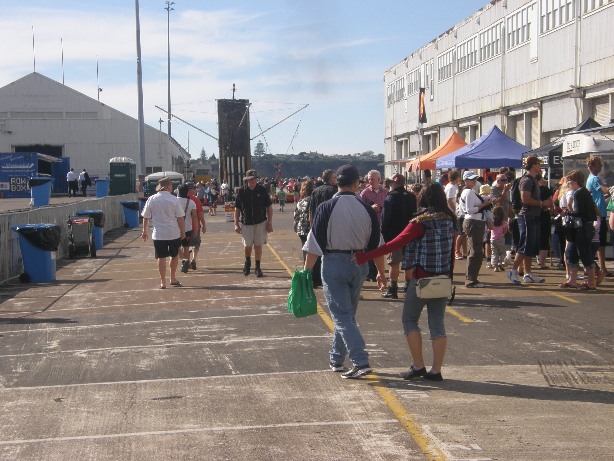 Despite little advertising the wharf was thronging with people. Where did they all come from? Hard to say. Just came down town after Anzac Day looking for something to do, and saw there was something up at Queens Wharf Party Central and headed on down. Despite little advertising the wharf was thronging with people. Where did they all come from? Hard to say. Just came down town after Anzac Day looking for something to do, and saw there was something up at Queens Wharf Party Central and headed on down. |
 Vintage vehicles, games, bouncy castles, take away food, the odd portaloo. Shade was hard to find though. In all that sun... Vintage vehicles, games, bouncy castles, take away food, the odd portaloo. Shade was hard to find though. In all that sun... |
 And the Ports had laid on their party special. Everyone came down to the end of the wharf to look... And the Ports had laid on their party special. Everyone came down to the end of the wharf to look... |
 Yep. Dancing tugboats. Something for everybody. Yep. Dancing tugboats. Something for everybody. |
 They came on their bikes, disability buggies, wheel chairs, skate boards, and they came in their hundreds taking photos and enjoying being somewhere they'd never been allowed before... They came on their bikes, disability buggies, wheel chairs, skate boards, and they came in their hundreds taking photos and enjoying being somewhere they'd never been allowed before... |
 And they came to have a look inside those sheds. Both sheds were open to view. Pity nobody could look in the upper floor of Shed 10 - but it's not that safe at the moment... And they came to have a look inside those sheds. Both sheds were open to view. Pity nobody could look in the upper floor of Shed 10 - but it's not that safe at the moment... |
 Many people took the opportunity to have a good look around. See what they could see. Not everybody can see the potential. That's par for the course. It's only after some love, design and attention to detail that the sheds will be able to come into their own... Many people took the opportunity to have a good look around. See what they could see. Not everybody can see the potential. That's par for the course. It's only after some love, design and attention to detail that the sheds will be able to come into their own... |
 The temporary ceiling is there, now, with strip lighting - fairly institutional - for when Shed 10 is used as cruise ship terminal which happens at the moment when Princes Wharf has a cruise ship. The temporary ceiling is there, now, with strip lighting - fairly institutional - for when Shed 10 is used as cruise ship terminal which happens at the moment when Princes Wharf has a cruise ship. |
SOS Queens Wharf Save Our Sheds |
Sign their petition at: http://www.sosqueenswharf.co.nz/ Go to Facebook, and check out their page: SOS Queens Wharf |
 The big attraction on the day was undoubtedly the Navy. Their ship attracted huge amounts of attention. Everybody wanted to be shown around. The big attraction on the day was undoubtedly the Navy. Their ship attracted huge amounts of attention. Everybody wanted to be shown around. |
 It got tiring in the sun. There are quite a few old timbers around to sit on, and the sheds were great shelter from the sun. It got tiring in the sun. There are quite a few old timbers around to sit on, and the sheds were great shelter from the sun. |
 These big timbers make great seats. And they all seem to be in the right place. These big timbers make great seats. And they all seem to be in the right place. |
 As I sailed back to Devonport in the ferry, it was great to look back and see people on the peoples' wharf. Walking around the sheds. Enjoying their newest Regional Park. It was a great step of ARC and Government to buy this wharf and everything upon it. As I sailed back to Devonport in the ferry, it was great to look back and see people on the peoples' wharf. Walking around the sheds. Enjoying their newest Regional Park. It was a great step of ARC and Government to buy this wharf and everything upon it. |
We need to think hard before doing anything permanent that will detract from the promise and the potential of the "peoples' wharf".... |


Tuesday, April 20, 2010
ARC's Clear Conflict of Interest at Queens Wharf
But not the corridors of power...
The Auckland Regional Council is Auckland's main heritage guardian. It has gone to war on several occasions while I've been on Council. It spent hundreds of thousands in expert evidence and legal advice protecting maori dump sites (middens) and colonial earth works at Long Bay. This applied energy means that the private land owners of that land cannot, now, develop that land or urbanise it. And I supported that action. New Zealand - and Auckland especially it seems - is very short of heritage and history because it has a habit of destroying it.
Tank Farm is another very good example. A great slice of Auckland Waterfront. With a fair distribution of pre-second world war buildings of considerable heritage and character. ARC has left few stones unturned in pursuit of development protection for those buildings - especially against demolition. Another blog on this site contain pictures of all of those buildings. You can see it at:
http://joelcayford.blogspot.com/2010/03/endangered-species-auckland-waterfront.html
Here, ARC has made private owners of those buildings jump through all kinds of hoops if it is their wish to develop their land.
Yet here we have Queens Wharf, in public ownership now for about 2 weeks after transferring the wharf from Ports of Auckland ownership to ARC and Government, and we have the extraordinary activity of ARC - owner and regulator - pushing with huge haste for the demolition of cargo sheds which were built not before second world war - these sheds were built before the first world war. 1912 I am advised.
"Practice what you preach" - was a phrase used by more than one ARC councillor in the debate that occurred this Monday in at the ARC. But to no avail.
If it was not for the letter from the Historic Places Trust - calling for a proper heritage assessment of wharf and structures - the vote to approve dismantling would have been a doddle. As it is, ARC's decision to dismantle is subject to the outcome of consultation with the Historic Places Trust and presumably to it carrying out its own Heritage assessment.
The word "dismantle" is now being used instead of "demolish". The Chair of ARC has begun using it lately. One or two ARC councillors like it too. There is talk of using some bits and pieces of the dismantled shed - as a sort of aide memoir of what is there now. Bit like takling the best bits of a Model T Vintage car and blending them into the construction of a brand new Holden - made of carbon fibre, or plastic.
That is the argument that was used to mitigate the Princes Wharf design. They said they'd reuse some of the old building structure. You can vaguely make it out buried underneath the Hilton Hotel and the Apartments. But it is tokenism. Facadism. Sad.
The advice ARC has already received from the heritage report it commissioned jointly with Auckland City Council is very strong. ARC's own heritage officers provided advice to the executive team writing the report that was considered on Monday. They wrote in respect to the Matthews & Matthews Architects Heritage Assessment report:
...due to their high heritage values and ready adaptability, the heritage assessment recommends that serious consideration be given to retaining and adapting the sheds as part pof the redevelopment of Queens Wharf. The (ARC's) Cultural Heritage Team concurs with this recommendation, as the presumption should be to protect and preserve heritage items of high significance. In designing any temporary or permanent development of Queens Wharf, it is our view that at least one of the sheds (Shed 10 is the least altered and in best condition of the two) should be retained and sensitively adapted for a new short-term or long-term use...
You don't get much clearer advice than that. But that wasn't the advice that was given to ARC councillors. Oh dear no. It got watered down by those preparing the ARC council meeting report. Here's what Councillors got to read from their Chief Executive and his staff:
The heritage assessment recommends that serious consideration be given to
retaining and adapting the sheds as part of the redevelopment of Queens Wharf. The
Council’s resolution of December 22 to endorse QW04 as the basis of the
development of Queens Wharf carries with it the consequential requirement that both
be removed to achieve the design. The proposed staged development set out in this
report also requires the removal of both sheds before the Rugby World Cup.
Through the development of the proposal, Government representatives have
repeatedly expressed their consideration that, despite the heritage value of the
sheds, their location, the limitations on what can be done to them to meet the
requirements of the site as a cruise terminal, and the major uncertainty over the cost of attempting to modify them, mean that they obstruct both the short term and long term development of the wharf and that, on balance, they should be removed.
In recognition of the heritage value of the wharf and the sheds, it is recommended
that, as part of the next stage of the development, the Council complete a heritage
assessment of the site with the intention of recording its heritage, maximizing the
retention and integration of heritage features on the wharf into the development, reusing materials from the sheds and ensuring appropriate interpretation of the history and heritage of the wharf is reflected in the development of the wharf.
It is further recommended that, when the sheds are removed, that they are
dismantled to maximize the recovery and reuse of materials in the development.
Spot the difference - is my challenge.
So. ARC got a very clear steer from the heritage report that it commissioned. It got very clear advice from its own expert staff. But it got all boiled down to "dismantling" by the Chief Executive, no doubt in cahoots with ARC's Chairman.
Practice what you preach guys.
You demonstrate serious conflict of interest here - Cruise Ships before Heritage - where's the balance. Hence the whiff of hypocrisy...
Friday, November 27, 2009
Masonic Hotel - Devonport - Evidence and History
The Society has appealed to the Environment Court against a resource consent obtained from North Shore City Council by the owner of the Masonic Hotel to redevelop the site.
The case has yet to be heard. However, a very considerable body of evidence has been unearthed and researched by the Society. This information is of enormous value.
Given this material is now in the public domain, I have copied a tiny fraction of it below. Should anyone wish to see more, then I am sure a donation to the Masonic Friendly Society would secure copies of this material.
Below is a little snippet of the history of Masonic Hotel that has been uncovered by Susan Joffe, who is an independent historical researcher, and which is contained in her substantial evidence to the Environment Court....
Interesting, don't you think. And that's just a taste of the detail and colour that has been uncovered by Susan Joffe. Other affidavits add considerable architectural detail. Worth protecting that heritage and those historic connections with old Auckland. Great work guys.Figure 1. Masonic Hotel, c.1879. J. Richardson.
3. Summary of History
3.1 Masonic Hotel was built in 1866 by George Beddoes under contract to Thomas John Duder. It was intended to be a resort for wealthy travelers and a holiday destination. With eleven bedrooms and two sitting rooms on the second storey all well decorated and furnished. The ground floor rooms catered to gentlemen’s
sports such a billiards and meeting rooms.
3.2 It immediately became the center of social and commercial activity in the new settlement of East Devonport. It was the watering hole for workers in the shipyards of Torpedo Bay and the meeting place for community groups, sports clubs and local government – Flagstaff Highway Board.
3.3 Photographs of this time show the thriving industry on the foreshore – ship
building, timber milling, wharves with unloading scows.
3.4 The 1883 extension added more bedrooms and kitchen was moved to in a separate building. The south and west facades were altered. It was renamed Pearce’s Masonic Hotel.
3.5 It remained the premier hotel in Devonport until the Esplanade 1902. At this time the commercial center had gradually moved to Victoria Road. However, the
community use of the facility for celebrations and meetings continued.
3.6 The hotel narrowly escaped a fire that damaged the separate two storied building housing servants rooms and the kitchen in 1905.
3.7 Masonic Hotel was sold out of the Duder family in 19247 and, after less than a
decade in private ownerships, was bought by Dominion Breweries in 1937.
3.8 Alterations in the 1960s included the filling in of the verandas.
3.9 With the extension of the licensing hours in 1967 it became Masonic Tavern and
no longer provided accommodation....
4. Historic Significance
There are many aspects to be considered when evaluating historical and cultural
significance. The Masonic Tavern (Hotel) is over 140 years and is therefore
valued for its age. Having been designed by one of Auckland’s early architects
and that the form and ornamentation are typical of public buildings of the time,
also attracts merit. However, it is the social and community values and the part it
has played in the history of the development of Devonport, the associations with
events and people that are of utmost importance in assigning historical
significance in this case.
Dr David Throsby Professor of Economics at Macquarie University, Melbourne
has researched and written widely on the cultural value of heritage buildings.
These values are multi faceted and include the aesthetic, spiritual, social, historic,
symbolic and educational. They are not easily translated into economics as there
is no single unit of account but attempts are being made. The non use values
include the fact that heritage buildings exist, are part of the landscape, are
pleasant to look at and contribute to a sense of well being and belonging.
Heritage buildings are cultural capital that demand a duty of care. There must be
a balancing of economic and cultural values to ensure that future generations have
equitable access to our heritage.
The following definitions are taken from the Auckland City Council assessment
criteria 2009 (draft)
4.1 People: Is the place directly associated with the life or works of well-known or
important individuals?The Masonic Hotel’s association with person or persons is significant.
The name Duder is inextricably linked with the early Development of Devonport.
Thomas Duder owned the land the Masonic is built on, caused it to be built and the hotel remained in the family for nearly sixty years.
Robert Duder lived in the hotel for many years and many of the Duder enterprises were concentrated in the immediate vicinity.(Annex I p.19)
George Beddoes a pioneering shipbuilder, the first industry in Devonport, built the hotel.(Annex p.25)
Richard Keals one of New Zealand’s early architect who built many public
buildings, designed the hotel (Annex II p.22)
Edward Bartley architect of 1883 additions is recognized as a leading influence in colonial architecture, designed the 1883 alterations.(Annex II p.28)
4.2 Themes/subthemes: – does the place have a direct and demonstrable association with important aspects of historical significance?4.2.1 Masonic’s role in the rivalry over the establishment of the commercial center of Devonport. The Masonic was built as a direct result of the opposition to the Holmes Bros. establishment of the Flagstaff Hotel on the foreshore at Victoria Road. The competition to have the center of commercial and civic activity at Church Street involved prominent leaders in the development of Devonport who – who are commemorated in place names.
4.2.2 Contribution to Devonport becoming a holiday destination .
The Masonic Hotel was designed for the holidaying families,
honeymooners and invalids and recuperating patients.
This was reported in the accounts of the opening which extol the well
appointed bedrooms, sitting rooms and sanitary facilities. Mr Cock in his
opening speech expressly mentions that he does not want to cultivate the
‘bar trade’. He also planned to build bathing sheds – salt water and
swimming was considered to have curative powers. The bathing machine
was built in 1869 by Mr James.
The tourism attractions in Devonport were expanded with the Esplanade
Hotel built in 1902 and the Ventnor on King Edward Parade.
The North Auckland Hotel at Stokes Point (Northcote) was built for
travelers going north or coming to the city. It was a holiday destination.
It burnt down and was replaced by the Northcote Tavern.
Masonic remained as a hotel until 1967 when it became a tavern.
4.3 Rarity: Is the place unique, uncommon at a district, regional or national level in relation to particular historic themes?4.3.1 The Masonic is oldest hotel (tavern) in Devonport and arguably the oldest building in the area. The hotel has served the public in the same fashion for 143 years apart from offering accommodation, which ceased forty years ago.
4.3.2 The two other hotels opened in 1866 in Victoria Road, British Hotel and Victoria Hotel had both ceased to exist by mid 1880s.
4.4 Social Values: Community association Is the place important to a community
because of the associations and meaning developed through use and association?
Identity: Is the place a focus of community identity or sense of place, and
does it have social value and provide evidence of cultural or historical
continuity.Throughout its history the Masonic has been a meeting place for locals,
and venue for social occasions. It is identified with the beginnings of
many of Devonport’s sports clubs – many of which are still functioning.
The Flagstaff hotel no longer exists and the Esplanade built in 1902 cannot claim to have played a similar role in the life of the community as the Masonic. Being forty years later it was not the center of the development of local politics, sports clubs and other social activities of the young settlement.
Even before it officially opened its doors the Masonic Hotel was the center of social activity in the community. In July 1866 a lunch was held to
celebrate the launching of a ship.
Significant to the yachting community from the early days of Auckland
Regatta to Peter Blake planning for his America’s Cup Campaign, the
Masonic has served this maritime community.
Throughout its existence the Masonic has played host to the various
defence forces occupying North Head and Fort Tamaki.
Of more recent times it has been the venue for developing musical talent
as being in a band has become a right of passage for Devonport youth.
4.5 Public esteem: Is the place held in high public esteem for its local or
district significance of cultural sentiment?The Masonic Hotel and the buildings around are valued as evidence of the early days of Devonport and the industry and commerce that gave thrived there. It was the first public meeting space. The first local government entity, the Flagstaff Highway Board Annual Meeting 1867. The meeting for fund raising for the Devonport Hall was held there.
The hotel itself has been host to generations of Devonportians who enjoy
the knowledge that their grandfather celebrated in the same hotel.
It holds a special place as the venue for the beginnings of sports clubs
their meetings and after match celebrations....

You can see more at: http://www.masonicfriendlysociety.org/
Tuesday, July 14, 2009
Queens Wharf - A Site Visit - Shed 10
 Shed 10 is the one on Queens Wharf nearest Quay Street. Here we are at the front door. Ready for a site visit of ARC councillors and staff involved in this interesting and exciting project. For a start, you can get an idea of the size of the ground floor level of Shed 10 from this picture. You can drive a fleet of buses inside this doorway...
 It might not be very pretty on the outside at the moment. Needs a certain amount of tlc. And you can see along the side, more or less where those pipes are, where an oxy-acetylene torch has been used to cut away the supports that would have held those big verandahs...
 Interesting inside when the big roller doors are slid open. Pretty much as they were built....
 This is the cast iron footing for one of the ceiling/1st floor supports....
 And this gives an idea of the underside of the 1st floor. This picture gives no idea of size, but I reckon the joist timbers are around 50x20 cms. That's a very hefty joist.
 And this picture shows a close up of the floor timbers. They look about the cross section of railway sleepers, and are coach-nailed into the joists. It was like walking on concrete. You had no idea it was a floor with a big open space below...
 This long character-filled space was evocative of all the work that has gone on in there for almost a century. Even with just a few sky-lights on a grey day the light was great...
 Apparently the roof trusses, and probably quite a lot more of the original stucture, was floated out here from Britain complete. Just needed bolting together...
 Some temporary openings in the side walls give an idea of the perspective you get, looking out...
 And again. I liked the feel of the building. Good bones.
Queens Wharf - A Site Visit
 Almost an anti-climax to be allowed to walk over Queens Wharf today. I feel as if I know it like the back of my hand, but there's nothing quite like a walk over. We were only allowed to look inside Shed 10. That's the one nearest Quay Street. The shed shown here is at the end of the wharf. It's just one storey in height, and is currently let to a cool store company. Guess it's full of fruit...
 Close up of the bollards, shock-absorbers and timbers and rail sections on the surface of the wharf. One of the Ports workers with us mentioned that in the old days a few of these bollards actually got ripped out under the strain of ropes tied to ships. One got flicked all the way to Quay Street...apparently
 Here's the site visit team at the end of Queens Wharf. This area feels very big and wide. Exposed on a day like this...
 But there are these interesting nooks and crannies you get to see when you stand at the end. Nothing like a bit of rust on some steps, and watching the waves lapping there.
 And there's plenty of timber and concrete and ironwork that give the wharf that feel, and Aucklanders that opportunity to touch and enjoy something maritime and old and authentic. Without being close to a pumping restaurant and bar complex...
 You'd expect the views to be good. And they are. North Head and Mount Victoria are easy to see. This would be a great vantage point to watch the big ships come and go...
 The Harbour Bridge - so often missing from Auckland CBD's downtown view is great from Queens Wharf. You can see Chelsea Sugar Works underneath...
 So that's the cool store shed to the right, and Shed 10 to the left ahead. You can see that Queens Wharf is split level. The Cool Shed and Shed 10 sit on wharf structure about a metre above the access level that runs up the middle of Queens Wharf....
 This is a close view of that metre rise. You can see the sea through those gaps at the bottom. Perhaps this low wall would be a good place for a few seats...
 And here's the eastern edge of the Queens Wharf. Bollards are white here...
 These floats lie beside Shed 10. Maybe get dropped in the sea next to the wharf when a ship ties up....
 And right at the Quay Street end of Queens Wharf, you are painfully aware of the tacky red fence between you and the ferry terminal. (This is a cheap and nasty bit of fence - not like that wonderful wrought iron stuff that adorns Quay Street.) You also notice the unimaginative and shut in concrete block wall of the ferry terminal additions. Note to all: get rid of those car parks. There is no room for private office carparks here. Lose the cheap red fence asap. Nor is there room for Fullers rubbish. And those buildings need to be opened up so they spill onto Queens Wharf.
Wednesday, June 24, 2009
Wellington Waterfront - Artworks and Wharfpiles
 Wellington Waterfront. Midwinter pictures. Artwork 1.
He's about to dive.
People hold his hand.
Take lots of photos.
And there are no railings to clutter the picture, or the wharf...
 Wellington Waterfront. Midwinter pictures. Artwork 2.
Whale of a tale in bronze.
 Wellington Waterfront. Midwinter pictures. Artwork 3.
Water Whirler.
Bring on the wind.
Blow wind and crack your cheeks...
 Wellington Waterfront. Midwinter pictures. Artwork 4.
Fountain of fun.
 Wellington Waterfront. Midwinter pictures. Artwork 5.
... the last word in part of a line on wood at the edge of a wharf that reads: "...the sudden pull of kahawai or kingfish..."
 Wellington Waterfront. Midwinter pictures. Wharf and piles 1.
 Wellington Waterfront. Midwinter pictures. Wharf and piles 2.
You are welcome to jump off this one. Even a ladder up so you can do it again.
 Wellington Waterfront. Midwinter pictures. Wharf and piles 3.
All those bollards, ropes, chains, and cracked-open hunks of hard wood.
 Wellington Waterfront. Midwinter pictures. Wharf and piles 4.
... and again...
Thursday, November 3, 2011
Submissions H: Waterfront Plan
RMA Plan Change for Queens Wharf |
Progressive Incorporation of Maritime Heritage into Wynyard Quarter |
Submission 9: Wynyard Quarter provision for maritime heritage and culture needs more direction to ensure the waterfront: “…incorporates Auckland’s cultural heritage and history, and provides a home for the display and use of representative examples….” |
Submission 10: Wynyard Quarter proposals need to provide for a progressive approach to maritime heritage (one which starts now), including the allocation of berthing space now in the Silo Harbour enclosed area to heritage boats and the provision of land side interpretation signage there and related amenity and that this attraction be built into the heritage trail. |
Submission 11: An explicit proposal is required which provides places and spaces for representation and cultural displays of Maori and Pacific Island maritime activities and traditions. This proposal needs to be progressive and to start now. |
Submission 12: An explicit proposal is required relating to adaptive re-use of Vos and Brijs site and buildings. |
Slow Movement Zone along waterfront supported |
Submission 13: The public passenger transport link to Britomart should be along Fanshaw Street, not across Te Whero Island. |
Marsden Wharf |
Submission 14: Marsden Wharf presents a cultural and economic opportunity which needs protection and recognition in the Waterfront Plan. |
Saturday, July 17, 2010
QW - Politics:1 Auckland:1
| Friday's joint decision by ARC and Government to keep Shed 10, build a temporary structure alongside, and deliver Party Central Rugby World Cup obligations on Queens Wharf is a classic political compromise. Two political faces get saved, the media feeding frenzy eases, the public relaxes. Politics 1. Politics won.... |
| And Auckland loses a shed. Auckland 1. Just one will remain. That's the price of compromise. Auckland didn't need to lose Shed 11 to deliver a great fan zone and party central experience. It needed to lose Shed 11 to satisfy political egos. That's politics. Where anything goes. Including heritage... |
| Heritage isn't just about individual buildings. It's about landscapes. Queens Wharf used to have 6 of these sheds. Heritage assessments remark that the heritage value of Queens Wharf is less with 2 than with 6 sheds. So why get rid of Shed 10's sister? Why leave the wharf with an orphan? (Though if the graceless Minister for the RWC had his way Shed 10 would be gone by lunchtime.) |
| The Fan Zone needs 6000 square metres of floor space apparently. The two floors in Shed 10, plus the floor area of Shed 11 total 6750 square metres. More than enough. The locations of these sheds is perfect for the two cruise ships that will temporarily park on Queens Wharf, and house 3000 international fans. They can house and store logistics needed for the ships, as well as providing great weather proof environments for fan zone spaces. I guess I should not shed tears for Shed 11. Instead be grateful that Shed 10 has a stay of demolition. It is good that there will be no rush to do Shed 10 up, nor rush to extend it and add hasty adaptations. The opportunity presented by Shed 10 and the rest of Queens Wharf remains, and needs to be protected. Come on Historic Places Trust get that heritage registration finished. |
Sunday, April 25, 2010
Queens Wharf Opens on Anzac Day
| What fantastic weather there was for the public opening of Queens Wharf as a "Peoples' Wharf" by ARC Chairman Mike Lee and Minister of Rugby World Cup Murray McCully. |
| Despite little advertising the wharf was thronging with people. Where did they all come from? Hard to say. Just came down town after Anzac Day looking for something to do, and saw there was something up at Queens Wharf Party Central and headed on down. |
| Vintage vehicles, games, bouncy castles, take away food, the odd portaloo. Shade was hard to find though. In all that sun... |
| And the Ports had laid on their party special. Everyone came down to the end of the wharf to look... |
| Yep. Dancing tugboats. Something for everybody. |
| They came on their bikes, disability buggies, wheel chairs, skate boards, and they came in their hundreds taking photos and enjoying being somewhere they'd never been allowed before... |
| And they came to have a look inside those sheds. Both sheds were open to view. Pity nobody could look in the upper floor of Shed 10 - but it's not that safe at the moment... |
| Many people took the opportunity to have a good look around. See what they could see. Not everybody can see the potential. That's par for the course. It's only after some love, design and attention to detail that the sheds will be able to come into their own... |
| The temporary ceiling is there, now, with strip lighting - fairly institutional - for when Shed 10 is used as cruise ship terminal which happens at the moment when Princes Wharf has a cruise ship. |
SOS Queens Wharf Save Our Sheds |
Sign their petition at: http://www.sosqueenswharf.co.nz/ Go to Facebook, and check out their page: SOS Queens Wharf |
| The big attraction on the day was undoubtedly the Navy. Their ship attracted huge amounts of attention. Everybody wanted to be shown around. |
| It got tiring in the sun. There are quite a few old timbers around to sit on, and the sheds were great shelter from the sun. |
| These big timbers make great seats. And they all seem to be in the right place. |
| As I sailed back to Devonport in the ferry, it was great to look back and see people on the peoples' wharf. Walking around the sheds. Enjoying their newest Regional Park. It was a great step of ARC and Government to buy this wharf and everything upon it. |
We need to think hard before doing anything permanent that will detract from the promise and the potential of the "peoples' wharf".... |
Tuesday, April 20, 2010
ARC's Clear Conflict of Interest at Queens Wharf
But not the corridors of power...
The Auckland Regional Council is Auckland's main heritage guardian. It has gone to war on several occasions while I've been on Council. It spent hundreds of thousands in expert evidence and legal advice protecting maori dump sites (middens) and colonial earth works at Long Bay. This applied energy means that the private land owners of that land cannot, now, develop that land or urbanise it. And I supported that action. New Zealand - and Auckland especially it seems - is very short of heritage and history because it has a habit of destroying it.
Tank Farm is another very good example. A great slice of Auckland Waterfront. With a fair distribution of pre-second world war buildings of considerable heritage and character. ARC has left few stones unturned in pursuit of development protection for those buildings - especially against demolition. Another blog on this site contain pictures of all of those buildings. You can see it at:
http://joelcayford.blogspot.com/2010/03/endangered-species-auckland-waterfront.html
Here, ARC has made private owners of those buildings jump through all kinds of hoops if it is their wish to develop their land.
Yet here we have Queens Wharf, in public ownership now for about 2 weeks after transferring the wharf from Ports of Auckland ownership to ARC and Government, and we have the extraordinary activity of ARC - owner and regulator - pushing with huge haste for the demolition of cargo sheds which were built not before second world war - these sheds were built before the first world war. 1912 I am advised.
"Practice what you preach" - was a phrase used by more than one ARC councillor in the debate that occurred this Monday in at the ARC. But to no avail.
If it was not for the letter from the Historic Places Trust - calling for a proper heritage assessment of wharf and structures - the vote to approve dismantling would have been a doddle. As it is, ARC's decision to dismantle is subject to the outcome of consultation with the Historic Places Trust and presumably to it carrying out its own Heritage assessment.
The word "dismantle" is now being used instead of "demolish". The Chair of ARC has begun using it lately. One or two ARC councillors like it too. There is talk of using some bits and pieces of the dismantled shed - as a sort of aide memoir of what is there now. Bit like takling the best bits of a Model T Vintage car and blending them into the construction of a brand new Holden - made of carbon fibre, or plastic.
That is the argument that was used to mitigate the Princes Wharf design. They said they'd reuse some of the old building structure. You can vaguely make it out buried underneath the Hilton Hotel and the Apartments. But it is tokenism. Facadism. Sad.
The advice ARC has already received from the heritage report it commissioned jointly with Auckland City Council is very strong. ARC's own heritage officers provided advice to the executive team writing the report that was considered on Monday. They wrote in respect to the Matthews & Matthews Architects Heritage Assessment report:
...due to their high heritage values and ready adaptability, the heritage assessment recommends that serious consideration be given to retaining and adapting the sheds as part pof the redevelopment of Queens Wharf. The (ARC's) Cultural Heritage Team concurs with this recommendation, as the presumption should be to protect and preserve heritage items of high significance. In designing any temporary or permanent development of Queens Wharf, it is our view that at least one of the sheds (Shed 10 is the least altered and in best condition of the two) should be retained and sensitively adapted for a new short-term or long-term use...
You don't get much clearer advice than that. But that wasn't the advice that was given to ARC councillors. Oh dear no. It got watered down by those preparing the ARC council meeting report. Here's what Councillors got to read from their Chief Executive and his staff:
The heritage assessment recommends that serious consideration be given to
retaining and adapting the sheds as part of the redevelopment of Queens Wharf. The
Council’s resolution of December 22 to endorse QW04 as the basis of the
development of Queens Wharf carries with it the consequential requirement that both
be removed to achieve the design. The proposed staged development set out in this
report also requires the removal of both sheds before the Rugby World Cup.
Through the development of the proposal, Government representatives have
repeatedly expressed their consideration that, despite the heritage value of the
sheds, their location, the limitations on what can be done to them to meet the
requirements of the site as a cruise terminal, and the major uncertainty over the cost of attempting to modify them, mean that they obstruct both the short term and long term development of the wharf and that, on balance, they should be removed.
In recognition of the heritage value of the wharf and the sheds, it is recommended
that, as part of the next stage of the development, the Council complete a heritage
assessment of the site with the intention of recording its heritage, maximizing the
retention and integration of heritage features on the wharf into the development, reusing materials from the sheds and ensuring appropriate interpretation of the history and heritage of the wharf is reflected in the development of the wharf.
It is further recommended that, when the sheds are removed, that they are
dismantled to maximize the recovery and reuse of materials in the development.
Spot the difference - is my challenge.
So. ARC got a very clear steer from the heritage report that it commissioned. It got very clear advice from its own expert staff. But it got all boiled down to "dismantling" by the Chief Executive, no doubt in cahoots with ARC's Chairman.
Practice what you preach guys.
You demonstrate serious conflict of interest here - Cruise Ships before Heritage - where's the balance. Hence the whiff of hypocrisy...
Friday, November 27, 2009
Masonic Hotel - Devonport - Evidence and History
The Society has appealed to the Environment Court against a resource consent obtained from North Shore City Council by the owner of the Masonic Hotel to redevelop the site.
The case has yet to be heard. However, a very considerable body of evidence has been unearthed and researched by the Society. This information is of enormous value.
Given this material is now in the public domain, I have copied a tiny fraction of it below. Should anyone wish to see more, then I am sure a donation to the Masonic Friendly Society would secure copies of this material.
Below is a little snippet of the history of Masonic Hotel that has been uncovered by Susan Joffe, who is an independent historical researcher, and which is contained in her substantial evidence to the Environment Court....
Interesting, don't you think. And that's just a taste of the detail and colour that has been uncovered by Susan Joffe. Other affidavits add considerable architectural detail. Worth protecting that heritage and those historic connections with old Auckland. Great work guys.
3. Summary of History
3.1 Masonic Hotel was built in 1866 by George Beddoes under contract to Thomas John Duder. It was intended to be a resort for wealthy travelers and a holiday destination. With eleven bedrooms and two sitting rooms on the second storey all well decorated and furnished. The ground floor rooms catered to gentlemen’s
sports such a billiards and meeting rooms.
3.2 It immediately became the center of social and commercial activity in the new settlement of East Devonport. It was the watering hole for workers in the shipyards of Torpedo Bay and the meeting place for community groups, sports clubs and local government – Flagstaff Highway Board.
3.3 Photographs of this time show the thriving industry on the foreshore – ship
building, timber milling, wharves with unloading scows.
3.4 The 1883 extension added more bedrooms and kitchen was moved to in a separate building. The south and west facades were altered. It was renamed Pearce’s Masonic Hotel.
3.5 It remained the premier hotel in Devonport until the Esplanade 1902. At this time the commercial center had gradually moved to Victoria Road. However, the
community use of the facility for celebrations and meetings continued.
3.6 The hotel narrowly escaped a fire that damaged the separate two storied building housing servants rooms and the kitchen in 1905.
3.7 Masonic Hotel was sold out of the Duder family in 19247 and, after less than a
decade in private ownerships, was bought by Dominion Breweries in 1937.
3.8 Alterations in the 1960s included the filling in of the verandas.
3.9 With the extension of the licensing hours in 1967 it became Masonic Tavern and
no longer provided accommodation....
4. Historic Significance
There are many aspects to be considered when evaluating historical and cultural
significance. The Masonic Tavern (Hotel) is over 140 years and is therefore
valued for its age. Having been designed by one of Auckland’s early architects
and that the form and ornamentation are typical of public buildings of the time,
also attracts merit. However, it is the social and community values and the part it
has played in the history of the development of Devonport, the associations with
events and people that are of utmost importance in assigning historical
significance in this case.
Dr David Throsby Professor of Economics at Macquarie University, Melbourne
has researched and written widely on the cultural value of heritage buildings.
These values are multi faceted and include the aesthetic, spiritual, social, historic,
symbolic and educational. They are not easily translated into economics as there
is no single unit of account but attempts are being made. The non use values
include the fact that heritage buildings exist, are part of the landscape, are
pleasant to look at and contribute to a sense of well being and belonging.
Heritage buildings are cultural capital that demand a duty of care. There must be
a balancing of economic and cultural values to ensure that future generations have
equitable access to our heritage.
The following definitions are taken from the Auckland City Council assessment
criteria 2009 (draft)
4.1 People: Is the place directly associated with the life or works of well-known or
important individuals?The Masonic Hotel’s association with person or persons is significant.
The name Duder is inextricably linked with the early Development of Devonport.
Thomas Duder owned the land the Masonic is built on, caused it to be built and the hotel remained in the family for nearly sixty years.
Robert Duder lived in the hotel for many years and many of the Duder enterprises were concentrated in the immediate vicinity.(Annex I p.19)
George Beddoes a pioneering shipbuilder, the first industry in Devonport, built the hotel.(Annex p.25)
Richard Keals one of New Zealand’s early architect who built many public
buildings, designed the hotel (Annex II p.22)
Edward Bartley architect of 1883 additions is recognized as a leading influence in colonial architecture, designed the 1883 alterations.(Annex II p.28)
4.2 Themes/subthemes: – does the place have a direct and demonstrable association with important aspects of historical significance?4.2.1 Masonic’s role in the rivalry over the establishment of the commercial center of Devonport. The Masonic was built as a direct result of the opposition to the Holmes Bros. establishment of the Flagstaff Hotel on the foreshore at Victoria Road. The competition to have the center of commercial and civic activity at Church Street involved prominent leaders in the development of Devonport who – who are commemorated in place names.
4.2.2 Contribution to Devonport becoming a holiday destination .
The Masonic Hotel was designed for the holidaying families,
honeymooners and invalids and recuperating patients.
This was reported in the accounts of the opening which extol the well
appointed bedrooms, sitting rooms and sanitary facilities. Mr Cock in his
opening speech expressly mentions that he does not want to cultivate the
‘bar trade’. He also planned to build bathing sheds – salt water and
swimming was considered to have curative powers. The bathing machine
was built in 1869 by Mr James.
The tourism attractions in Devonport were expanded with the Esplanade
Hotel built in 1902 and the Ventnor on King Edward Parade.
The North Auckland Hotel at Stokes Point (Northcote) was built for
travelers going north or coming to the city. It was a holiday destination.
It burnt down and was replaced by the Northcote Tavern.
Masonic remained as a hotel until 1967 when it became a tavern.
4.3 Rarity: Is the place unique, uncommon at a district, regional or national level in relation to particular historic themes?4.3.1 The Masonic is oldest hotel (tavern) in Devonport and arguably the oldest building in the area. The hotel has served the public in the same fashion for 143 years apart from offering accommodation, which ceased forty years ago.
4.3.2 The two other hotels opened in 1866 in Victoria Road, British Hotel and Victoria Hotel had both ceased to exist by mid 1880s.
4.4 Social Values: Community association Is the place important to a community
because of the associations and meaning developed through use and association?
Identity: Is the place a focus of community identity or sense of place, and
does it have social value and provide evidence of cultural or historical
continuity.Throughout its history the Masonic has been a meeting place for locals,
and venue for social occasions. It is identified with the beginnings of
many of Devonport’s sports clubs – many of which are still functioning.
The Flagstaff hotel no longer exists and the Esplanade built in 1902 cannot claim to have played a similar role in the life of the community as the Masonic. Being forty years later it was not the center of the development of local politics, sports clubs and other social activities of the young settlement.
Even before it officially opened its doors the Masonic Hotel was the center of social activity in the community. In July 1866 a lunch was held to
celebrate the launching of a ship.
Significant to the yachting community from the early days of Auckland
Regatta to Peter Blake planning for his America’s Cup Campaign, the
Masonic has served this maritime community.
Throughout its existence the Masonic has played host to the various
defence forces occupying North Head and Fort Tamaki.
Of more recent times it has been the venue for developing musical talent
as being in a band has become a right of passage for Devonport youth.
4.5 Public esteem: Is the place held in high public esteem for its local or
district significance of cultural sentiment?The Masonic Hotel and the buildings around are valued as evidence of the early days of Devonport and the industry and commerce that gave thrived there. It was the first public meeting space. The first local government entity, the Flagstaff Highway Board Annual Meeting 1867. The meeting for fund raising for the Devonport Hall was held there.
The hotel itself has been host to generations of Devonportians who enjoy
the knowledge that their grandfather celebrated in the same hotel.
It holds a special place as the venue for the beginnings of sports clubs
their meetings and after match celebrations....
You can see more at: http://www.masonicfriendlysociety.org/
Tuesday, July 14, 2009
Queens Wharf - A Site Visit - Shed 10
Shed 10 is the one on Queens Wharf nearest Quay Street. Here we are at the front door. Ready for a site visit of ARC councillors and staff involved in this interesting and exciting project. For a start, you can get an idea of the size of the ground floor level of Shed 10 from this picture. You can drive a fleet of buses inside this doorway...It might not be very pretty on the outside at the moment. Needs a certain amount of tlc. And you can see along the side, more or less where those pipes are, where an oxy-acetylene torch has been used to cut away the supports that would have held those big verandahs...Interesting inside when the big roller doors are slid open. Pretty much as they were built....This is the cast iron footing for one of the ceiling/1st floor supports....And this gives an idea of the underside of the 1st floor. This picture gives no idea of size, but I reckon the joist timbers are around 50x20 cms. That's a very hefty joist.And this picture shows a close up of the floor timbers. They look about the cross section of railway sleepers, and are coach-nailed into the joists. It was like walking on concrete. You had no idea it was a floor with a big open space below...This long character-filled space was evocative of all the work that has gone on in there for almost a century. Even with just a few sky-lights on a grey day the light was great...Apparently the roof trusses, and probably quite a lot more of the original stucture, was floated out here from Britain complete. Just needed bolting together...Some temporary openings in the side walls give an idea of the perspective you get, looking out...And again. I liked the feel of the building. Good bones.Queens Wharf - A Site Visit
Almost an anti-climax to be allowed to walk over Queens Wharf today. I feel as if I know it like the back of my hand, but there's nothing quite like a walk over. We were only allowed to look inside Shed 10. That's the one nearest Quay Street. The shed shown here is at the end of the wharf. It's just one storey in height, and is currently let to a cool store company. Guess it's full of fruit...Close up of the bollards, shock-absorbers and timbers and rail sections on the surface of the wharf. One of the Ports workers with us mentioned that in the old days a few of these bollards actually got ripped out under the strain of ropes tied to ships. One got flicked all the way to Quay Street...apparentlyHere's the site visit team at the end of Queens Wharf. This area feels very big and wide. Exposed on a day like this...But there are these interesting nooks and crannies you get to see when you stand at the end. Nothing like a bit of rust on some steps, and watching the waves lapping there.And there's plenty of timber and concrete and ironwork that give the wharf that feel, and Aucklanders that opportunity to touch and enjoy something maritime and old and authentic. Without being close to a pumping restaurant and bar complex...You'd expect the views to be good. And they are. North Head and Mount Victoria are easy to see. This would be a great vantage point to watch the big ships come and go...The Harbour Bridge - so often missing from Auckland CBD's downtown view is great from Queens Wharf. You can see Chelsea Sugar Works underneath...So that's the cool store shed to the right, and Shed 10 to the left ahead. You can see that Queens Wharf is split level. The Cool Shed and Shed 10 sit on wharf structure about a metre above the access level that runs up the middle of Queens Wharf....This is a close view of that metre rise. You can see the sea through those gaps at the bottom. Perhaps this low wall would be a good place for a few seats...And here's the eastern edge of the Queens Wharf. Bollards are white here...These floats lie beside Shed 10. Maybe get dropped in the sea next to the wharf when a ship ties up....And right at the Quay Street end of Queens Wharf, you are painfully aware of the tacky red fence between you and the ferry terminal. (This is a cheap and nasty bit of fence - not like that wonderful wrought iron stuff that adorns Quay Street.) You also notice the unimaginative and shut in concrete block wall of the ferry terminal additions. Note to all: get rid of those car parks. There is no room for private office carparks here. Lose the cheap red fence asap. Nor is there room for Fullers rubbish. And those buildings need to be opened up so they spill onto Queens Wharf.Wednesday, June 24, 2009
Wellington Waterfront - Artworks and Wharfpiles
Wellington Waterfront. Midwinter pictures. Artwork 1.He's about to dive.
People hold his hand.
Take lots of photos.
And there are no railings to clutter the picture, or the wharf...
Wellington Waterfront. Midwinter pictures. Artwork 2.Whale of a tale in bronze.
Wellington Waterfront. Midwinter pictures. Artwork 3.Water Whirler.
Bring on the wind.
Blow wind and crack your cheeks...
Wellington Waterfront. Midwinter pictures. Artwork 4.Fountain of fun.
Wellington Waterfront. Midwinter pictures. Artwork 5.... the last word in part of a line on wood at the edge of a wharf that reads: "...the sudden pull of kahawai or kingfish..."
Wellington Waterfront. Midwinter pictures. Wharf and piles 1.Wellington Waterfront. Midwinter pictures. Wharf and piles 2.You are welcome to jump off this one. Even a ladder up so you can do it again.
Wellington Waterfront. Midwinter pictures. Wharf and piles 3.All those bollards, ropes, chains, and cracked-open hunks of hard wood.
Wellington Waterfront. Midwinter pictures. Wharf and piles 4.... and again...