This is the outside of Shed 10 on Auckland's Queens Wharf right now, as work progresses on refurbishing, restoration, and preparation for a new life for this heritage building as part-time cruise ship terminal and events space on Queens Wharf.
You can see an interpretation display showing how Queens Wharf looked when there were six sheds there. The building is now cloaked in scaffolding outside....
I had the chance of sneak preview inside last week. And was keen to take a look....
The view out from inside the front door of Shed 10 is as it was - the ferry building...
But inside there are interesting changes- explained here by John Smith - ex ARC and now consulting to Waterfront Development Agency. Stephen Rainbow takes it all in...
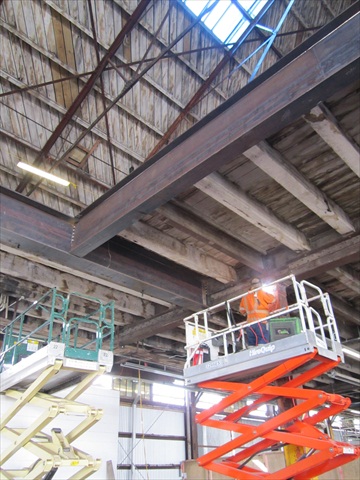
Just inside the front door, an opening has been made into the second floor. This opening will provide for a lift and staircase enabling easy access between the floors. You can see here up to the ceiling of the second floor - made from kauri timber sarking and iron. Huge iron girders form the structure....
Another view from ground floor looking up into the second level - which will be used to embark and disembark passengers from cruise ships on a part-time basis. It is designed for multi-purpose events also.
You can see some of the structural detailing here. New steel work has been incorporated and integrated with the old...
New tools are used alongside the old...
Pieces of old steel girder are being retained for future interpretation and exhibits that help tell the story of the building's history...
This hole cut through the ferro-concrete wharf below provides a reminder and perspective of the fact that this building is in fact on a wharf, and is in fact above the sea...
These chunks of timber are sections cut from existing flooring - where new openings have been created. The cross-sections looked like new timber.... I was told the timber was Matai. With the main wooden beams being of kauri (see later).
This opening is at the opposite end of Shed 10.
Again you can see the new sections of steel that have been introduced supporting the old massive beams of Kauri, into which the Matai flooring timbers are nailed....
Where-ever possible existing network infrastructure has been used, but new services have been laid where necessary - the aim being to be in keeping with existing
This opening also provides interesting visual viewpoints within the building...
Shed 10's potential as an exhibition and event space, a place for encounters and public exchange, is starting to unfold and be revealed...
John Smith explains a detail to me - trying to keep his eyes off the gumboots I hastily donned from the workroom because I turned up in "open-toed shoes" (sandals). Not allowed on the site visit. Quite right. I was still a bit in holiday mode...
The various window openings that are starting to be installed - consistent with the original design - are bringing new light inside and add to the visual interest...
And here John Smith and Stephen Rainbow give an idea of the sheer scale of the main kauri beams used in Shed 10. These massive sections have been cut from the openings between the two floors...
Bits and pieces of new and old steel are dotted around the floor...
This picture is included so you can see how well my choice of shirt matched with the Hi Vis vest
Having walked through Shed 10 from the Queens Street end we walked outside to climb up a set of steps in the scaffolding to inspect level two....
Here we are on level two - the scale is vast - now that the temporary structures that had been in there have been removed...
The matai floor is a huge feature....
It was explained that every effort is being made to retain the original look, texture and feel of the flooring....
... and the openings to the Port provide wonderful views toward the Harbour entrance, and of the Port itself.
The plan is to retain the original floor markings...
...and cast iron sections - like this hinge...
Level two will also include infrastructure in these openings that will allow passengers on and off ships when they dock at Queens Wharf.
We walked back down to the Queen Street end of Shed 10, along Level 2, and came back to the opening that will contain the stairwell and lifts....
You can look down from this gallery point of view to the main entrance door, but you can also see another opening in the wall directly across. This is like a huge bay window that looks up Queen Street and across the ferry terminal to the ferry building and beyond. A favorite haunt I am sure in future...
This box appeared to hold all the old nails that had been used to hold the floor timbers in place.
Everything seems to have been saved for a future project where the story of Shed 10, Queens Wharf, and the whole of Auckland's waterfront gets told and interpreted.
Some sort of integrated heritage trail is called for from Marsden Wharf (where Rainbow Warrior was blown up by the French), along Quay Street, including Queens Wharf, the Viaduct, Maritime Museum, Voyager, Te Whero, across the walking bridge to North Wharf, Silo Park, Heritage Landing (with examples of heritage fleet), Vos and Bris Building and slipway....
There are some delightful reminders and remainders of times past on Shed 10...
Skilled workers carefully manhandle sections of old timber, as original window openings are revealed...
There's nothing quite like a good corrugated iron shed. An authentic piece of kiwiana....
Monday, January 21, 2013
Auckland Bikelanes - Shakey, Fading Future
There's nothing like a good clear bike lane when you're out cycling. Strong white lines. Good strong signage. No doubt where you stand, or where you cycle...
But sometimes the message is less clear.You feel maybe you're on shakey ground. The rules have changed a bit but no-one's quite sure how or why... Looks like the only thing that's really changed is the sign-writer's stencil...
Here's another way of solving that particular sign-writing problem. Why use one when two will do?
... might be better to keep them a bit further apart...
...these pictures were taken in Lake Road Devonport, and round the corner into Ngataringa Road...
... what does our street signage say about us? About our priorities...
These white lines were painted just before Christmas. But the cycle signs have been left to fade. Hope that's not a sign of a change in cycle policy...
Wednesday, December 19, 2012
Barrister: "Kaipara Rates Invalid"
Media Release - December 2012
Mangawhai Residents and Ratepayers Association
Barrister’s Legal Opinion: “Kaipara Rates Resolutions Invalid”
A legal opinion prepared for ratepayers group Mangawhai Residents and Ratepayers Association (MRRA) by Quay Chambers Barrister Kitt Littlejohn identifies several breaches of the Local Government Act (LGA) by Kaipara District Council (KDC).
The legal opinion raises important questions about the lawfulness of processes and decisions made by Council when setting the KDC Long Term Plan and Rates for 2012-2013. A key issue is that KDC made significant changes to the draft Long Term Plan (LTP) and did not consult the community – as it is required to – about major changes.
The legal opinion states:
64. ……Kaipara District Council adopted a completely different (and previously un-signalled) financial strategy to deal with its significant debt levels at the 11th hour in an attempt to quell widespread criticism of the lack of information, poor financial management and scale of proposed rates increase, and in doing so, increased the total cost of the debt to the district and its ratepayers for much longer.
“This opinion adds to our understanding of what the law says about how our Council has behaved and makes us more determined to fix it,” says Bruce Rogan, Chair of MRRA, which is leading a Kaipara District campaign to address issues arising from the controversial Mangawhai EcoCare Sewage scheme.
The legal opinion explains:
53. ….I am satisfied that there are significant provisions in the adopted LTP that go beyond the scope of the draft LTP and were not reasonably or fairly raised by any submission on the LTP. In my opinion, the KDC had no power to adopt these revised provisions without first proceeding through the special consultative procedure. Its decision to adopt the LTP without following that procedure is therefore in breach of the LGA. If that decision is invalid then the LTP is defective and the rates resolutions made in reliance on that document are invalid.
“This opinion vindicates ratepayer strike action”, says Bruce Rogan.
Two weeks ago Kaipara ratepayers received a letter with their rates demand from John Robertson, Chair of the government appointed commissioners. This letter states: “The rates were set before we took over. We had no influence over the 2012/2013 rates but we are absolutely clear that the rates must be paid.”
The letter from Robertson also states, “73% of Kaipara ratepayers have paid their rates in full and on time. A further 19% have made part-payments… 8.5% have not paid anything.”
More than one thousand ratepayers have joined the rates strike.
Rogan responds, “It is totally unfair that commissioners are putting pressure on ratepayers like this at Christmas. They say they had no say over the rates but send threatening letters without justifying the legality of those rate demands.”
The legal opinion goes on:
77. Ultimately, it is not for the ratepayers to prove that they are entitled to with-hold payment; it is for the KDC to establish that the rates are valid and were validly set.
Rogan says, “we believe commissioners owe it to themselves and to the community to prove the rates bills are legal. So far all we get is silence on that front. We don’t want to spend any more money than is necessary, but we are not sitting on our hands. We may be forced to take this matter to the High Court.”
The legal opinion states:
59. To advance and “prove” the complaints against the KDC’s compliance with the LGA, the appropriate course of action is to apply for judicial review under the Judicature Amendment Act 1971 of the KDC’s decisions to notify the LTP prior to adopting an annual report, to adopt the LTP out of time and in breach of its decision making powers, and to set the 2012/2013 rates for the district on the basis of that LTP.
PS: Since this opinion was obtained, MRRA has obtained via the OIA various documents from Kaipara District Council which indicate that KDC has spent some $36,000 with law firm Simpson Grierson on advice relating to the rates. The documents reveal the close involvement of Dept of Internal Affairs officials at key advisory meetings attended by Commissioners, KDC's CEO, and Simpson Grierson lawyers.
The Government is keeping very close tabs on what is happening at Mangawhai. Unsurprising really. The Long Term Plan for 2012-2013 might have been signed off by the departing Councillors, but it has all the hallmarks of being designed in Wellington by Government officials.
Auditor General on Auckland Council
In December this year, the Office of the Auditor General released a report about Auckland Council, Transition and various related issues including Council Controlled Organisations. I have cut and pasted sections here which give a flavour. I have not included material from the report relating to: Regional leadership; Two tier structure; or Maori participation.
Of particular interest is the attention placed toward the end of OAG's report on CCO governance. I have high-lighted in bold sections which concentrate on this. The OAG's advice to Council - which you can see in context below is that: "....If a CCO is not meeting the Council’s expectations, the Council should remove the board, replacing it with members who the Council has more confidence in to act on its expectations...."
Look here for the full report, and chapter by chapter sections.
Transition
The Auckland local government reforms are one of the most significant public reforms of the last 30 years. The reforms were carried out in just 18 months. We asked the (50) people we spoke to what they thought could be learned from such a major transition.
In July 2012, Auckland moved up four places to be ranked as the ninth most liveable city in the world on Monocle Magazine’s annual quality of life top 25 cities index. Monocle Magazine attributed the lift, among other things, to Auckland’s new governance structure. In 2009, the Royal Commission on Auckland Governance noted that Auckland ranked fifth on the Mercer Worldwide Quality of Living Survey. In 2011, Auckland had moved to third place.
The ATA described the new planning system for Auckland as “the cornerstone of the Auckland reforms”. It foresaw that achieving one spatial plan, LTP, and unitary resource management plan would be challenging for the planning and policy activities and elected bodies of the Council. However, it also saw that there would be efficiencies for the region’s citizens, businesses, and organisations in having one set of consistent rules and policies, rather than the eight sets of different plans and policies, numbering in the hundreds, that existed before the amalgamation.
The Royal Commission identified two broad, systemic problems with Auckland’s former local government arrangements – weak and fragmented regional governance and poor community engagement. It cited disputes between councils over urban growth and the development and sharing of important infrastructure, inconsistent standards and plans, and limited sharing of services between councils. The Commission considered that this resulted in delayed (and sometimes suboptimal) decisions for the region, poorer services at a higher cost than necessary, and prolonged formal and duplicative consultation instead of true connection with their communities.
As we were writing this report, Parliament was debating the role of local authorities in the economic, social, environmental, and cultural well-being of their communities. Many people we spoke to observed that the expectation of local government to contribute to community well-being had been fundamental to the Auckland reforms.
We have observed the support for the Auckland Plan during our audits. This support is an early indication of the significant and promising differences that new governance arrangements could achieve. However, we were told that regional integration is creating “winners and losers” as it begins to affect communities and households – for example, the current rating changes and consolidation of contracts for services.
Rating System
The Council has completely overhauled the rating systems used by the former councils to provide a stable and predictable basis for rating throughout the region. The main platform of the new rating system is a capital value-based general rate, with eight property type-based differentials ranging from 0.25 to 2.63 for each dollar of capital value, and a uniform annual general charge ($350 for each separately used or inhabited part of a property). The Council has taken a taxation approach to rating rather than attempting to set rates to reflect the benefits received from services in each area.
The new system has meant significant shifts in the rates paid by households. These shifts are influenced by changes in the valuation of properties and by the extent to which the new system differs from that used by the former councils. The rates some ratepayers pay have reduced, while those of others have increased.
Budget and Debt
The Council currently funds just under 65% of its depreciation expenses. It will build to fully funding its depreciation expense during the term of the LTP. Debt is drawn down only when costs are committed, and forecast capital expenditure is deferred until it is actually required. Although the Council’s focus on managing operating costs will generate further savings, the Council’s longer-term growth and development needs see the Council’s group debt rise from $4.03 billion at 30 June 2011 to the $12.7 billion in 2021/22 forecast in its LTP. About half the projected debt relates to transport activities; a quarter to water, wastewater, and storm-water activities; and a quarter to other core Council activities.
This debt forecast is based on projected rates increases of 4.9% for each year of the LTP. A 3.6% increase was passed by the governing body for 2012/13, the first year of the LTP, Recently, in proposing the Council budget for 2013/14, the Mayor has indicated a rates increase of 2.9%. In the longer term, debt looks likely to increase and to become a more significant factor in the Council’s financial management. Debt is increasing during the long term as the Council invests in infrastructure but, as discussed in more depth in our report on matters arising from the 2012-22 LTPs, the forecast debt remains well within the policies’ limits of the Council and appears prudent.
Management Systems
We were told that the quality of management and monitoring information given to the Council’s Senior Leadership Team has been poor, although it is improving. We also heard that information system and management issues are affecting those in governance roles. Elected members expressed concern that they did not know when or by whom the work to integrate the Council’s systems was being carried out.
The immediate transition to a unitary Council has passed. The stability of day-to-day services has been ensured, and the main strategy and planning documents have been prepared. The Council is starting to optimise the value that can be gained from the initial change process. Many people we spoke to considered that it will take two to three electoral periods to settle the changes, to consolidate and standardise service systems and processes, to unravel and resolve issues, and to learn how to better understand and manage inherent tensions.
The Chief Executive and the Executive Leadership are now leading a process of organisational transformation to improve the Council’s capability to deliver the Auckland Plan and value for money. However, significant challenges remain. As one of the largest organisations in the country, the Council will wrestle with its size to communicate effectively between its governance tiers, departments, and CCOs, and to be responsive and agile. Significant work remains to:
• understand the different policies and regulations currently in force;
• understand the levels of service and the performance of each area against these levels, and determine future service levels that are seen as fair and equitable; and
• develop systems to address the Council’s internal and external service performance needs.
Regional leadership, Two tier structure, Maori participation...
Delivering services through CCOs
A substantive CCO is unique to Auckland and is established under the Local Government (Tamaki Makaurau) Reorganisation Act 2009 or the Local Government (Auckland Council) Act 2009. A substantive CCO is a CCO that is responsible for delivering a significant service or activity on behalf of the Council, or that owns or manages assets with a value of more than $10 million.
The Auckland Council is operating under a new model where substantive CCOs deliver services and activities that are funded by more than 35% of the Council’s total rates. These CCOs also manage $25 billion of assets owned for the benefit of the public, which makes up 70% of the Council’s consolidated total assets. The Council’s CCOs provide many of the services that usually form the core activities of local authorities in New Zealand. These services include roading and public transport, water and waste water, and economic development activities.
The ATA saw CCOs as a way of ensuring efficient management of operations, allowing the Council to focus on developing policies, strategies, and plans to drive Auckland forward.
The expectations of the Council are set out in the CCO accountability policy, the Mayor’s annual letter of expectations, and the Guide for Council-Controlled Organisations.
The CCO accountability policy outlines the Council’s expectations of its substantive CCOs. The policy, which is required by legislation, identifies CCOs as partners in the delivery of the Council’s objectives and priorities, with a key role to play in the Council’s vision for Auckland. The Council expects each CCO to align its activities with those of the Council and to act consistently with its vision and with the objectives set for it by legislation.
The Mayor’s annual letter of expectations is intended to guide the CCOs’ strategic direction and help them prepare their SOIs. The letter of expectations sets out the parts of the draft Auckland Plan that each CCO is expected to contribute to, priorities in the draft LTP that each CCO is required to give effect to, and local community priorities and preferences identified in local board plans that each CCO is to consider addressing when preparing its SOI.
Records of discussions between the governing body and CCO board members conclude that there is enough formal performance monitoring between the Council and CCOs. More interaction was sought between CCO board members and councillors to foster a culture of co-operation and trust that is oriented towards the future, and that enables CCO governors and staff to understand the effect of CCOs’ business decisions for the Council.
For their part, Council staff told us that monitoring performance measures and targets is easy – after the fact. Their greater difficulty was with integrating and aligning planning and future initiatives. CCO boards were sometimes viewed as a barrier to the Council’s strategy and planning, by not refining their leadership of the CCO for the new arrangements and changing circumstances.
The Council appeared to be taking other steps to secure this alignment and integration, in addition to the Shareholder Expectations Guide. In particular, we were told that the Council is currently amending CCO constitutions so that the Chief Executive of the Council can be appointed as a member to any board.
We also heard that Council staff had found it difficult to get information from CCOs in the templates or time frames required for preparation of the LTP. There have not been similar issues for those CCOs that receive financial services from the Council. The CCOs that were perceived to be unhelpful in providing information said they were surprised and dismayed when Council staff raised these issues. The issues were attributed to miscommunication and misunderstanding of the overall financial model the Council was constructing, leading to information being supplied in a different way to that sought.
We were told that the CCOs are very responsive to the needs of the Mayor and governing body. However, they are seen as less responsive to Council staff. For example, we were told that CCOs could be slow to provide information on the grounds that it needs to be discussed by the CCO board first. Council staff were concerned that, as a result, governing body and local board members were frequently surprised by late information about matters such as project and budget changes.
Strong and Appropriate Governance - Important
In a letter to the Chief Executives of the Council and Watercare Services in August 2011, the Auditor-General noted that it is important that the Council has strong and appropriate governance arrangements for its CCOs. She noted, in particular, that the substantive CCOs are central to the well-being of Auckland and that the Council is politically responsible for their activities. She advised that she expected a framework for governance and accountability that:
• reflects the importance of CCOs to Auckland and to the Council;
• enables governing body members to pursue their political interest in CCOs’ business openly and transparently;
• offers opportunity for genuine engagement between the Council and the CCOs, at appropriate intervals and at the appropriate level of seniority, on the Council’s strategy and priorities and on the CCOs’ business performance and risks;
• enables adequate consideration of CCOs’ draft SOI and draft asset management and funding plans;
• complies with the relevant legislation; and
• does not impose a "compliance burden”.
The letter identified two main risks for the Council from its current effort to develop more formal governance reporting and monitoring frameworks:
• that a CCO’s independence from the Council is threatened or circumscribed in some way, in particular, if there were general ratepayer dissatisfaction with a CCO’s performance on any matter that gave rise to heightened political concern; and
• the creation of a "compliance burden".
The Council and CCO governance relationships are evolving. However, we noted a tendency by people we spoke with to focus on formal processes and mechanisms for consultation and monitoring between the Council and CCO staff. We were surprised at how infrequently the extent, nature, and quality of engagement with CCO board members was discussed.
We are not confident that the Council will be able to move to a more futureoriented and trust-based culture through the use of more formal processes and mechanisms. Ultimately, the mechanism for accountability of a CCO to its owner is through the board. If a CCO is not meeting the Council’s expectations, the Council should remove the board, replacing it with members who the Council has more confidence in to act on its expectations.
We consider that the Council could improve the feedback from the governing body on the CCOs’ SOIs. In our view, the feedback should prioritise the input on the CCO’s SOI from other parts of the Council to give CCO boards clear expectations about the Council’s preferences and priorities.
A Council Chief Executive who is also appointed as a CCO board member is likely to face conflicts between their duty to act in the best interest of the Council and to act in the best interests of the CCO as a director.
All CCOs – in particular, those that have a critical part to play in the public’s trust in the Council and the achievement of the Council’s consolidated LTP and the Auckland Plan – need to understand and demonstrate their commitment to playing their part.
A CCO board must endeavour to give the Council confidence that it understands the Council’s expectations.
Of particular interest is the attention placed toward the end of OAG's report on CCO governance. I have high-lighted in bold sections which concentrate on this. The OAG's advice to Council - which you can see in context below is that: "....If a CCO is not meeting the Council’s expectations, the Council should remove the board, replacing it with members who the Council has more confidence in to act on its expectations...."
Look here for the full report, and chapter by chapter sections.
Auckland Council: Transition and emerging challenges
Prepared by: Office of Auditor General, December 2012
Transition
The Auckland local government reforms are one of the most significant public reforms of the last 30 years. The reforms were carried out in just 18 months. We asked the (50) people we spoke to what they thought could be learned from such a major transition.
In July 2012, Auckland moved up four places to be ranked as the ninth most liveable city in the world on Monocle Magazine’s annual quality of life top 25 cities index. Monocle Magazine attributed the lift, among other things, to Auckland’s new governance structure. In 2009, the Royal Commission on Auckland Governance noted that Auckland ranked fifth on the Mercer Worldwide Quality of Living Survey. In 2011, Auckland had moved to third place.
The ATA described the new planning system for Auckland as “the cornerstone of the Auckland reforms”. It foresaw that achieving one spatial plan, LTP, and unitary resource management plan would be challenging for the planning and policy activities and elected bodies of the Council. However, it also saw that there would be efficiencies for the region’s citizens, businesses, and organisations in having one set of consistent rules and policies, rather than the eight sets of different plans and policies, numbering in the hundreds, that existed before the amalgamation.
The Royal Commission identified two broad, systemic problems with Auckland’s former local government arrangements – weak and fragmented regional governance and poor community engagement. It cited disputes between councils over urban growth and the development and sharing of important infrastructure, inconsistent standards and plans, and limited sharing of services between councils. The Commission considered that this resulted in delayed (and sometimes suboptimal) decisions for the region, poorer services at a higher cost than necessary, and prolonged formal and duplicative consultation instead of true connection with their communities.
As we were writing this report, Parliament was debating the role of local authorities in the economic, social, environmental, and cultural well-being of their communities. Many people we spoke to observed that the expectation of local government to contribute to community well-being had been fundamental to the Auckland reforms.
We have observed the support for the Auckland Plan during our audits. This support is an early indication of the significant and promising differences that new governance arrangements could achieve. However, we were told that regional integration is creating “winners and losers” as it begins to affect communities and households – for example, the current rating changes and consolidation of contracts for services.
Rating System
The Council has completely overhauled the rating systems used by the former councils to provide a stable and predictable basis for rating throughout the region. The main platform of the new rating system is a capital value-based general rate, with eight property type-based differentials ranging from 0.25 to 2.63 for each dollar of capital value, and a uniform annual general charge ($350 for each separately used or inhabited part of a property). The Council has taken a taxation approach to rating rather than attempting to set rates to reflect the benefits received from services in each area.
The new system has meant significant shifts in the rates paid by households. These shifts are influenced by changes in the valuation of properties and by the extent to which the new system differs from that used by the former councils. The rates some ratepayers pay have reduced, while those of others have increased.
Budget and Debt
The Council currently funds just under 65% of its depreciation expenses. It will build to fully funding its depreciation expense during the term of the LTP. Debt is drawn down only when costs are committed, and forecast capital expenditure is deferred until it is actually required. Although the Council’s focus on managing operating costs will generate further savings, the Council’s longer-term growth and development needs see the Council’s group debt rise from $4.03 billion at 30 June 2011 to the $12.7 billion in 2021/22 forecast in its LTP. About half the projected debt relates to transport activities; a quarter to water, wastewater, and storm-water activities; and a quarter to other core Council activities.
This debt forecast is based on projected rates increases of 4.9% for each year of the LTP. A 3.6% increase was passed by the governing body for 2012/13, the first year of the LTP, Recently, in proposing the Council budget for 2013/14, the Mayor has indicated a rates increase of 2.9%. In the longer term, debt looks likely to increase and to become a more significant factor in the Council’s financial management. Debt is increasing during the long term as the Council invests in infrastructure but, as discussed in more depth in our report on matters arising from the 2012-22 LTPs, the forecast debt remains well within the policies’ limits of the Council and appears prudent.
Management Systems
We were told that the quality of management and monitoring information given to the Council’s Senior Leadership Team has been poor, although it is improving. We also heard that information system and management issues are affecting those in governance roles. Elected members expressed concern that they did not know when or by whom the work to integrate the Council’s systems was being carried out.
The immediate transition to a unitary Council has passed. The stability of day-to-day services has been ensured, and the main strategy and planning documents have been prepared. The Council is starting to optimise the value that can be gained from the initial change process. Many people we spoke to considered that it will take two to three electoral periods to settle the changes, to consolidate and standardise service systems and processes, to unravel and resolve issues, and to learn how to better understand and manage inherent tensions.
The Chief Executive and the Executive Leadership are now leading a process of organisational transformation to improve the Council’s capability to deliver the Auckland Plan and value for money. However, significant challenges remain. As one of the largest organisations in the country, the Council will wrestle with its size to communicate effectively between its governance tiers, departments, and CCOs, and to be responsive and agile. Significant work remains to:
• understand the different policies and regulations currently in force;
• understand the levels of service and the performance of each area against these levels, and determine future service levels that are seen as fair and equitable; and
• develop systems to address the Council’s internal and external service performance needs.
Regional leadership, Two tier structure, Maori participation...
Delivering services through CCOs
A substantive CCO is unique to Auckland and is established under the Local Government (Tamaki Makaurau) Reorganisation Act 2009 or the Local Government (Auckland Council) Act 2009. A substantive CCO is a CCO that is responsible for delivering a significant service or activity on behalf of the Council, or that owns or manages assets with a value of more than $10 million.
The Auckland Council is operating under a new model where substantive CCOs deliver services and activities that are funded by more than 35% of the Council’s total rates. These CCOs also manage $25 billion of assets owned for the benefit of the public, which makes up 70% of the Council’s consolidated total assets. The Council’s CCOs provide many of the services that usually form the core activities of local authorities in New Zealand. These services include roading and public transport, water and waste water, and economic development activities.
The ATA saw CCOs as a way of ensuring efficient management of operations, allowing the Council to focus on developing policies, strategies, and plans to drive Auckland forward.
The expectations of the Council are set out in the CCO accountability policy, the Mayor’s annual letter of expectations, and the Guide for Council-Controlled Organisations.
The CCO accountability policy outlines the Council’s expectations of its substantive CCOs. The policy, which is required by legislation, identifies CCOs as partners in the delivery of the Council’s objectives and priorities, with a key role to play in the Council’s vision for Auckland. The Council expects each CCO to align its activities with those of the Council and to act consistently with its vision and with the objectives set for it by legislation.
The Mayor’s annual letter of expectations is intended to guide the CCOs’ strategic direction and help them prepare their SOIs. The letter of expectations sets out the parts of the draft Auckland Plan that each CCO is expected to contribute to, priorities in the draft LTP that each CCO is required to give effect to, and local community priorities and preferences identified in local board plans that each CCO is to consider addressing when preparing its SOI.
Records of discussions between the governing body and CCO board members conclude that there is enough formal performance monitoring between the Council and CCOs. More interaction was sought between CCO board members and councillors to foster a culture of co-operation and trust that is oriented towards the future, and that enables CCO governors and staff to understand the effect of CCOs’ business decisions for the Council.
For their part, Council staff told us that monitoring performance measures and targets is easy – after the fact. Their greater difficulty was with integrating and aligning planning and future initiatives. CCO boards were sometimes viewed as a barrier to the Council’s strategy and planning, by not refining their leadership of the CCO for the new arrangements and changing circumstances.
The Council appeared to be taking other steps to secure this alignment and integration, in addition to the Shareholder Expectations Guide. In particular, we were told that the Council is currently amending CCO constitutions so that the Chief Executive of the Council can be appointed as a member to any board.
We also heard that Council staff had found it difficult to get information from CCOs in the templates or time frames required for preparation of the LTP. There have not been similar issues for those CCOs that receive financial services from the Council. The CCOs that were perceived to be unhelpful in providing information said they were surprised and dismayed when Council staff raised these issues. The issues were attributed to miscommunication and misunderstanding of the overall financial model the Council was constructing, leading to information being supplied in a different way to that sought.
We were told that the CCOs are very responsive to the needs of the Mayor and governing body. However, they are seen as less responsive to Council staff. For example, we were told that CCOs could be slow to provide information on the grounds that it needs to be discussed by the CCO board first. Council staff were concerned that, as a result, governing body and local board members were frequently surprised by late information about matters such as project and budget changes.
Strong and Appropriate Governance - Important
In a letter to the Chief Executives of the Council and Watercare Services in August 2011, the Auditor-General noted that it is important that the Council has strong and appropriate governance arrangements for its CCOs. She noted, in particular, that the substantive CCOs are central to the well-being of Auckland and that the Council is politically responsible for their activities. She advised that she expected a framework for governance and accountability that:
• reflects the importance of CCOs to Auckland and to the Council;
• enables governing body members to pursue their political interest in CCOs’ business openly and transparently;
• offers opportunity for genuine engagement between the Council and the CCOs, at appropriate intervals and at the appropriate level of seniority, on the Council’s strategy and priorities and on the CCOs’ business performance and risks;
• enables adequate consideration of CCOs’ draft SOI and draft asset management and funding plans;
• complies with the relevant legislation; and
• does not impose a "compliance burden”.
The letter identified two main risks for the Council from its current effort to develop more formal governance reporting and monitoring frameworks:
• that a CCO’s independence from the Council is threatened or circumscribed in some way, in particular, if there were general ratepayer dissatisfaction with a CCO’s performance on any matter that gave rise to heightened political concern; and
• the creation of a "compliance burden".
The Council and CCO governance relationships are evolving. However, we noted a tendency by people we spoke with to focus on formal processes and mechanisms for consultation and monitoring between the Council and CCO staff. We were surprised at how infrequently the extent, nature, and quality of engagement with CCO board members was discussed.
We are not confident that the Council will be able to move to a more futureoriented and trust-based culture through the use of more formal processes and mechanisms. Ultimately, the mechanism for accountability of a CCO to its owner is through the board. If a CCO is not meeting the Council’s expectations, the Council should remove the board, replacing it with members who the Council has more confidence in to act on its expectations.
We consider that the Council could improve the feedback from the governing body on the CCOs’ SOIs. In our view, the feedback should prioritise the input on the CCO’s SOI from other parts of the Council to give CCO boards clear expectations about the Council’s preferences and priorities.
A Council Chief Executive who is also appointed as a CCO board member is likely to face conflicts between their duty to act in the best interest of the Council and to act in the best interests of the CCO as a director.
All CCOs – in particular, those that have a critical part to play in the public’s trust in the Council and the achievement of the Council’s consolidated LTP and the Auckland Plan – need to understand and demonstrate their commitment to playing their part.
A CCO board must endeavour to give the Council confidence that it understands the Council’s expectations.
Ports of Auckland and PWC Report
On the 27th November this year, PricewaterhouseCoopers provided Auckland Council (and other bodies involved in the Upper North Island Strategic Alliance - UNISA) with its report entitled: "Upper North Island port and port-related infrastructure supply and demand study".
Some water has passed under the bridge since the Auckland Council first considered the report at a meeting of its Regional Development and Operations Ctte on the 6th of December which I attended along with a number of others - including Alex Swney and Greg McKeown who made representations on behalf of Heart of the City. You can see the agenda item here.
You can also download the actual PWC report in chunks of about 8 meg apiece - parts 1, 2 and 3.
I hadn't read the PWC report before attending, but have since thoroughly digested its analysis of where we are today, and its Exec Summary of how to plan for next 30 years.
This posting contains my reflections under these headings: what the PWC report recommends in a nutshell; quoted extracts from the PWC report; what the mayor and councillors said at their meeting.....
What the PWC report recommends in a nutshell
This is the crucial finding in my opinion:PWC expect any requirements for future infrastructure development at Ports of Auckland to be "smaller in scale than the preferred reclamation options in the 2008 Port Development Plan."
So. This piece of advice calls for the Ports of Auckland expansion plans that caused such an uproar earlier this year to be shelved. It goes on to suggest ways and means whereby increases in demand can be met by incremental changes over the 30 year planning period, including increased efficiencies in the use of existing reclaimed land, and "the uptake of consented berth developments, reclamations, and channel and berth deepening...". (As I write down that quote I wonder whether the adjective "consented" applies to all of the nouns that follow it, or just the first....)
Extracts from the PWC report
These extracts from the PWC report provide an independent view of the state of Ports of Auckland vs Ports of Tauranga, and more importantly explain supply chain logistics and what motivates exporters or importers to chose POT over POA - even when they might be based in South Auckland. It also explains well the role of inland ports (like Wiri and Metroport).
What the mayor and councillors said
I won't report much of this here. A few Councillors had given the PWC report more than a skim. Council Economic Development staff - who wrote the accompanying report - tried to rescue something positive from the PWC report that supported their determination to hang on to the old POA reclamation plans. Come hell or high water. But it is hard to avoid PWC's statement that whatever happened at POA it should be: "smaller in scale than the preferred reclamation options in the 2008 Port Development Plan."
Interestingly, Mayor Len Brown fronted the debate. As usual he was feisty and in campaign mode. I took a few notes and bullit point them here:
When I reflected on what the Mayor said, actually said, I couldn't think of a single fact or idea that was in the PWC report. After the PWC people summarised their report - under watchful eye of Council officers - there was a good question and answer session. Cllrs Coney and Lee - being ex-ARC - had a strong grounding already, and their questions and comments reflected that. Cllr George Wood was the most impressive of the rest. He had actually read the report and asked probing questions about Wiri - why was it so under-utilised.
However the guts of the discussion was what to do for/about the port reclamation plans in the Unitary Plan. The focus was the Unitary Plan. Not the Port.
Cllr Hulse asked, "what are you suggesting goes into the Unitary Plan?"
Officer Harvey Brookes replied, "we haven't done the work. Up to now its been handled as "discretionary" activity. A resource consent is all that's required. Could be almost prohibited. Or could be permissable...."
The upshot appeared to be not to make any decision at this meeting about that.
Leave it under review. Leave it for another day....
Some water has passed under the bridge since the Auckland Council first considered the report at a meeting of its Regional Development and Operations Ctte on the 6th of December which I attended along with a number of others - including Alex Swney and Greg McKeown who made representations on behalf of Heart of the City. You can see the agenda item here.
You can also download the actual PWC report in chunks of about 8 meg apiece - parts 1, 2 and 3.
I hadn't read the PWC report before attending, but have since thoroughly digested its analysis of where we are today, and its Exec Summary of how to plan for next 30 years.
This posting contains my reflections under these headings: what the PWC report recommends in a nutshell; quoted extracts from the PWC report; what the mayor and councillors said at their meeting.....
What the PWC report recommends in a nutshell
This is the crucial finding in my opinion:PWC expect any requirements for future infrastructure development at Ports of Auckland to be "smaller in scale than the preferred reclamation options in the 2008 Port Development Plan."
So. This piece of advice calls for the Ports of Auckland expansion plans that caused such an uproar earlier this year to be shelved. It goes on to suggest ways and means whereby increases in demand can be met by incremental changes over the 30 year planning period, including increased efficiencies in the use of existing reclaimed land, and "the uptake of consented berth developments, reclamations, and channel and berth deepening...". (As I write down that quote I wonder whether the adjective "consented" applies to all of the nouns that follow it, or just the first....)
Extracts from the PWC report
These extracts from the PWC report provide an independent view of the state of Ports of Auckland vs Ports of Tauranga, and more importantly explain supply chain logistics and what motivates exporters or importers to chose POT over POA - even when they might be based in South Auckland. It also explains well the role of inland ports (like Wiri and Metroport).
Pg 44: Central government and councils have set strategies for driving economic development through export growth (see eg the Government's Business Griwth Agenda and the Auckland Plan). The analysis in this report does not reflect upon these policy objectives for four reasons:
1. our analysis is based on weight not value
2. we exclude all exports through airports, which accounted for 17% of export value in 2012
3. we consider merchandise trade only and exclude service exports, which accounted for 21% of exports in 2011 according to World Bank statistics
4. we expect the relationship between trade weights and trade values to change over time, as trade in high-value/low weight products is likely to grow.
Pg 72: New Zealand ports, including the UNI ports, are not at the forefront of technology or efficiency.... this suggests that the UNI ports have scope to manage demand growth by increasing efficiency rather than increasing in size or undertaking expensive infrastructure upgrades... There are a number of areas where significant investments can be made. They include upgrading harbours and berths to accommodate larger ships, deploying automated container stacking... and developing inland ports to allow cargo to be consolidated and cleared through customs at a cheaper location....
Pg 72: Ports of Tauranga performs better on most measures of port efficiency and productivity than Ports of Auckland. For example its crane rates are comparable with all but the most efficient international ports, while Ports of Auckland's performance is significantly lower...
Pg 72: Another common, more comparable measure of container port efficiency is the crane rate, or number of containers moved per crane per hour... this indicates that POT is the only New Zealand port in the upper tier of efficiency, while POA is below the NZ average...
Pg 74: Ports of Tauranga remains New Zealand's best performing port on most measures.
Pg 75: In many cases, it is cheaper to move freight between Auckland and Southeast Asia than it is to move it between locations within New Zealand...
Pg 76: These calculations suggest that for many imports and exports, a large share of total supply chain costs are incurred within New Zealand rather than for sea freight...
Pg 77: ...because domestic freight costs are large relative to sea freight costs, changes to the NZ port sector that require increased domestic cargo movements may have a large impact on importers and exporters from more distant region.... transport costs from Whangerei to Auckland and other UIN locations are likely to make it uneconomic to develop Northport to handle containerised cargo unless significant investments were made in land transport infrastructure and inland ports.... one important caveat to this analysis is that consolidating freight volumes on rail may increase cost-effectiveness of moving freight domestically. Rail provides increasing returns to scale for large volumes of freight. For example (an expert) estimated that two-way container traffic of 35,000 TEUs per year would reduce per -container rail costs by almost 70% relative to the prices for a single container. Consequently, inland ports or other means of consolidating freight from high volume shippers may reduce the costs to distance significantly. This is apparent in the case of Metroport, which,.... has enabled Ports of Tauranga to compete for freight in the Auckland region.
Pg 79: ...inland ports can lower costs for importers and exporters by exploiting the cost efficiencies available when moving large volumes of containers by rail. The basic idea is to allow importers and exporters to avoid the costs of road freight (and, in particular, congestion in Auckland's road network) by consolidating freight at a closer location and moving it by rail to a port.... Ports of Tauranga developed Metroport in order to enable it to compete for a share of Auckland's international trade. As a result, POT has become a viable substitute for POA for many categories of cargo.... the development of Metroport in Auckland has made it easier for South Auckland manufacturers to export through Tauranga...
Pg 80: Metroport's annual throughput increased from 32,000 TEUs in its first year of operation to 138,000 TEUs in the year ending June 2011. This represents 55% capacity utilisation. 23% of POT's container throughput is currently routed through Metroport.... Wiri Inland Port is located 25 kms from POA, reportedly within a 10 km radius of the origin or destination of 70% of POA's container trade.... In the year ended 2010, Wiri handled 30,000 TEU, or 20% of its capacity. Only 3% of POA's total container throughput was routed through Wiri....
Pg 81: Inland ports... do have some public policy implications for land use and infrastructure planning. If inland ports provide a commercially viable proposition to shippers - ie they reduce supply chain costs by consolidating sufficient volumes of freight and moving it to and from a seaport by rail - they may have an impact on land uses in the surrounding area. For example, they may strengthen incentives for production or distribution facilities to locate close to the inland port.
What the mayor and councillors said
I won't report much of this here. A few Councillors had given the PWC report more than a skim. Council Economic Development staff - who wrote the accompanying report - tried to rescue something positive from the PWC report that supported their determination to hang on to the old POA reclamation plans. Come hell or high water. But it is hard to avoid PWC's statement that whatever happened at POA it should be: "smaller in scale than the preferred reclamation options in the 2008 Port Development Plan."
Interestingly, Mayor Len Brown fronted the debate. As usual he was feisty and in campaign mode. I took a few notes and bullit point them here:
- part of national framework
- will be here forever
- about competitiveness
- desire for economic outreach to near neighbours
- UNISA is about collaboration, mutual benefit, for economic reasons
- the debate in March was largely uninformed and emotional
- I didn't take part in it. I didn't like it.
- Was media led. We need an analytical platform.
- This report is a starting point. It is practical. Some say it is not bold enough. It is a good template.
- Port is necessary. So is Ports of Tauranga. So is Northport.
- We can't move it. Needs some common sense. Was never going to be all the way to Devonport.
- Clear pathway for discussion with POAL Board.
- Better discussion with POT and Northport and Government
- As we reflect on being competitive with rest of the world.
When I reflected on what the Mayor said, actually said, I couldn't think of a single fact or idea that was in the PWC report. After the PWC people summarised their report - under watchful eye of Council officers - there was a good question and answer session. Cllrs Coney and Lee - being ex-ARC - had a strong grounding already, and their questions and comments reflected that. Cllr George Wood was the most impressive of the rest. He had actually read the report and asked probing questions about Wiri - why was it so under-utilised.
However the guts of the discussion was what to do for/about the port reclamation plans in the Unitary Plan. The focus was the Unitary Plan. Not the Port.
Cllr Hulse asked, "what are you suggesting goes into the Unitary Plan?"
Officer Harvey Brookes replied, "we haven't done the work. Up to now its been handled as "discretionary" activity. A resource consent is all that's required. Could be almost prohibited. Or could be permissable...."
The upshot appeared to be not to make any decision at this meeting about that.
Leave it under review. Leave it for another day....
Sunday, December 2, 2012
Writing a Sprawl Repair Manual for Auckland
You know the compact city rhetoric. I've been saying it for a long time too. Auckland's Regional Growth strategy has been calling for compact city development since 1998.
The criticism of the strategy has been the absence of implementation planning.
The main thrust has been pretty much this:
In the not too distant past there was also a strategy of "Infill Development". And North Shore City for a while experimented with "Minor Dwelling Units". With varying degrees of success.
Those preparing the Unitary Plan seem to be adopting a Zone Control approach as the main implementation tool. Thou shalt conform with the Zone. This is causing a variety of reactions across the region:
It hadn't occurred to me that since the USA invented the problem, they might also be the first to start thinking constructively about how to solve it.
The key difference in their approach - and something that we need to engage with - is the need to repair existing sprawling suburbs. The need to make them better. Here in Auckland we criticise them and go on about how we don't want anymore. But then we ignore the ones that already exist - apart from where they run along a growth corridor, or sit round a growth node.
The repair approach is to look closely at our different sprawling suburbs - the ones with all the problem of single zoning - and identify strategies that fit local sprawling communities. More importantly - the challenge is to come up with ways that motivate the community to make the change - rather than them feeling the change is being imposed on them by a draconian Council zone.
Here's a few extracts from the US thinking....
One response - accessory dwelling units - is rather like minor units. Goes like this:
But the different way of thinking that Auckland can learn from - skipping ahead - is to recognise the opportunity we have to redevelop sprawl. This entails looking at what needs to be repaired. It's about retrofitting suburbia. This new thinking aims to first of all illustrate how to repair the different range of suburban conditions - and aiming to create more self-contained - or complete - communities, out of what is there already. This picture is Papatoetoe. And it's repeated across Auckland. The first step is to look at the full range of opportunities that might exist for our classic sprawl as illustrated in this picture - design how to engineer and incentivise those interventions. And only then fit them into the regulatory framework.
They will need to be implemented with permitting strategies and financial incentives.
It is thinking that builds on existing built infrastructure, and service infrastructure.
You will be aware of the current Government Grant scheme, run out of EECA (Energy Efficiency and Conservation Authority), where about $1000 of government money is available if you insulate your house. A whole heap of contractors are out there to do the work.
Take that scheme and change it like this. It's a scheme for doubling (say) the residential housing capacity of a suburban street/community/neighbourhood in Auckland.
Imagine the objective is that the children that grow up in that area could buy a low cost unit there (alongside and amongst the stock of 3 bedroom detached houses). The idea also is that as you get old and want to retire to a smaller home, you can find one in the neighbourhood - whereas before you had to pack your bags and head for the nearest retirement village 20 kms away, and away from your friends and family. That idea, that vision, would be the social incentive to participate in the scheme, and to support it, embrace it - rather than fighting an ill-thought out unitary plan imposed from above.
Imagine the financial incentive is a government grant - a contribution to the redevelopment of a single section, or more likely a few adjacent properties. Auckland suburbs - many of them - contain good well built wooden homes that can be re-located or moved sideways. Space made for a medium density cluster perhaps. Or a corner shop. You get the idea. Just a few thoughts to get the grey cells working.
It's one thing to have a plan to build 100,000 houses - it's another plan figuring out how to fit a lot of those into repaired suburbs by engaging communities, getting them to buy into the plan, and doing it from the bottom up.
The criticism of the strategy has been the absence of implementation planning.
The main thrust has been pretty much this:
- stop greenfield sprawl (North and South)
- intensify around public transport corridors (Dominion Road etc)
- develop transit oriented nodes (like New Lynn)
In the not too distant past there was also a strategy of "Infill Development". And North Shore City for a while experimented with "Minor Dwelling Units". With varying degrees of success.
Those preparing the Unitary Plan seem to be adopting a Zone Control approach as the main implementation tool. Thou shalt conform with the Zone. This is causing a variety of reactions across the region:
- how will heritage be protected;
- what say will local communities have to neighbourhood change;
- which communities will be protected;
- how will development community respond;
- is it just one size fits all?
It hadn't occurred to me that since the USA invented the problem, they might also be the first to start thinking constructively about how to solve it.
The key difference in their approach - and something that we need to engage with - is the need to repair existing sprawling suburbs. The need to make them better. Here in Auckland we criticise them and go on about how we don't want anymore. But then we ignore the ones that already exist - apart from where they run along a growth corridor, or sit round a growth node.
The repair approach is to look closely at our different sprawling suburbs - the ones with all the problem of single zoning - and identify strategies that fit local sprawling communities. More importantly - the challenge is to come up with ways that motivate the community to make the change - rather than them feeling the change is being imposed on them by a draconian Council zone.
Here's a few extracts from the US thinking....
For sixty years, Americans have been living in the Age of the Burbs. The zoning ordinances that created the strictly residential neighborhoods of the Burbs also zoned residential uses out of downtown areas. Now that the Baby Boomers -- whose arrival prompted the suburban residential expansion -- are aging, their preferences and needs argue for more diverse housing options that are closer to shops and services....
Demographic shifts are noticeable on Long Island, where the proportion of young adults (aged 25 to 34) in the population declined by 15% between 2000 and 2009 at the same time that the proportion of people 55 and older increased by 22%....
The loss of young people should be a major concern because it indicates their needs are not being met locally. Yet theirs is a demographic that is critical to maintaining a healthy economy, in large part because their presence attracts employers but also because their earning power and spending patterns are crucial to supporting local businesses.....
These younger generations want and require different types of housing than their parents did. If their needs and preferences are not met locally, they migrate to other areas....
Older residents prefer smaller spaces that require less maintenance and are within walking distance of shops, services and transit connections, according to a 2004 survey by the National Association of Realtors and Smart Growth America. The survey also revealed that a majority (65%) also prefer neighborhoods that offer a mix of housing that accommodates people across all stages of life....
The national transition from a manufacturing economy to primarily a service economy has all but eliminated the conditions that caused communities to strictly segregate work areas from residential areas. Allowing a mix of commercial and residential uses has many advantages....
Cities and towns across the nation are staggering under the weight of the rising cost of providing municipal services to sprawling communities. In an effort to contain these costs, they are increasingly directing new growth to vacant spaces within their communities and places in need of redevelopment.....
Smaller lots mean that more households within an area of a given size can be served by fewer and shorter municipal water and sewage lines. Shorter lines cost less to build and maintain.... Adapting existing buildings to new uses reduces environmental impacts by requiring fewer building materials and by contributing to more compact development patterns....
One response - accessory dwelling units - is rather like minor units. Goes like this:
Many communities are increasing housing options in existing neighborhoods that are zoned for single family residences by allowing property owners to build what are commonly called granny flats. Planners refer to granny flats as accessory dwelling units. How and where these can be added varies between and within communities depending on lot sizes and configurations. In some places they are only permitted if they are interior to or attached to the main dwelling, while in others they can be constructed over a detached garage or as a separate unit or guest house, as long as minimum distances are maintained from lot lines and other structures on the property.
Accessory dwelling units can serve several functions. For aging homeowners who need assistance, they can provide caregiver or caretaker quarters. Some communities attempt to limit accessory dwelling units to these uses by requiring residents to be members of the homeowner’s family. Where no tenancy restrictions are imposed, accessory dwelling units can accommodate guests or produce rental income for the property owner.
South Pasadena, like all California cities and counties, is required by the State to allow accessory dwelling units in order to help ease a severe statewide affordable housing shortage. South Pasadena’s ordinance is designed to comply with state law while protecting the existing character and integrity of residential neighborhoods.
But the different way of thinking that Auckland can learn from - skipping ahead - is to recognise the opportunity we have to redevelop sprawl. This entails looking at what needs to be repaired. It's about retrofitting suburbia. This new thinking aims to first of all illustrate how to repair the different range of suburban conditions - and aiming to create more self-contained - or complete - communities, out of what is there already. This picture is Papatoetoe. And it's repeated across Auckland. The first step is to look at the full range of opportunities that might exist for our classic sprawl as illustrated in this picture - design how to engineer and incentivise those interventions. And only then fit them into the regulatory framework.
They will need to be implemented with permitting strategies and financial incentives.
It is thinking that builds on existing built infrastructure, and service infrastructure.
You will be aware of the current Government Grant scheme, run out of EECA (Energy Efficiency and Conservation Authority), where about $1000 of government money is available if you insulate your house. A whole heap of contractors are out there to do the work.
Take that scheme and change it like this. It's a scheme for doubling (say) the residential housing capacity of a suburban street/community/neighbourhood in Auckland.
Imagine the objective is that the children that grow up in that area could buy a low cost unit there (alongside and amongst the stock of 3 bedroom detached houses). The idea also is that as you get old and want to retire to a smaller home, you can find one in the neighbourhood - whereas before you had to pack your bags and head for the nearest retirement village 20 kms away, and away from your friends and family. That idea, that vision, would be the social incentive to participate in the scheme, and to support it, embrace it - rather than fighting an ill-thought out unitary plan imposed from above.
Imagine the financial incentive is a government grant - a contribution to the redevelopment of a single section, or more likely a few adjacent properties. Auckland suburbs - many of them - contain good well built wooden homes that can be re-located or moved sideways. Space made for a medium density cluster perhaps. Or a corner shop. You get the idea. Just a few thoughts to get the grey cells working.
It's one thing to have a plan to build 100,000 houses - it's another plan figuring out how to fit a lot of those into repaired suburbs by engaging communities, getting them to buy into the plan, and doing it from the bottom up.
Barrister damns Kaipara Rates Decision
A media release, issued by Mangawhai Residents and Ratepayers Association and dated 30 November 2012, is set out in full....
Council Reports Available
There is a lot of information now available on Kaipara District Council's website, that hasn't been there - either for a while, or for ever. A number of special reports are available:
One of these is entitled: Ecocare - From Conception to Handover, and this includes up front the text:
The report I found most helpful - which comes complete with a set of attachments - is one which catalogues the minutes of all of the relevant council decisions from inception, including all confidential decisions (held with public excluded). This report includes hot links to all relevant attachments that are referred to.
A legal opinion being prepared by Quay Chambers barrister Kitt Littlejohn for ratepayers group Mangawhai Residents & Ratepayers Association (MRRA) is highly critical of Council’s recent planning and rating decisions. It states that Kaipara District Council showed “contumelious disregard” for decision-making processes legally required by the Local Government Act, when setting residential rates for the current (2012-2013) financial year.Details from the legal opinion will be provided here when it is finalised. Interestingly, the letter from John Robertson, Commissioners Chair, states that the report from the Office of the Auditor General will "not be available for several months".... This is hardly good enough.
Bruce Rogan, Chair of MRRA, which is leading a district wide rate-strike action, says, “this vindicates the position we are taking and justifies Kaipara residents with-holding their rates.”
Kaipara residents received a letter from John Roberston - Chair of Commissioners appointed by Government – with their rates demand from Kaipara Council. This letter states: “The rates were set before we took over. We had no influence over the 2012/2013 rates but we are absolutely clear that the rates must be paid.”
Rogan responds, “Commissioners need to read our legal advice very carefully. They are imposing illegally set rates. Commissioners need to decide whether they are part of the solution - or part of the problem?”
The letter from Robertson also states: “73% of Kaipara ratepayers have paid their rates in full and on time. A further 19% have made part-payments… 8.5% have not paid anything.”
More than one thousand ratepayers have joined the rates strike.
Rogan commented that some people had chosen to pay rates at last year’s level. “They reckon those were fair rates”, he said. “But many ratepayers are just waking up to what’s been going on. They haven’t touched their bank standing order yet. Most people want to do the right thing – and pay fair and reasonable rates. But the more they learn about the mess behind the scenes, the more angry they get.”
MRRA’s legal advice indicates that a High Court judicial review will be necessary to confirm the illegality of Kaipara Council’s rating decisions.
The MRRA Executive is meeting to consider the legal advice and to decide its next set of actions. Rogan commented, “we don’t want to put the council to un-necessary legal costs, but to date it has played a game of threats and bluster. We are not going to sit on our hands until justice is done and is seen to be done.”
Council Reports Available
There is a lot of information now available on Kaipara District Council's website, that hasn't been there - either for a while, or for ever. A number of special reports are available:
One of these is entitled: Ecocare - From Conception to Handover, and this includes up front the text:
This is one of four current reviews into the Mangawhai Community Wastewater Scheme.This is a very interesting read. If you are interested in others, best place to start is the index of KDC reports, and scan down to "M" for Mangawhai.
The other three are:
1. Independent Review of rating issues, that includes the first principles review (commissioned from Jonathan Salter, Simpson Grierson)
2. Financial review, that includes costs, financing and funding issues (in-house review in the first instance); and
3. Valuation of the Mangawhai Community Wastewater Scheme (commissioned from MWH)
The timeframe for completion of these reviews is mid- to late December 2011.
The report I found most helpful - which comes complete with a set of attachments - is one which catalogues the minutes of all of the relevant council decisions from inception, including all confidential decisions (held with public excluded). This report includes hot links to all relevant attachments that are referred to.
Watercare exploits its Requiring Authority
It was when I began preparing my submission to Watercare's RMA applications related to the Central Interceptor project that I began to understand what it means for us all, now that Watercare has been granted the power to be its own Requiring Authority....
I needed to remind myself of the details of the application, and so consulted the Council website. The first page you find easily is the public notice.
In this notice the following broad information is contained about the notice of requirement, and about the reasons changes are needed in the designations. It reads like this:
This is where it gets interesting.
If you look at the "Lodged notices of requirement" what immediately strikes you is that there is nothing there for the Central Interceptor project. Well. Not until you get right to the bottom, and there you will find this information:
No mention of the familiar words "Central Interceptor" only the abbreviation: "CSO".
This is followed by six links. These relate to: Moa Reserve, Wingate Street, Waterview Reserve, Howlett and Waterview Walkways, Seaside Reserve, Alan Wood Reserve.
I suggest you have a look at one of these. I suggest Moa Reserve.
What you get is a glossy summary document entitled: Central Interceptor Scheme: Combined Sewer Overflow Collector Sewers Notice of Requirement 1.
The first page of this document contains this information:
So. What this reminds the reader is that Watercare is now a Requiring Authority. It wasn't before. Looking at the gazette notice we read the following:
What is proposed for the Central Interceptor project appears to be the willful segmentation of the project into tiny pieces, each requiring its own little designation, and each apparently only being subject to submissions by invitation from Auckland Council - even though the land that is affected appears to be Council reserve land. Public land, and even though each of these little pieces is itself part of a much larger $800 million project.
I object to what appears to be an abuse of process.
Talk about trying to slip this one in under the public radar.....
I needed to remind myself of the details of the application, and so consulted the Council website. The first page you find easily is the public notice.
In this notice the following broad information is contained about the notice of requirement, and about the reasons changes are needed in the designations. It reads like this:
Construction sites are required at the surface along the tunnel alignment to construct the tunnels and provide permanent facilities associated with ongoing operations and maintenance. There will be a total of 19 construction sites along the main tunnel and link tunnel alignments. These sites are located where connections to the existing or proposed network will occur, where a construction base is required for tunnel construction, and/or where permanent access is required for maintenance/inspection purposes. Most sites are required for all three purposes.Further down the public notice readers are advised: "Any person or organisation may make a submission on the notices of requirement....". Links are provided. Several of these lead to this page. And then you click the link there: Lodged notices of requirement.
This is where it gets interesting.
If you look at the "Lodged notices of requirement" what immediately strikes you is that there is nothing there for the Central Interceptor project. Well. Not until you get right to the bottom, and there you will find this information:
Limited notificationOnly those persons who are notified by Council!.
The following Notices of requirement for the Watercare CSO Collector sewer sites (6) will be subject to limited notification. Only those persons who are notified by council will be able to lodge submissions on the sites.
No mention of the familiar words "Central Interceptor" only the abbreviation: "CSO".
This is followed by six links. These relate to: Moa Reserve, Wingate Street, Waterview Reserve, Howlett and Waterview Walkways, Seaside Reserve, Alan Wood Reserve.
I suggest you have a look at one of these. I suggest Moa Reserve.
What you get is a glossy summary document entitled: Central Interceptor Scheme: Combined Sewer Overflow Collector Sewers Notice of Requirement 1.
The first page of this document contains this information:
WATERCARE SERVICES LIMITED (“Watercare”) gives notice of a requirement for a designation of land for the construction, operation and maintenance of wastewater infrastructure.
The Requirement applies to land owned by Auckland Council....
The Requirement is for the designation of land required for temporary construction activities and for the long term operation, access, inspection and maintenance of wastewater infrastructure. Watercare requires that the designation be included on the relevant planning maps and schedules in the Auckland Council District Plan: (Auckland City Isthmus Section) and any subsequent proposed District Plan applying to the land subject to the designation....
Watercare is the water and wastewater service provider for Auckland. Watercare was approved as a requiring authority by notice in the New Zealand Gazette No. 69 on 21 June 2012....
Watercare is planning to construct a new wastewater interceptor, referred to as the “Central Interceptor”. The Central Interceptor comprises a tunnelled wastewater interceptor extending from Western Springs to the Mangere Wastewater Treatment Plant, with connections to Watercare’s existing wastewater network which will divert flow into the new interceptor....
So. What this reminds the reader is that Watercare is now a Requiring Authority. It wasn't before. Looking at the gazette notice we read the following:
Pursuant to section 167 of the Resource Management Act 1991, the Minister for the Environment hereby gives the following notice.Interestingly, Section 167 of the RMA (which provides the Minister with the power to grant requiring authority powers), states the Minister should not grant these powers unless he or she is satisfied that:
N o t i c e
1. Title and commencement—
(1) This notice may be cited as the Resource Management (Approval of Watercare Services Limited as Requiring Authority) Notice 2012.
(2) This notice shall come into force on 1 July 2012.
2. Approval as a requiring authority—Watercare Service Limited is hereby approved as a requiring authority, under section 167 of the Resource Management Act 1991, for its network utility operations of:
(a) undertaking the distribution of water for supply; and
(b) undertaking a drainage and sewerage system; including the operation, maintenance, replacement, upgrading and improvement of infrastructure related to these operations, in the Auckland region and in the Waikato Region, for the purposes of providing services to Auckland.
3. Interpretation—This approval includes infrastructure relating to the abstraction, storage, supply and treatment of water and the collection, treatment and disposal of wastewater.
...the applicant is likely to satisfactorily carry out all of the responsibilities of a requiring authority under this Act and will give proper regard to the interests of those affected and to the interests of the environment....
What is proposed for the Central Interceptor project appears to be the willful segmentation of the project into tiny pieces, each requiring its own little designation, and each apparently only being subject to submissions by invitation from Auckland Council - even though the land that is affected appears to be Council reserve land. Public land, and even though each of these little pieces is itself part of a much larger $800 million project.
I object to what appears to be an abuse of process.
Talk about trying to slip this one in under the public radar.....
Subscribe to:
Posts (Atom)
Monday, January 21, 2013
Inside Peek at Shed 10 on Queens Wharf
This is the outside of Shed 10 on Auckland's Queens Wharf right now, as work progresses on refurbishing, restoration, and preparation for a new life for this heritage building as part-time cruise ship terminal and events space on Queens Wharf.
You can see an interpretation display showing how Queens Wharf looked when there were six sheds there. The building is now cloaked in scaffolding outside....
I had the chance of sneak preview inside last week. And was keen to take a look....
The view out from inside the front door of Shed 10 is as it was - the ferry building...
But inside there are interesting changes- explained here by John Smith - ex ARC and now consulting to Waterfront Development Agency. Stephen Rainbow takes it all in...
Just inside the front door, an opening has been made into the second floor. This opening will provide for a lift and staircase enabling easy access between the floors. You can see here up to the ceiling of the second floor - made from kauri timber sarking and iron. Huge iron girders form the structure....
Another view from ground floor looking up into the second level - which will be used to embark and disembark passengers from cruise ships on a part-time basis. It is designed for multi-purpose events also.
You can see some of the structural detailing here. New steel work has been incorporated and integrated with the old...
New tools are used alongside the old...
Pieces of old steel girder are being retained for future interpretation and exhibits that help tell the story of the building's history...
This hole cut through the ferro-concrete wharf below provides a reminder and perspective of the fact that this building is in fact on a wharf, and is in fact above the sea...
These chunks of timber are sections cut from existing flooring - where new openings have been created. The cross-sections looked like new timber.... I was told the timber was Matai. With the main wooden beams being of kauri (see later).
This opening is at the opposite end of Shed 10.
Again you can see the new sections of steel that have been introduced supporting the old massive beams of Kauri, into which the Matai flooring timbers are nailed....
Where-ever possible existing network infrastructure has been used, but new services have been laid where necessary - the aim being to be in keeping with existing
This opening also provides interesting visual viewpoints within the building...
Shed 10's potential as an exhibition and event space, a place for encounters and public exchange, is starting to unfold and be revealed...
John Smith explains a detail to me - trying to keep his eyes off the gumboots I hastily donned from the workroom because I turned up in "open-toed shoes" (sandals). Not allowed on the site visit. Quite right. I was still a bit in holiday mode...
The various window openings that are starting to be installed - consistent with the original design - are bringing new light inside and add to the visual interest...
And here John Smith and Stephen Rainbow give an idea of the sheer scale of the main kauri beams used in Shed 10. These massive sections have been cut from the openings between the two floors...
Bits and pieces of new and old steel are dotted around the floor...
This picture is included so you can see how well my choice of shirt matched with the Hi Vis vest
Having walked through Shed 10 from the Queens Street end we walked outside to climb up a set of steps in the scaffolding to inspect level two....
Here we are on level two - the scale is vast - now that the temporary structures that had been in there have been removed...
The matai floor is a huge feature....
It was explained that every effort is being made to retain the original look, texture and feel of the flooring....
... and the openings to the Port provide wonderful views toward the Harbour entrance, and of the Port itself.
The plan is to retain the original floor markings...
...and cast iron sections - like this hinge...
Level two will also include infrastructure in these openings that will allow passengers on and off ships when they dock at Queens Wharf.
We walked back down to the Queen Street end of Shed 10, along Level 2, and came back to the opening that will contain the stairwell and lifts....
You can look down from this gallery point of view to the main entrance door, but you can also see another opening in the wall directly across. This is like a huge bay window that looks up Queen Street and across the ferry terminal to the ferry building and beyond. A favorite haunt I am sure in future...
This box appeared to hold all the old nails that had been used to hold the floor timbers in place.
Everything seems to have been saved for a future project where the story of Shed 10, Queens Wharf, and the whole of Auckland's waterfront gets told and interpreted.
Some sort of integrated heritage trail is called for from Marsden Wharf (where Rainbow Warrior was blown up by the French), along Quay Street, including Queens Wharf, the Viaduct, Maritime Museum, Voyager, Te Whero, across the walking bridge to North Wharf, Silo Park, Heritage Landing (with examples of heritage fleet), Vos and Bris Building and slipway....
There are some delightful reminders and remainders of times past on Shed 10...
Skilled workers carefully manhandle sections of old timber, as original window openings are revealed...
There's nothing quite like a good corrugated iron shed. An authentic piece of kiwiana....
Auckland Bikelanes - Shakey, Fading Future
There's nothing like a good clear bike lane when you're out cycling. Strong white lines. Good strong signage. No doubt where you stand, or where you cycle...
But sometimes the message is less clear.You feel maybe you're on shakey ground. The rules have changed a bit but no-one's quite sure how or why... Looks like the only thing that's really changed is the sign-writer's stencil...
Here's another way of solving that particular sign-writing problem. Why use one when two will do?
... might be better to keep them a bit further apart...
...these pictures were taken in Lake Road Devonport, and round the corner into Ngataringa Road...
... what does our street signage say about us? About our priorities...
These white lines were painted just before Christmas. But the cycle signs have been left to fade. Hope that's not a sign of a change in cycle policy...
But sometimes the message is less clear.You feel maybe you're on shakey ground. The rules have changed a bit but no-one's quite sure how or why... Looks like the only thing that's really changed is the sign-writer's stencil...
Here's another way of solving that particular sign-writing problem. Why use one when two will do?
... might be better to keep them a bit further apart...
...these pictures were taken in Lake Road Devonport, and round the corner into Ngataringa Road...
... what does our street signage say about us? About our priorities...
These white lines were painted just before Christmas. But the cycle signs have been left to fade. Hope that's not a sign of a change in cycle policy...
Wednesday, December 19, 2012
Barrister: "Kaipara Rates Invalid"
Media Release - December 2012
Mangawhai Residents and Ratepayers Association
Barrister’s Legal Opinion: “Kaipara Rates Resolutions Invalid”
A legal opinion prepared for ratepayers group Mangawhai Residents and Ratepayers Association (MRRA) by Quay Chambers Barrister Kitt Littlejohn identifies several breaches of the Local Government Act (LGA) by Kaipara District Council (KDC).
The legal opinion raises important questions about the lawfulness of processes and decisions made by Council when setting the KDC Long Term Plan and Rates for 2012-2013. A key issue is that KDC made significant changes to the draft Long Term Plan (LTP) and did not consult the community – as it is required to – about major changes.
The legal opinion states:
64. ……Kaipara District Council adopted a completely different (and previously un-signalled) financial strategy to deal with its significant debt levels at the 11th hour in an attempt to quell widespread criticism of the lack of information, poor financial management and scale of proposed rates increase, and in doing so, increased the total cost of the debt to the district and its ratepayers for much longer.
“This opinion adds to our understanding of what the law says about how our Council has behaved and makes us more determined to fix it,” says Bruce Rogan, Chair of MRRA, which is leading a Kaipara District campaign to address issues arising from the controversial Mangawhai EcoCare Sewage scheme.
The legal opinion explains:
53. ….I am satisfied that there are significant provisions in the adopted LTP that go beyond the scope of the draft LTP and were not reasonably or fairly raised by any submission on the LTP. In my opinion, the KDC had no power to adopt these revised provisions without first proceeding through the special consultative procedure. Its decision to adopt the LTP without following that procedure is therefore in breach of the LGA. If that decision is invalid then the LTP is defective and the rates resolutions made in reliance on that document are invalid.
“This opinion vindicates ratepayer strike action”, says Bruce Rogan.
Two weeks ago Kaipara ratepayers received a letter with their rates demand from John Robertson, Chair of the government appointed commissioners. This letter states: “The rates were set before we took over. We had no influence over the 2012/2013 rates but we are absolutely clear that the rates must be paid.”
The letter from Robertson also states, “73% of Kaipara ratepayers have paid their rates in full and on time. A further 19% have made part-payments… 8.5% have not paid anything.”
More than one thousand ratepayers have joined the rates strike.
Rogan responds, “It is totally unfair that commissioners are putting pressure on ratepayers like this at Christmas. They say they had no say over the rates but send threatening letters without justifying the legality of those rate demands.”
The legal opinion goes on:
77. Ultimately, it is not for the ratepayers to prove that they are entitled to with-hold payment; it is for the KDC to establish that the rates are valid and were validly set.
Rogan says, “we believe commissioners owe it to themselves and to the community to prove the rates bills are legal. So far all we get is silence on that front. We don’t want to spend any more money than is necessary, but we are not sitting on our hands. We may be forced to take this matter to the High Court.”
The legal opinion states:
59. To advance and “prove” the complaints against the KDC’s compliance with the LGA, the appropriate course of action is to apply for judicial review under the Judicature Amendment Act 1971 of the KDC’s decisions to notify the LTP prior to adopting an annual report, to adopt the LTP out of time and in breach of its decision making powers, and to set the 2012/2013 rates for the district on the basis of that LTP.
PS: Since this opinion was obtained, MRRA has obtained via the OIA various documents from Kaipara District Council which indicate that KDC has spent some $36,000 with law firm Simpson Grierson on advice relating to the rates. The documents reveal the close involvement of Dept of Internal Affairs officials at key advisory meetings attended by Commissioners, KDC's CEO, and Simpson Grierson lawyers.
The Government is keeping very close tabs on what is happening at Mangawhai. Unsurprising really. The Long Term Plan for 2012-2013 might have been signed off by the departing Councillors, but it has all the hallmarks of being designed in Wellington by Government officials.
Auditor General on Auckland Council
In December this year, the Office of the Auditor General released a report about Auckland Council, Transition and various related issues including Council Controlled Organisations. I have cut and pasted sections here which give a flavour. I have not included material from the report relating to: Regional leadership; Two tier structure; or Maori participation.
Of particular interest is the attention placed toward the end of OAG's report on CCO governance. I have high-lighted in bold sections which concentrate on this. The OAG's advice to Council - which you can see in context below is that: "....If a CCO is not meeting the Council’s expectations, the Council should remove the board, replacing it with members who the Council has more confidence in to act on its expectations...."
Look here for the full report, and chapter by chapter sections.
Transition
The Auckland local government reforms are one of the most significant public reforms of the last 30 years. The reforms were carried out in just 18 months. We asked the (50) people we spoke to what they thought could be learned from such a major transition.
In July 2012, Auckland moved up four places to be ranked as the ninth most liveable city in the world on Monocle Magazine’s annual quality of life top 25 cities index. Monocle Magazine attributed the lift, among other things, to Auckland’s new governance structure. In 2009, the Royal Commission on Auckland Governance noted that Auckland ranked fifth on the Mercer Worldwide Quality of Living Survey. In 2011, Auckland had moved to third place.
The ATA described the new planning system for Auckland as “the cornerstone of the Auckland reforms”. It foresaw that achieving one spatial plan, LTP, and unitary resource management plan would be challenging for the planning and policy activities and elected bodies of the Council. However, it also saw that there would be efficiencies for the region’s citizens, businesses, and organisations in having one set of consistent rules and policies, rather than the eight sets of different plans and policies, numbering in the hundreds, that existed before the amalgamation.
The Royal Commission identified two broad, systemic problems with Auckland’s former local government arrangements – weak and fragmented regional governance and poor community engagement. It cited disputes between councils over urban growth and the development and sharing of important infrastructure, inconsistent standards and plans, and limited sharing of services between councils. The Commission considered that this resulted in delayed (and sometimes suboptimal) decisions for the region, poorer services at a higher cost than necessary, and prolonged formal and duplicative consultation instead of true connection with their communities.
As we were writing this report, Parliament was debating the role of local authorities in the economic, social, environmental, and cultural well-being of their communities. Many people we spoke to observed that the expectation of local government to contribute to community well-being had been fundamental to the Auckland reforms.
We have observed the support for the Auckland Plan during our audits. This support is an early indication of the significant and promising differences that new governance arrangements could achieve. However, we were told that regional integration is creating “winners and losers” as it begins to affect communities and households – for example, the current rating changes and consolidation of contracts for services.
Rating System
The Council has completely overhauled the rating systems used by the former councils to provide a stable and predictable basis for rating throughout the region. The main platform of the new rating system is a capital value-based general rate, with eight property type-based differentials ranging from 0.25 to 2.63 for each dollar of capital value, and a uniform annual general charge ($350 for each separately used or inhabited part of a property). The Council has taken a taxation approach to rating rather than attempting to set rates to reflect the benefits received from services in each area.
The new system has meant significant shifts in the rates paid by households. These shifts are influenced by changes in the valuation of properties and by the extent to which the new system differs from that used by the former councils. The rates some ratepayers pay have reduced, while those of others have increased.
Budget and Debt
The Council currently funds just under 65% of its depreciation expenses. It will build to fully funding its depreciation expense during the term of the LTP. Debt is drawn down only when costs are committed, and forecast capital expenditure is deferred until it is actually required. Although the Council’s focus on managing operating costs will generate further savings, the Council’s longer-term growth and development needs see the Council’s group debt rise from $4.03 billion at 30 June 2011 to the $12.7 billion in 2021/22 forecast in its LTP. About half the projected debt relates to transport activities; a quarter to water, wastewater, and storm-water activities; and a quarter to other core Council activities.
This debt forecast is based on projected rates increases of 4.9% for each year of the LTP. A 3.6% increase was passed by the governing body for 2012/13, the first year of the LTP, Recently, in proposing the Council budget for 2013/14, the Mayor has indicated a rates increase of 2.9%. In the longer term, debt looks likely to increase and to become a more significant factor in the Council’s financial management. Debt is increasing during the long term as the Council invests in infrastructure but, as discussed in more depth in our report on matters arising from the 2012-22 LTPs, the forecast debt remains well within the policies’ limits of the Council and appears prudent.
Management Systems
We were told that the quality of management and monitoring information given to the Council’s Senior Leadership Team has been poor, although it is improving. We also heard that information system and management issues are affecting those in governance roles. Elected members expressed concern that they did not know when or by whom the work to integrate the Council’s systems was being carried out.
The immediate transition to a unitary Council has passed. The stability of day-to-day services has been ensured, and the main strategy and planning documents have been prepared. The Council is starting to optimise the value that can be gained from the initial change process. Many people we spoke to considered that it will take two to three electoral periods to settle the changes, to consolidate and standardise service systems and processes, to unravel and resolve issues, and to learn how to better understand and manage inherent tensions.
The Chief Executive and the Executive Leadership are now leading a process of organisational transformation to improve the Council’s capability to deliver the Auckland Plan and value for money. However, significant challenges remain. As one of the largest organisations in the country, the Council will wrestle with its size to communicate effectively between its governance tiers, departments, and CCOs, and to be responsive and agile. Significant work remains to:
• understand the different policies and regulations currently in force;
• understand the levels of service and the performance of each area against these levels, and determine future service levels that are seen as fair and equitable; and
• develop systems to address the Council’s internal and external service performance needs.
Regional leadership, Two tier structure, Maori participation...
Delivering services through CCOs
A substantive CCO is unique to Auckland and is established under the Local Government (Tamaki Makaurau) Reorganisation Act 2009 or the Local Government (Auckland Council) Act 2009. A substantive CCO is a CCO that is responsible for delivering a significant service or activity on behalf of the Council, or that owns or manages assets with a value of more than $10 million.
The Auckland Council is operating under a new model where substantive CCOs deliver services and activities that are funded by more than 35% of the Council’s total rates. These CCOs also manage $25 billion of assets owned for the benefit of the public, which makes up 70% of the Council’s consolidated total assets. The Council’s CCOs provide many of the services that usually form the core activities of local authorities in New Zealand. These services include roading and public transport, water and waste water, and economic development activities.
The ATA saw CCOs as a way of ensuring efficient management of operations, allowing the Council to focus on developing policies, strategies, and plans to drive Auckland forward.
The expectations of the Council are set out in the CCO accountability policy, the Mayor’s annual letter of expectations, and the Guide for Council-Controlled Organisations.
The CCO accountability policy outlines the Council’s expectations of its substantive CCOs. The policy, which is required by legislation, identifies CCOs as partners in the delivery of the Council’s objectives and priorities, with a key role to play in the Council’s vision for Auckland. The Council expects each CCO to align its activities with those of the Council and to act consistently with its vision and with the objectives set for it by legislation.
The Mayor’s annual letter of expectations is intended to guide the CCOs’ strategic direction and help them prepare their SOIs. The letter of expectations sets out the parts of the draft Auckland Plan that each CCO is expected to contribute to, priorities in the draft LTP that each CCO is required to give effect to, and local community priorities and preferences identified in local board plans that each CCO is to consider addressing when preparing its SOI.
Records of discussions between the governing body and CCO board members conclude that there is enough formal performance monitoring between the Council and CCOs. More interaction was sought between CCO board members and councillors to foster a culture of co-operation and trust that is oriented towards the future, and that enables CCO governors and staff to understand the effect of CCOs’ business decisions for the Council.
For their part, Council staff told us that monitoring performance measures and targets is easy – after the fact. Their greater difficulty was with integrating and aligning planning and future initiatives. CCO boards were sometimes viewed as a barrier to the Council’s strategy and planning, by not refining their leadership of the CCO for the new arrangements and changing circumstances.
The Council appeared to be taking other steps to secure this alignment and integration, in addition to the Shareholder Expectations Guide. In particular, we were told that the Council is currently amending CCO constitutions so that the Chief Executive of the Council can be appointed as a member to any board.
We also heard that Council staff had found it difficult to get information from CCOs in the templates or time frames required for preparation of the LTP. There have not been similar issues for those CCOs that receive financial services from the Council. The CCOs that were perceived to be unhelpful in providing information said they were surprised and dismayed when Council staff raised these issues. The issues were attributed to miscommunication and misunderstanding of the overall financial model the Council was constructing, leading to information being supplied in a different way to that sought.
We were told that the CCOs are very responsive to the needs of the Mayor and governing body. However, they are seen as less responsive to Council staff. For example, we were told that CCOs could be slow to provide information on the grounds that it needs to be discussed by the CCO board first. Council staff were concerned that, as a result, governing body and local board members were frequently surprised by late information about matters such as project and budget changes.
Strong and Appropriate Governance - Important
In a letter to the Chief Executives of the Council and Watercare Services in August 2011, the Auditor-General noted that it is important that the Council has strong and appropriate governance arrangements for its CCOs. She noted, in particular, that the substantive CCOs are central to the well-being of Auckland and that the Council is politically responsible for their activities. She advised that she expected a framework for governance and accountability that:
• reflects the importance of CCOs to Auckland and to the Council;
• enables governing body members to pursue their political interest in CCOs’ business openly and transparently;
• offers opportunity for genuine engagement between the Council and the CCOs, at appropriate intervals and at the appropriate level of seniority, on the Council’s strategy and priorities and on the CCOs’ business performance and risks;
• enables adequate consideration of CCOs’ draft SOI and draft asset management and funding plans;
• complies with the relevant legislation; and
• does not impose a "compliance burden”.
The letter identified two main risks for the Council from its current effort to develop more formal governance reporting and monitoring frameworks:
• that a CCO’s independence from the Council is threatened or circumscribed in some way, in particular, if there were general ratepayer dissatisfaction with a CCO’s performance on any matter that gave rise to heightened political concern; and
• the creation of a "compliance burden".
The Council and CCO governance relationships are evolving. However, we noted a tendency by people we spoke with to focus on formal processes and mechanisms for consultation and monitoring between the Council and CCO staff. We were surprised at how infrequently the extent, nature, and quality of engagement with CCO board members was discussed.
We are not confident that the Council will be able to move to a more futureoriented and trust-based culture through the use of more formal processes and mechanisms. Ultimately, the mechanism for accountability of a CCO to its owner is through the board. If a CCO is not meeting the Council’s expectations, the Council should remove the board, replacing it with members who the Council has more confidence in to act on its expectations.
We consider that the Council could improve the feedback from the governing body on the CCOs’ SOIs. In our view, the feedback should prioritise the input on the CCO’s SOI from other parts of the Council to give CCO boards clear expectations about the Council’s preferences and priorities.
A Council Chief Executive who is also appointed as a CCO board member is likely to face conflicts between their duty to act in the best interest of the Council and to act in the best interests of the CCO as a director.
All CCOs – in particular, those that have a critical part to play in the public’s trust in the Council and the achievement of the Council’s consolidated LTP and the Auckland Plan – need to understand and demonstrate their commitment to playing their part.
A CCO board must endeavour to give the Council confidence that it understands the Council’s expectations.
Of particular interest is the attention placed toward the end of OAG's report on CCO governance. I have high-lighted in bold sections which concentrate on this. The OAG's advice to Council - which you can see in context below is that: "....If a CCO is not meeting the Council’s expectations, the Council should remove the board, replacing it with members who the Council has more confidence in to act on its expectations...."
Look here for the full report, and chapter by chapter sections.
Auckland Council: Transition and emerging challenges
Prepared by: Office of Auditor General, December 2012
Transition
The Auckland local government reforms are one of the most significant public reforms of the last 30 years. The reforms were carried out in just 18 months. We asked the (50) people we spoke to what they thought could be learned from such a major transition.
In July 2012, Auckland moved up four places to be ranked as the ninth most liveable city in the world on Monocle Magazine’s annual quality of life top 25 cities index. Monocle Magazine attributed the lift, among other things, to Auckland’s new governance structure. In 2009, the Royal Commission on Auckland Governance noted that Auckland ranked fifth on the Mercer Worldwide Quality of Living Survey. In 2011, Auckland had moved to third place.
The ATA described the new planning system for Auckland as “the cornerstone of the Auckland reforms”. It foresaw that achieving one spatial plan, LTP, and unitary resource management plan would be challenging for the planning and policy activities and elected bodies of the Council. However, it also saw that there would be efficiencies for the region’s citizens, businesses, and organisations in having one set of consistent rules and policies, rather than the eight sets of different plans and policies, numbering in the hundreds, that existed before the amalgamation.
The Royal Commission identified two broad, systemic problems with Auckland’s former local government arrangements – weak and fragmented regional governance and poor community engagement. It cited disputes between councils over urban growth and the development and sharing of important infrastructure, inconsistent standards and plans, and limited sharing of services between councils. The Commission considered that this resulted in delayed (and sometimes suboptimal) decisions for the region, poorer services at a higher cost than necessary, and prolonged formal and duplicative consultation instead of true connection with their communities.
As we were writing this report, Parliament was debating the role of local authorities in the economic, social, environmental, and cultural well-being of their communities. Many people we spoke to observed that the expectation of local government to contribute to community well-being had been fundamental to the Auckland reforms.
We have observed the support for the Auckland Plan during our audits. This support is an early indication of the significant and promising differences that new governance arrangements could achieve. However, we were told that regional integration is creating “winners and losers” as it begins to affect communities and households – for example, the current rating changes and consolidation of contracts for services.
Rating System
The Council has completely overhauled the rating systems used by the former councils to provide a stable and predictable basis for rating throughout the region. The main platform of the new rating system is a capital value-based general rate, with eight property type-based differentials ranging from 0.25 to 2.63 for each dollar of capital value, and a uniform annual general charge ($350 for each separately used or inhabited part of a property). The Council has taken a taxation approach to rating rather than attempting to set rates to reflect the benefits received from services in each area.
The new system has meant significant shifts in the rates paid by households. These shifts are influenced by changes in the valuation of properties and by the extent to which the new system differs from that used by the former councils. The rates some ratepayers pay have reduced, while those of others have increased.
Budget and Debt
The Council currently funds just under 65% of its depreciation expenses. It will build to fully funding its depreciation expense during the term of the LTP. Debt is drawn down only when costs are committed, and forecast capital expenditure is deferred until it is actually required. Although the Council’s focus on managing operating costs will generate further savings, the Council’s longer-term growth and development needs see the Council’s group debt rise from $4.03 billion at 30 June 2011 to the $12.7 billion in 2021/22 forecast in its LTP. About half the projected debt relates to transport activities; a quarter to water, wastewater, and storm-water activities; and a quarter to other core Council activities.
This debt forecast is based on projected rates increases of 4.9% for each year of the LTP. A 3.6% increase was passed by the governing body for 2012/13, the first year of the LTP, Recently, in proposing the Council budget for 2013/14, the Mayor has indicated a rates increase of 2.9%. In the longer term, debt looks likely to increase and to become a more significant factor in the Council’s financial management. Debt is increasing during the long term as the Council invests in infrastructure but, as discussed in more depth in our report on matters arising from the 2012-22 LTPs, the forecast debt remains well within the policies’ limits of the Council and appears prudent.
Management Systems
We were told that the quality of management and monitoring information given to the Council’s Senior Leadership Team has been poor, although it is improving. We also heard that information system and management issues are affecting those in governance roles. Elected members expressed concern that they did not know when or by whom the work to integrate the Council’s systems was being carried out.
The immediate transition to a unitary Council has passed. The stability of day-to-day services has been ensured, and the main strategy and planning documents have been prepared. The Council is starting to optimise the value that can be gained from the initial change process. Many people we spoke to considered that it will take two to three electoral periods to settle the changes, to consolidate and standardise service systems and processes, to unravel and resolve issues, and to learn how to better understand and manage inherent tensions.
The Chief Executive and the Executive Leadership are now leading a process of organisational transformation to improve the Council’s capability to deliver the Auckland Plan and value for money. However, significant challenges remain. As one of the largest organisations in the country, the Council will wrestle with its size to communicate effectively between its governance tiers, departments, and CCOs, and to be responsive and agile. Significant work remains to:
• understand the different policies and regulations currently in force;
• understand the levels of service and the performance of each area against these levels, and determine future service levels that are seen as fair and equitable; and
• develop systems to address the Council’s internal and external service performance needs.
Regional leadership, Two tier structure, Maori participation...
Delivering services through CCOs
A substantive CCO is unique to Auckland and is established under the Local Government (Tamaki Makaurau) Reorganisation Act 2009 or the Local Government (Auckland Council) Act 2009. A substantive CCO is a CCO that is responsible for delivering a significant service or activity on behalf of the Council, or that owns or manages assets with a value of more than $10 million.
The Auckland Council is operating under a new model where substantive CCOs deliver services and activities that are funded by more than 35% of the Council’s total rates. These CCOs also manage $25 billion of assets owned for the benefit of the public, which makes up 70% of the Council’s consolidated total assets. The Council’s CCOs provide many of the services that usually form the core activities of local authorities in New Zealand. These services include roading and public transport, water and waste water, and economic development activities.
The ATA saw CCOs as a way of ensuring efficient management of operations, allowing the Council to focus on developing policies, strategies, and plans to drive Auckland forward.
The expectations of the Council are set out in the CCO accountability policy, the Mayor’s annual letter of expectations, and the Guide for Council-Controlled Organisations.
The CCO accountability policy outlines the Council’s expectations of its substantive CCOs. The policy, which is required by legislation, identifies CCOs as partners in the delivery of the Council’s objectives and priorities, with a key role to play in the Council’s vision for Auckland. The Council expects each CCO to align its activities with those of the Council and to act consistently with its vision and with the objectives set for it by legislation.
The Mayor’s annual letter of expectations is intended to guide the CCOs’ strategic direction and help them prepare their SOIs. The letter of expectations sets out the parts of the draft Auckland Plan that each CCO is expected to contribute to, priorities in the draft LTP that each CCO is required to give effect to, and local community priorities and preferences identified in local board plans that each CCO is to consider addressing when preparing its SOI.
Records of discussions between the governing body and CCO board members conclude that there is enough formal performance monitoring between the Council and CCOs. More interaction was sought between CCO board members and councillors to foster a culture of co-operation and trust that is oriented towards the future, and that enables CCO governors and staff to understand the effect of CCOs’ business decisions for the Council.
For their part, Council staff told us that monitoring performance measures and targets is easy – after the fact. Their greater difficulty was with integrating and aligning planning and future initiatives. CCO boards were sometimes viewed as a barrier to the Council’s strategy and planning, by not refining their leadership of the CCO for the new arrangements and changing circumstances.
The Council appeared to be taking other steps to secure this alignment and integration, in addition to the Shareholder Expectations Guide. In particular, we were told that the Council is currently amending CCO constitutions so that the Chief Executive of the Council can be appointed as a member to any board.
We also heard that Council staff had found it difficult to get information from CCOs in the templates or time frames required for preparation of the LTP. There have not been similar issues for those CCOs that receive financial services from the Council. The CCOs that were perceived to be unhelpful in providing information said they were surprised and dismayed when Council staff raised these issues. The issues were attributed to miscommunication and misunderstanding of the overall financial model the Council was constructing, leading to information being supplied in a different way to that sought.
We were told that the CCOs are very responsive to the needs of the Mayor and governing body. However, they are seen as less responsive to Council staff. For example, we were told that CCOs could be slow to provide information on the grounds that it needs to be discussed by the CCO board first. Council staff were concerned that, as a result, governing body and local board members were frequently surprised by late information about matters such as project and budget changes.
Strong and Appropriate Governance - Important
In a letter to the Chief Executives of the Council and Watercare Services in August 2011, the Auditor-General noted that it is important that the Council has strong and appropriate governance arrangements for its CCOs. She noted, in particular, that the substantive CCOs are central to the well-being of Auckland and that the Council is politically responsible for their activities. She advised that she expected a framework for governance and accountability that:
• reflects the importance of CCOs to Auckland and to the Council;
• enables governing body members to pursue their political interest in CCOs’ business openly and transparently;
• offers opportunity for genuine engagement between the Council and the CCOs, at appropriate intervals and at the appropriate level of seniority, on the Council’s strategy and priorities and on the CCOs’ business performance and risks;
• enables adequate consideration of CCOs’ draft SOI and draft asset management and funding plans;
• complies with the relevant legislation; and
• does not impose a "compliance burden”.
The letter identified two main risks for the Council from its current effort to develop more formal governance reporting and monitoring frameworks:
• that a CCO’s independence from the Council is threatened or circumscribed in some way, in particular, if there were general ratepayer dissatisfaction with a CCO’s performance on any matter that gave rise to heightened political concern; and
• the creation of a "compliance burden".
The Council and CCO governance relationships are evolving. However, we noted a tendency by people we spoke with to focus on formal processes and mechanisms for consultation and monitoring between the Council and CCO staff. We were surprised at how infrequently the extent, nature, and quality of engagement with CCO board members was discussed.
We are not confident that the Council will be able to move to a more futureoriented and trust-based culture through the use of more formal processes and mechanisms. Ultimately, the mechanism for accountability of a CCO to its owner is through the board. If a CCO is not meeting the Council’s expectations, the Council should remove the board, replacing it with members who the Council has more confidence in to act on its expectations.
We consider that the Council could improve the feedback from the governing body on the CCOs’ SOIs. In our view, the feedback should prioritise the input on the CCO’s SOI from other parts of the Council to give CCO boards clear expectations about the Council’s preferences and priorities.
A Council Chief Executive who is also appointed as a CCO board member is likely to face conflicts between their duty to act in the best interest of the Council and to act in the best interests of the CCO as a director.
All CCOs – in particular, those that have a critical part to play in the public’s trust in the Council and the achievement of the Council’s consolidated LTP and the Auckland Plan – need to understand and demonstrate their commitment to playing their part.
A CCO board must endeavour to give the Council confidence that it understands the Council’s expectations.
Ports of Auckland and PWC Report
On the 27th November this year, PricewaterhouseCoopers provided Auckland Council (and other bodies involved in the Upper North Island Strategic Alliance - UNISA) with its report entitled: "Upper North Island port and port-related infrastructure supply and demand study".
Some water has passed under the bridge since the Auckland Council first considered the report at a meeting of its Regional Development and Operations Ctte on the 6th of December which I attended along with a number of others - including Alex Swney and Greg McKeown who made representations on behalf of Heart of the City. You can see the agenda item here.
You can also download the actual PWC report in chunks of about 8 meg apiece - parts 1, 2 and 3.
I hadn't read the PWC report before attending, but have since thoroughly digested its analysis of where we are today, and its Exec Summary of how to plan for next 30 years.
This posting contains my reflections under these headings: what the PWC report recommends in a nutshell; quoted extracts from the PWC report; what the mayor and councillors said at their meeting.....
What the PWC report recommends in a nutshell
This is the crucial finding in my opinion:PWC expect any requirements for future infrastructure development at Ports of Auckland to be "smaller in scale than the preferred reclamation options in the 2008 Port Development Plan."
So. This piece of advice calls for the Ports of Auckland expansion plans that caused such an uproar earlier this year to be shelved. It goes on to suggest ways and means whereby increases in demand can be met by incremental changes over the 30 year planning period, including increased efficiencies in the use of existing reclaimed land, and "the uptake of consented berth developments, reclamations, and channel and berth deepening...". (As I write down that quote I wonder whether the adjective "consented" applies to all of the nouns that follow it, or just the first....)
Extracts from the PWC report
These extracts from the PWC report provide an independent view of the state of Ports of Auckland vs Ports of Tauranga, and more importantly explain supply chain logistics and what motivates exporters or importers to chose POT over POA - even when they might be based in South Auckland. It also explains well the role of inland ports (like Wiri and Metroport).
What the mayor and councillors said
I won't report much of this here. A few Councillors had given the PWC report more than a skim. Council Economic Development staff - who wrote the accompanying report - tried to rescue something positive from the PWC report that supported their determination to hang on to the old POA reclamation plans. Come hell or high water. But it is hard to avoid PWC's statement that whatever happened at POA it should be: "smaller in scale than the preferred reclamation options in the 2008 Port Development Plan."
Interestingly, Mayor Len Brown fronted the debate. As usual he was feisty and in campaign mode. I took a few notes and bullit point them here:
When I reflected on what the Mayor said, actually said, I couldn't think of a single fact or idea that was in the PWC report. After the PWC people summarised their report - under watchful eye of Council officers - there was a good question and answer session. Cllrs Coney and Lee - being ex-ARC - had a strong grounding already, and their questions and comments reflected that. Cllr George Wood was the most impressive of the rest. He had actually read the report and asked probing questions about Wiri - why was it so under-utilised.
However the guts of the discussion was what to do for/about the port reclamation plans in the Unitary Plan. The focus was the Unitary Plan. Not the Port.
Cllr Hulse asked, "what are you suggesting goes into the Unitary Plan?"
Officer Harvey Brookes replied, "we haven't done the work. Up to now its been handled as "discretionary" activity. A resource consent is all that's required. Could be almost prohibited. Or could be permissable...."
The upshot appeared to be not to make any decision at this meeting about that.
Leave it under review. Leave it for another day....
Some water has passed under the bridge since the Auckland Council first considered the report at a meeting of its Regional Development and Operations Ctte on the 6th of December which I attended along with a number of others - including Alex Swney and Greg McKeown who made representations on behalf of Heart of the City. You can see the agenda item here.
You can also download the actual PWC report in chunks of about 8 meg apiece - parts 1, 2 and 3.
I hadn't read the PWC report before attending, but have since thoroughly digested its analysis of where we are today, and its Exec Summary of how to plan for next 30 years.
This posting contains my reflections under these headings: what the PWC report recommends in a nutshell; quoted extracts from the PWC report; what the mayor and councillors said at their meeting.....
What the PWC report recommends in a nutshell
This is the crucial finding in my opinion:PWC expect any requirements for future infrastructure development at Ports of Auckland to be "smaller in scale than the preferred reclamation options in the 2008 Port Development Plan."
So. This piece of advice calls for the Ports of Auckland expansion plans that caused such an uproar earlier this year to be shelved. It goes on to suggest ways and means whereby increases in demand can be met by incremental changes over the 30 year planning period, including increased efficiencies in the use of existing reclaimed land, and "the uptake of consented berth developments, reclamations, and channel and berth deepening...". (As I write down that quote I wonder whether the adjective "consented" applies to all of the nouns that follow it, or just the first....)
Extracts from the PWC report
These extracts from the PWC report provide an independent view of the state of Ports of Auckland vs Ports of Tauranga, and more importantly explain supply chain logistics and what motivates exporters or importers to chose POT over POA - even when they might be based in South Auckland. It also explains well the role of inland ports (like Wiri and Metroport).
Pg 44: Central government and councils have set strategies for driving economic development through export growth (see eg the Government's Business Griwth Agenda and the Auckland Plan). The analysis in this report does not reflect upon these policy objectives for four reasons:
1. our analysis is based on weight not value
2. we exclude all exports through airports, which accounted for 17% of export value in 2012
3. we consider merchandise trade only and exclude service exports, which accounted for 21% of exports in 2011 according to World Bank statistics
4. we expect the relationship between trade weights and trade values to change over time, as trade in high-value/low weight products is likely to grow.
Pg 72: New Zealand ports, including the UNI ports, are not at the forefront of technology or efficiency.... this suggests that the UNI ports have scope to manage demand growth by increasing efficiency rather than increasing in size or undertaking expensive infrastructure upgrades... There are a number of areas where significant investments can be made. They include upgrading harbours and berths to accommodate larger ships, deploying automated container stacking... and developing inland ports to allow cargo to be consolidated and cleared through customs at a cheaper location....
Pg 72: Ports of Tauranga performs better on most measures of port efficiency and productivity than Ports of Auckland. For example its crane rates are comparable with all but the most efficient international ports, while Ports of Auckland's performance is significantly lower...
Pg 72: Another common, more comparable measure of container port efficiency is the crane rate, or number of containers moved per crane per hour... this indicates that POT is the only New Zealand port in the upper tier of efficiency, while POA is below the NZ average...
Pg 74: Ports of Tauranga remains New Zealand's best performing port on most measures.
Pg 75: In many cases, it is cheaper to move freight between Auckland and Southeast Asia than it is to move it between locations within New Zealand...
Pg 76: These calculations suggest that for many imports and exports, a large share of total supply chain costs are incurred within New Zealand rather than for sea freight...
Pg 77: ...because domestic freight costs are large relative to sea freight costs, changes to the NZ port sector that require increased domestic cargo movements may have a large impact on importers and exporters from more distant region.... transport costs from Whangerei to Auckland and other UIN locations are likely to make it uneconomic to develop Northport to handle containerised cargo unless significant investments were made in land transport infrastructure and inland ports.... one important caveat to this analysis is that consolidating freight volumes on rail may increase cost-effectiveness of moving freight domestically. Rail provides increasing returns to scale for large volumes of freight. For example (an expert) estimated that two-way container traffic of 35,000 TEUs per year would reduce per -container rail costs by almost 70% relative to the prices for a single container. Consequently, inland ports or other means of consolidating freight from high volume shippers may reduce the costs to distance significantly. This is apparent in the case of Metroport, which,.... has enabled Ports of Tauranga to compete for freight in the Auckland region.
Pg 79: ...inland ports can lower costs for importers and exporters by exploiting the cost efficiencies available when moving large volumes of containers by rail. The basic idea is to allow importers and exporters to avoid the costs of road freight (and, in particular, congestion in Auckland's road network) by consolidating freight at a closer location and moving it by rail to a port.... Ports of Tauranga developed Metroport in order to enable it to compete for a share of Auckland's international trade. As a result, POT has become a viable substitute for POA for many categories of cargo.... the development of Metroport in Auckland has made it easier for South Auckland manufacturers to export through Tauranga...
Pg 80: Metroport's annual throughput increased from 32,000 TEUs in its first year of operation to 138,000 TEUs in the year ending June 2011. This represents 55% capacity utilisation. 23% of POT's container throughput is currently routed through Metroport.... Wiri Inland Port is located 25 kms from POA, reportedly within a 10 km radius of the origin or destination of 70% of POA's container trade.... In the year ended 2010, Wiri handled 30,000 TEU, or 20% of its capacity. Only 3% of POA's total container throughput was routed through Wiri....
Pg 81: Inland ports... do have some public policy implications for land use and infrastructure planning. If inland ports provide a commercially viable proposition to shippers - ie they reduce supply chain costs by consolidating sufficient volumes of freight and moving it to and from a seaport by rail - they may have an impact on land uses in the surrounding area. For example, they may strengthen incentives for production or distribution facilities to locate close to the inland port.
What the mayor and councillors said
I won't report much of this here. A few Councillors had given the PWC report more than a skim. Council Economic Development staff - who wrote the accompanying report - tried to rescue something positive from the PWC report that supported their determination to hang on to the old POA reclamation plans. Come hell or high water. But it is hard to avoid PWC's statement that whatever happened at POA it should be: "smaller in scale than the preferred reclamation options in the 2008 Port Development Plan."
Interestingly, Mayor Len Brown fronted the debate. As usual he was feisty and in campaign mode. I took a few notes and bullit point them here:
- part of national framework
- will be here forever
- about competitiveness
- desire for economic outreach to near neighbours
- UNISA is about collaboration, mutual benefit, for economic reasons
- the debate in March was largely uninformed and emotional
- I didn't take part in it. I didn't like it.
- Was media led. We need an analytical platform.
- This report is a starting point. It is practical. Some say it is not bold enough. It is a good template.
- Port is necessary. So is Ports of Tauranga. So is Northport.
- We can't move it. Needs some common sense. Was never going to be all the way to Devonport.
- Clear pathway for discussion with POAL Board.
- Better discussion with POT and Northport and Government
- As we reflect on being competitive with rest of the world.
When I reflected on what the Mayor said, actually said, I couldn't think of a single fact or idea that was in the PWC report. After the PWC people summarised their report - under watchful eye of Council officers - there was a good question and answer session. Cllrs Coney and Lee - being ex-ARC - had a strong grounding already, and their questions and comments reflected that. Cllr George Wood was the most impressive of the rest. He had actually read the report and asked probing questions about Wiri - why was it so under-utilised.
However the guts of the discussion was what to do for/about the port reclamation plans in the Unitary Plan. The focus was the Unitary Plan. Not the Port.
Cllr Hulse asked, "what are you suggesting goes into the Unitary Plan?"
Officer Harvey Brookes replied, "we haven't done the work. Up to now its been handled as "discretionary" activity. A resource consent is all that's required. Could be almost prohibited. Or could be permissable...."
The upshot appeared to be not to make any decision at this meeting about that.
Leave it under review. Leave it for another day....
Sunday, December 2, 2012
Writing a Sprawl Repair Manual for Auckland
You know the compact city rhetoric. I've been saying it for a long time too. Auckland's Regional Growth strategy has been calling for compact city development since 1998.
The criticism of the strategy has been the absence of implementation planning.
The main thrust has been pretty much this:
In the not too distant past there was also a strategy of "Infill Development". And North Shore City for a while experimented with "Minor Dwelling Units". With varying degrees of success.
Those preparing the Unitary Plan seem to be adopting a Zone Control approach as the main implementation tool. Thou shalt conform with the Zone. This is causing a variety of reactions across the region:
It hadn't occurred to me that since the USA invented the problem, they might also be the first to start thinking constructively about how to solve it.
The key difference in their approach - and something that we need to engage with - is the need to repair existing sprawling suburbs. The need to make them better. Here in Auckland we criticise them and go on about how we don't want anymore. But then we ignore the ones that already exist - apart from where they run along a growth corridor, or sit round a growth node.
The repair approach is to look closely at our different sprawling suburbs - the ones with all the problem of single zoning - and identify strategies that fit local sprawling communities. More importantly - the challenge is to come up with ways that motivate the community to make the change - rather than them feeling the change is being imposed on them by a draconian Council zone.
Here's a few extracts from the US thinking....
One response - accessory dwelling units - is rather like minor units. Goes like this:
But the different way of thinking that Auckland can learn from - skipping ahead - is to recognise the opportunity we have to redevelop sprawl. This entails looking at what needs to be repaired. It's about retrofitting suburbia. This new thinking aims to first of all illustrate how to repair the different range of suburban conditions - and aiming to create more self-contained - or complete - communities, out of what is there already. This picture is Papatoetoe. And it's repeated across Auckland. The first step is to look at the full range of opportunities that might exist for our classic sprawl as illustrated in this picture - design how to engineer and incentivise those interventions. And only then fit them into the regulatory framework.
They will need to be implemented with permitting strategies and financial incentives.
It is thinking that builds on existing built infrastructure, and service infrastructure.
You will be aware of the current Government Grant scheme, run out of EECA (Energy Efficiency and Conservation Authority), where about $1000 of government money is available if you insulate your house. A whole heap of contractors are out there to do the work.
Take that scheme and change it like this. It's a scheme for doubling (say) the residential housing capacity of a suburban street/community/neighbourhood in Auckland.
Imagine the objective is that the children that grow up in that area could buy a low cost unit there (alongside and amongst the stock of 3 bedroom detached houses). The idea also is that as you get old and want to retire to a smaller home, you can find one in the neighbourhood - whereas before you had to pack your bags and head for the nearest retirement village 20 kms away, and away from your friends and family. That idea, that vision, would be the social incentive to participate in the scheme, and to support it, embrace it - rather than fighting an ill-thought out unitary plan imposed from above.
Imagine the financial incentive is a government grant - a contribution to the redevelopment of a single section, or more likely a few adjacent properties. Auckland suburbs - many of them - contain good well built wooden homes that can be re-located or moved sideways. Space made for a medium density cluster perhaps. Or a corner shop. You get the idea. Just a few thoughts to get the grey cells working.
It's one thing to have a plan to build 100,000 houses - it's another plan figuring out how to fit a lot of those into repaired suburbs by engaging communities, getting them to buy into the plan, and doing it from the bottom up.
The criticism of the strategy has been the absence of implementation planning.
The main thrust has been pretty much this:
- stop greenfield sprawl (North and South)
- intensify around public transport corridors (Dominion Road etc)
- develop transit oriented nodes (like New Lynn)
In the not too distant past there was also a strategy of "Infill Development". And North Shore City for a while experimented with "Minor Dwelling Units". With varying degrees of success.
Those preparing the Unitary Plan seem to be adopting a Zone Control approach as the main implementation tool. Thou shalt conform with the Zone. This is causing a variety of reactions across the region:
- how will heritage be protected;
- what say will local communities have to neighbourhood change;
- which communities will be protected;
- how will development community respond;
- is it just one size fits all?
It hadn't occurred to me that since the USA invented the problem, they might also be the first to start thinking constructively about how to solve it.
The key difference in their approach - and something that we need to engage with - is the need to repair existing sprawling suburbs. The need to make them better. Here in Auckland we criticise them and go on about how we don't want anymore. But then we ignore the ones that already exist - apart from where they run along a growth corridor, or sit round a growth node.
The repair approach is to look closely at our different sprawling suburbs - the ones with all the problem of single zoning - and identify strategies that fit local sprawling communities. More importantly - the challenge is to come up with ways that motivate the community to make the change - rather than them feeling the change is being imposed on them by a draconian Council zone.
Here's a few extracts from the US thinking....
For sixty years, Americans have been living in the Age of the Burbs. The zoning ordinances that created the strictly residential neighborhoods of the Burbs also zoned residential uses out of downtown areas. Now that the Baby Boomers -- whose arrival prompted the suburban residential expansion -- are aging, their preferences and needs argue for more diverse housing options that are closer to shops and services....
Demographic shifts are noticeable on Long Island, where the proportion of young adults (aged 25 to 34) in the population declined by 15% between 2000 and 2009 at the same time that the proportion of people 55 and older increased by 22%....
The loss of young people should be a major concern because it indicates their needs are not being met locally. Yet theirs is a demographic that is critical to maintaining a healthy economy, in large part because their presence attracts employers but also because their earning power and spending patterns are crucial to supporting local businesses.....
These younger generations want and require different types of housing than their parents did. If their needs and preferences are not met locally, they migrate to other areas....
Older residents prefer smaller spaces that require less maintenance and are within walking distance of shops, services and transit connections, according to a 2004 survey by the National Association of Realtors and Smart Growth America. The survey also revealed that a majority (65%) also prefer neighborhoods that offer a mix of housing that accommodates people across all stages of life....
The national transition from a manufacturing economy to primarily a service economy has all but eliminated the conditions that caused communities to strictly segregate work areas from residential areas. Allowing a mix of commercial and residential uses has many advantages....
Cities and towns across the nation are staggering under the weight of the rising cost of providing municipal services to sprawling communities. In an effort to contain these costs, they are increasingly directing new growth to vacant spaces within their communities and places in need of redevelopment.....
Smaller lots mean that more households within an area of a given size can be served by fewer and shorter municipal water and sewage lines. Shorter lines cost less to build and maintain.... Adapting existing buildings to new uses reduces environmental impacts by requiring fewer building materials and by contributing to more compact development patterns....
One response - accessory dwelling units - is rather like minor units. Goes like this:
Many communities are increasing housing options in existing neighborhoods that are zoned for single family residences by allowing property owners to build what are commonly called granny flats. Planners refer to granny flats as accessory dwelling units. How and where these can be added varies between and within communities depending on lot sizes and configurations. In some places they are only permitted if they are interior to or attached to the main dwelling, while in others they can be constructed over a detached garage or as a separate unit or guest house, as long as minimum distances are maintained from lot lines and other structures on the property.
Accessory dwelling units can serve several functions. For aging homeowners who need assistance, they can provide caregiver or caretaker quarters. Some communities attempt to limit accessory dwelling units to these uses by requiring residents to be members of the homeowner’s family. Where no tenancy restrictions are imposed, accessory dwelling units can accommodate guests or produce rental income for the property owner.
South Pasadena, like all California cities and counties, is required by the State to allow accessory dwelling units in order to help ease a severe statewide affordable housing shortage. South Pasadena’s ordinance is designed to comply with state law while protecting the existing character and integrity of residential neighborhoods.
But the different way of thinking that Auckland can learn from - skipping ahead - is to recognise the opportunity we have to redevelop sprawl. This entails looking at what needs to be repaired. It's about retrofitting suburbia. This new thinking aims to first of all illustrate how to repair the different range of suburban conditions - and aiming to create more self-contained - or complete - communities, out of what is there already. This picture is Papatoetoe. And it's repeated across Auckland. The first step is to look at the full range of opportunities that might exist for our classic sprawl as illustrated in this picture - design how to engineer and incentivise those interventions. And only then fit them into the regulatory framework.
They will need to be implemented with permitting strategies and financial incentives.
It is thinking that builds on existing built infrastructure, and service infrastructure.
You will be aware of the current Government Grant scheme, run out of EECA (Energy Efficiency and Conservation Authority), where about $1000 of government money is available if you insulate your house. A whole heap of contractors are out there to do the work.
Take that scheme and change it like this. It's a scheme for doubling (say) the residential housing capacity of a suburban street/community/neighbourhood in Auckland.
Imagine the objective is that the children that grow up in that area could buy a low cost unit there (alongside and amongst the stock of 3 bedroom detached houses). The idea also is that as you get old and want to retire to a smaller home, you can find one in the neighbourhood - whereas before you had to pack your bags and head for the nearest retirement village 20 kms away, and away from your friends and family. That idea, that vision, would be the social incentive to participate in the scheme, and to support it, embrace it - rather than fighting an ill-thought out unitary plan imposed from above.
Imagine the financial incentive is a government grant - a contribution to the redevelopment of a single section, or more likely a few adjacent properties. Auckland suburbs - many of them - contain good well built wooden homes that can be re-located or moved sideways. Space made for a medium density cluster perhaps. Or a corner shop. You get the idea. Just a few thoughts to get the grey cells working.
It's one thing to have a plan to build 100,000 houses - it's another plan figuring out how to fit a lot of those into repaired suburbs by engaging communities, getting them to buy into the plan, and doing it from the bottom up.
Barrister damns Kaipara Rates Decision
A media release, issued by Mangawhai Residents and Ratepayers Association and dated 30 November 2012, is set out in full....
Council Reports Available
There is a lot of information now available on Kaipara District Council's website, that hasn't been there - either for a while, or for ever. A number of special reports are available:
One of these is entitled: Ecocare - From Conception to Handover, and this includes up front the text:
The report I found most helpful - which comes complete with a set of attachments - is one which catalogues the minutes of all of the relevant council decisions from inception, including all confidential decisions (held with public excluded). This report includes hot links to all relevant attachments that are referred to.
A legal opinion being prepared by Quay Chambers barrister Kitt Littlejohn for ratepayers group Mangawhai Residents & Ratepayers Association (MRRA) is highly critical of Council’s recent planning and rating decisions. It states that Kaipara District Council showed “contumelious disregard” for decision-making processes legally required by the Local Government Act, when setting residential rates for the current (2012-2013) financial year.Details from the legal opinion will be provided here when it is finalised. Interestingly, the letter from John Robertson, Commissioners Chair, states that the report from the Office of the Auditor General will "not be available for several months".... This is hardly good enough.
Bruce Rogan, Chair of MRRA, which is leading a district wide rate-strike action, says, “this vindicates the position we are taking and justifies Kaipara residents with-holding their rates.”
Kaipara residents received a letter from John Roberston - Chair of Commissioners appointed by Government – with their rates demand from Kaipara Council. This letter states: “The rates were set before we took over. We had no influence over the 2012/2013 rates but we are absolutely clear that the rates must be paid.”
Rogan responds, “Commissioners need to read our legal advice very carefully. They are imposing illegally set rates. Commissioners need to decide whether they are part of the solution - or part of the problem?”
The letter from Robertson also states: “73% of Kaipara ratepayers have paid their rates in full and on time. A further 19% have made part-payments… 8.5% have not paid anything.”
More than one thousand ratepayers have joined the rates strike.
Rogan commented that some people had chosen to pay rates at last year’s level. “They reckon those were fair rates”, he said. “But many ratepayers are just waking up to what’s been going on. They haven’t touched their bank standing order yet. Most people want to do the right thing – and pay fair and reasonable rates. But the more they learn about the mess behind the scenes, the more angry they get.”
MRRA’s legal advice indicates that a High Court judicial review will be necessary to confirm the illegality of Kaipara Council’s rating decisions.
The MRRA Executive is meeting to consider the legal advice and to decide its next set of actions. Rogan commented, “we don’t want to put the council to un-necessary legal costs, but to date it has played a game of threats and bluster. We are not going to sit on our hands until justice is done and is seen to be done.”
Council Reports Available
There is a lot of information now available on Kaipara District Council's website, that hasn't been there - either for a while, or for ever. A number of special reports are available:
One of these is entitled: Ecocare - From Conception to Handover, and this includes up front the text:
This is one of four current reviews into the Mangawhai Community Wastewater Scheme.This is a very interesting read. If you are interested in others, best place to start is the index of KDC reports, and scan down to "M" for Mangawhai.
The other three are:
1. Independent Review of rating issues, that includes the first principles review (commissioned from Jonathan Salter, Simpson Grierson)
2. Financial review, that includes costs, financing and funding issues (in-house review in the first instance); and
3. Valuation of the Mangawhai Community Wastewater Scheme (commissioned from MWH)
The timeframe for completion of these reviews is mid- to late December 2011.
The report I found most helpful - which comes complete with a set of attachments - is one which catalogues the minutes of all of the relevant council decisions from inception, including all confidential decisions (held with public excluded). This report includes hot links to all relevant attachments that are referred to.
Watercare exploits its Requiring Authority
It was when I began preparing my submission to Watercare's RMA applications related to the Central Interceptor project that I began to understand what it means for us all, now that Watercare has been granted the power to be its own Requiring Authority....
I needed to remind myself of the details of the application, and so consulted the Council website. The first page you find easily is the public notice.
In this notice the following broad information is contained about the notice of requirement, and about the reasons changes are needed in the designations. It reads like this:
This is where it gets interesting.
If you look at the "Lodged notices of requirement" what immediately strikes you is that there is nothing there for the Central Interceptor project. Well. Not until you get right to the bottom, and there you will find this information:
No mention of the familiar words "Central Interceptor" only the abbreviation: "CSO".
This is followed by six links. These relate to: Moa Reserve, Wingate Street, Waterview Reserve, Howlett and Waterview Walkways, Seaside Reserve, Alan Wood Reserve.
I suggest you have a look at one of these. I suggest Moa Reserve.
What you get is a glossy summary document entitled: Central Interceptor Scheme: Combined Sewer Overflow Collector Sewers Notice of Requirement 1.
The first page of this document contains this information:
So. What this reminds the reader is that Watercare is now a Requiring Authority. It wasn't before. Looking at the gazette notice we read the following:
What is proposed for the Central Interceptor project appears to be the willful segmentation of the project into tiny pieces, each requiring its own little designation, and each apparently only being subject to submissions by invitation from Auckland Council - even though the land that is affected appears to be Council reserve land. Public land, and even though each of these little pieces is itself part of a much larger $800 million project.
I object to what appears to be an abuse of process.
Talk about trying to slip this one in under the public radar.....
I needed to remind myself of the details of the application, and so consulted the Council website. The first page you find easily is the public notice.
In this notice the following broad information is contained about the notice of requirement, and about the reasons changes are needed in the designations. It reads like this:
Construction sites are required at the surface along the tunnel alignment to construct the tunnels and provide permanent facilities associated with ongoing operations and maintenance. There will be a total of 19 construction sites along the main tunnel and link tunnel alignments. These sites are located where connections to the existing or proposed network will occur, where a construction base is required for tunnel construction, and/or where permanent access is required for maintenance/inspection purposes. Most sites are required for all three purposes.Further down the public notice readers are advised: "Any person or organisation may make a submission on the notices of requirement....". Links are provided. Several of these lead to this page. And then you click the link there: Lodged notices of requirement.
This is where it gets interesting.
If you look at the "Lodged notices of requirement" what immediately strikes you is that there is nothing there for the Central Interceptor project. Well. Not until you get right to the bottom, and there you will find this information:
Limited notificationOnly those persons who are notified by Council!.
The following Notices of requirement for the Watercare CSO Collector sewer sites (6) will be subject to limited notification. Only those persons who are notified by council will be able to lodge submissions on the sites.
No mention of the familiar words "Central Interceptor" only the abbreviation: "CSO".
This is followed by six links. These relate to: Moa Reserve, Wingate Street, Waterview Reserve, Howlett and Waterview Walkways, Seaside Reserve, Alan Wood Reserve.
I suggest you have a look at one of these. I suggest Moa Reserve.
What you get is a glossy summary document entitled: Central Interceptor Scheme: Combined Sewer Overflow Collector Sewers Notice of Requirement 1.
The first page of this document contains this information:
WATERCARE SERVICES LIMITED (“Watercare”) gives notice of a requirement for a designation of land for the construction, operation and maintenance of wastewater infrastructure.
The Requirement applies to land owned by Auckland Council....
The Requirement is for the designation of land required for temporary construction activities and for the long term operation, access, inspection and maintenance of wastewater infrastructure. Watercare requires that the designation be included on the relevant planning maps and schedules in the Auckland Council District Plan: (Auckland City Isthmus Section) and any subsequent proposed District Plan applying to the land subject to the designation....
Watercare is the water and wastewater service provider for Auckland. Watercare was approved as a requiring authority by notice in the New Zealand Gazette No. 69 on 21 June 2012....
Watercare is planning to construct a new wastewater interceptor, referred to as the “Central Interceptor”. The Central Interceptor comprises a tunnelled wastewater interceptor extending from Western Springs to the Mangere Wastewater Treatment Plant, with connections to Watercare’s existing wastewater network which will divert flow into the new interceptor....
So. What this reminds the reader is that Watercare is now a Requiring Authority. It wasn't before. Looking at the gazette notice we read the following:
Pursuant to section 167 of the Resource Management Act 1991, the Minister for the Environment hereby gives the following notice.Interestingly, Section 167 of the RMA (which provides the Minister with the power to grant requiring authority powers), states the Minister should not grant these powers unless he or she is satisfied that:
N o t i c e
1. Title and commencement—
(1) This notice may be cited as the Resource Management (Approval of Watercare Services Limited as Requiring Authority) Notice 2012.
(2) This notice shall come into force on 1 July 2012.
2. Approval as a requiring authority—Watercare Service Limited is hereby approved as a requiring authority, under section 167 of the Resource Management Act 1991, for its network utility operations of:
(a) undertaking the distribution of water for supply; and
(b) undertaking a drainage and sewerage system; including the operation, maintenance, replacement, upgrading and improvement of infrastructure related to these operations, in the Auckland region and in the Waikato Region, for the purposes of providing services to Auckland.
3. Interpretation—This approval includes infrastructure relating to the abstraction, storage, supply and treatment of water and the collection, treatment and disposal of wastewater.
...the applicant is likely to satisfactorily carry out all of the responsibilities of a requiring authority under this Act and will give proper regard to the interests of those affected and to the interests of the environment....
What is proposed for the Central Interceptor project appears to be the willful segmentation of the project into tiny pieces, each requiring its own little designation, and each apparently only being subject to submissions by invitation from Auckland Council - even though the land that is affected appears to be Council reserve land. Public land, and even though each of these little pieces is itself part of a much larger $800 million project.
I object to what appears to be an abuse of process.
Talk about trying to slip this one in under the public radar.....
Subscribe to:
Posts (Atom)