Showing posts with label historic places trust. Show all posts

Sunday, March 11, 2012

Show Respect for Shed 10

This is a great picture of Shed 10 on Queens Wharf. Despite agreeing to a review of the Port Expansion plans, Mayor Len Brown remains committed to a long term primary cruise ship terminal development on Queens Wharf incorporating Shed 10 into his plans.

He seems unconcerned that this is now a Historic Place. Queens Wharf is a Category 1 Historic Place now. This includes Queens Wharf as well as Shed 10. This place was registered as a historic place by the Auckland Historic Places Trust (HPT) on 10-Dec-2010.

Just because it's a historic place does not mean Shed 10 can't be adaptively reused for an appropriate purpose. That's true. But already I see ugly and damaging changes to the wharf and to the setting of Shed 10, as Len Brown's vision becomes more and more concrete. Unsightly fences are already there. If they are any indication of Len Brown's heritage sensitivity, I shudder to think about what's coming.

You might be thinking, "Joel, let it go. You've got a Port Expansion plan review. That's enough...."

Wrong. Auckland was promised an integrated waterfront plan. The key word there is "integrated". Auckland will suffer from a disintegrated waterfront plan. It is no good if we have a review of the Port plans - that gets done next year - and while we wait Queens Wharf gets taken over by cruise ships for ever. That is the risk. That is what Len Brown seems to be set on. That is why people like me wanted and expected an integrated waterfront masterplan - one which integrated the needs of cruise ships and container ships and considered how this heavy traffic could be dealt with by the port - leaving Queens Wharf as a historic place untroubled and undamaged by long term intervention.

The HPT heritage register says this about Queens Wharf and Shed 10:
Queens Wharf was constructed in 1907-13 as the centrepiece of a redevelopment by the Auckland Harbour Board (AHB) to improve Auckland's port facilities. At the forefront of innovative technology, it was among the earliest concrete wharves in New Zealand and contributed strongly to the development of Auckland's economy. Designed primarily for loading and unloading large overseas vessels, the wharf has also been an important place of embarkation and arrival for passengers and is associated with significant events in New Zealand's history including the 1913 Watersider's strike, the influenza pandemic of 1918 and the country's involvement in two World Wars. It is now the best-preserved of the early twentieth-century finger wharves along the Auckland waterfront, visibly retaining structures and features - including a notable double-storey shed - linked with its early use.

The wharf was erected in Commercial Bay, which was used by Maori for food gathering and other purposes before European arrival. Following the foundation of colonial Auckland in 1840, reclamation of the bay successively occurred. By the early 1860s, a large timber wharf had been erected to service the town's growing commercial centre. A timber wharf survived until the early 1900s, when the inadequate nature of Auckland's harbour facilities caused the AHB to instigate improvements.

In 1903, the AHB employed W.H. Hamer, who was previously Resident Engineer at the Royal Albert Docks in London. Hamer produced a plan for the comprehensive improvement of Auckland's waterfront incorporating a series of finger wharves. The Ferro-Concrete Company of Australasia, was contracted to erect the first of these in reinforced concrete at the Railway (later Kings) Wharf, and by early 1907 had begun building the new Queens Wharf. The company is reported to have been the first to use the Hennebique method of concrete construction in New Zealand, and simultaneously constructed Auckland's Grafton Bridge (1907-10) which had the world's largest single reinforced concrete span when built. From 1909 work at Queens Wharf was carried out by the AHB evidently under Hamer's supervision, and was completed in 1913.

Hamer's design for the wharf encompassed a central roadway; flanking sheds for the storage of cargo; and railway lines on the opposite side of the sheds beside each quayside. The tracks were connected to the North Island Main Trunk Line via the Auckland Goods Station, enabling direct access between the wharf and Auckland's extensive rural hinterland. Cargo sheds were of steel-frame construction with corrugated iron cladding, and were initially envisaged to all be double-storey to accommodate transit facilities on the ground floor and warehousing upstairs. The first of these (Shed 'G', later known as Shed 15, then Shed 10) was erected on the east side of the wharf in 1910. Single-storey steel-framed structures were built on the west side, including Shed 'J' (later known as Shed 18, then Shed 11) in 1914. A Police and Customs Building was constructed near the south end of the wharf in 1911-12.

Before the wharf was fully finished it was used for berthing the HMS New Zealand - a gift from the New Zealand government to the Royal Navy - which was visited by some 94,000 Aucklanders. Towards the end of 1913, the wharf was occupied and barricaded by special constables during the Waterfront strike. The opening of the Panama Canal in 1914 resulted in Auckland becoming the first point of call in New Zealand for ships from Europe and the eastern USA, leading to a further growth in activity. By 1920, Auckland had become the busiest port in New Zealand.

Throughout this period and during the following decades, the wharf remained a central part of the waterfront, housing the Wharf Police and Customs Offices, as well as providing regular ferry services to the North Shore from berths in its southwest corner. It was a venue for ceremonial events, including the departure of troops for the First World War (1914-18), and British royal visits. In 1918, it was linked with controversy over the introduction of the influenza pandemic to New Zealand, which ultimately claimed over 8,000 lives and has been regarded as the country's worst public health disaster. Many believed that the RMS Niagara was responsible for introducing the virus after it discharged passengers at Queens Wharf without quarantine, although this is no longer considered to be the case.

During the Second World War (1939-45) the wharf operated at full capacity to assist the allied war effort, and was part of the infrastructure that supported the military campaign in the Pacific. At this time, the port was considered to be of 'vital national importance.' Facilities were later affected by the 1951 Waterfront Workers Strike, one of New Zealand's longest and most costly industrial disputes.

Some changes to the wharf occurred in 1951, but it was with the advent of containerised transport that the biggest alterations occurred. The former Police and Customs building was demolished. Some of the sheds were destroyed or removed. In 2004, a new ferry terminal was built in the southwest part of the wharf, incorporating an early ferry shelter. In 2009, the main part of the wharf was purchased by the government and the Auckland Regional Council. Following a public debate about the fate of two remaining sheds, one (Shed 'J', or Shed 11) was dismantled and removed in November 2010, and the other (Shed 'G', or Shed 10) retained for ongoing use.
I am not alone in regretting that one of the legacies left Auckland by the Rugby World Cup is Murray McCully's Cloud. The construction and planning of this was rushed through under the Rugby World Cup Empowering Act. Resource Management Act (RMA) niceties were ignored because of Party Central demands. Fair enough I guess - we needed to have that party and do it well. But now it sits there. Empty - apart from events at the end with the view. But these could be provided for without the rest of the cloud.

Wynyard Quarter is praised by contrast. The good planning that led to these outcomes was under the RMA and included a set of Plan Changes and a suite of resource consent applications.

Due process for Queens Wharf under Len Brown's regime appears to be a process which subverts or avoids the RMA. No public process. No notified resource consent applications. Ask the best urban designers and architects to shoehorn something into Shed 10 that doesn't trigger the need for a resource consent. Let's see what we can get away with down there - at the edge of the law - get the best legal advice - because Len must have his cruise ship terminal. What is it about Cruise Ship terminals?

A few wines at Cunard's table seems to be all that is needed.

Come on Len. Be fair. Due process and all that. Do something temporary on Queens Wharf. You wouldn't want to pre-empt the findings of your Port Plans review would you.

Wednesday, June 23, 2010

Government split over Queens Wharf Sheds?

Letters written by different Government Ministers underline the fact they are not all aligned behind Rugby World Cup Minister McCully's demolition derby vision for Queens Wharf...

I have been forwarded Ministerial replies written in response to letters from people concerned at proposals to dismantle/demolish/remove the Queens Wharf Sheds.

In a letter to one such concerned citizen signed by Minister for the Rugby World Cup Murray McCully, we read:

"....Both the government and the ARC recognise the need to take account of the heritage value of Queens Wharf. The ARC is workin with the New Zealand Historic Places Trust to ensure that the historical significance of Queens Wharf is protected and promoted in its development. If the ARC decide that there are aspects of the sheds that deserve preservation, these matters will be considered as part of the removal process."

That same concerned citizen also received a reply from the Associate Minister of Tourism, because her original email was forwarded to him for his attention. The letter from the Hon Dr Jonathan Coleman, Associate Minister for Tourism, contains the same paragraphs as the one from Minister for the RWC, but the paragraph above has been changed by Dr Jonathan Coleman to read:

"....I can assure you that both the government and the ARC recognise the need to take account of the heritage value of Queens Wharf. The ARC is workin with the New Zealand Historic Places Trust to ensure that the historical significance of Queens Wharf is protected and promoted in its development. If the ARC decide that there are aspects of the sheds that deserve preservation, these matters will be considered as part of the Queens Wharf development process."

Spot the difference. Or am I getting desperate?

Friday, June 11, 2010

Navy Adapts Heritage Sheds


This is a great little story and I am proud to share it with greater Auckland. This is a view of North Head Devonport, from Mt Victoria. You can see the old military base buildings on North Head - now occupied by DOC. Dept of Conservation.

Looking closer, down by the water, you can see the Navy land at Torpedo Bay. That's the refurbished Torpedo Wharf.

And even closer you can see two shed like buildings on the waterfront, overlooked by residential buildings - many of them heritage villas.

This is the larger of the two sheds, and will soon open as the Navy Museum. I understand the opening of the museum is sometime in October this year. You can see Mt Victoria in the background.

The shed has been reclad in corrugated iron, but retains many of its features. The original shed was built over a hundred years ago, and was an important part of the harbour's defences against seaborn invasion.


This view of the shed frontage shows a modern style entry area has been designed for public entry and also to house a sea view cafe.

The windows are original - old drawings of the original shed showed these windows in this position. A heritage architect was retained by the Navy to get the detail as right as they could for their tight budget of less than $1.5 million for the whole job.

Inside the entry is the white reception and interpretation area. The original ironwork supporting the roof is a feature.


The main part of the museum is in sharp dark contrast. Again the original roof structure is evident. When first built this area was where the mines were assembled before being put in position across the harbour entrance.

The wooden structures are being added later - within the shed envelope - to house the Navy's collection of exhibits and museum displays.


Again, this dark space is lined with the original doors that led to the areas where the mines and explosives were stored.

There are 3 mine and explosive storage areas. These have the highest historic values I understand, and their restoration will be more detailed and painstaking. You can see on the floor the original rail tracks used for the trollies that carried the mines and their makings into the assembly area.

This picture shows the roof, which is curved, around 2 feet thick of concrete, which was poured into shape and supported by rail-lines structures that you can see in the ceiling.

The doorways, windows and walls are around 2 feet thick concrete also. Designed to withstand a significant explosion.

The explosives storage areas fit against the cliff with its coastal pohutakawa. Creating interesting spaces for education and coffee away from the wind.


The whole area has many interesting places to sit and explore. Whereever possible the design has incorporated the old and original woodwork and corrugated iron work and concrete.

Somehow it all blends into the surrounding Devonport landscape.

And here's the other shed, which sits alongside Torpedo Wharf.

It's an old structure too, needed some serious love and attention.

It was the Boat Shed at Torpedo Bay.


And inside it's a magic place.

Well done Navy.

You've shown Auckland what can be done within a tight budget, working with the Historic Places Trust, to adaptively reuse your old sheds.

Fantastic.

Thursday, November 5, 2009

Queens Wharf - Let Sleeping Dogs Lie....

There's wisdom in the more considered remarks of Hamish Keith in today's NZ Herald, and also in the letter there by Architect and ideas man Stephen Smythe.

Their advice calls to mind a wise comment made to me by an experienced former councillor. He said, "a good day in council is one where a bad decision was not made..."

The Queens Wharf design brief was a bad decision because ARC wanted to turn Queens Wharf into Auckland's primary Cruise Ship Terminal - with Cruise Ships allowed on both sides. That's what killed the plan to have a great public space there.

ARC's plan - led by its Chair - should have been put out for public consultation, along with other broad ideas for the use of Queens Wharf - like emphasising its public purpose and ferry use and using its heritage buildings for other purposes - long before Auckland's design community was put to work designing a dog of a design. Trying to make a silk purse out of a dog's ear.

Government's idea of Party Central was always a good simple idea, because all it called for was some temporary renovation and structures. Put them up in time for the Rugby Event and take them down afterward. Use the time as an opportunity to experiment with ideas - as I wrote in the Herald months ago.

I have always wanted to see much more effort put into fixing the Cruise Ship terminal on Princes Wharf. Making it work better than it does now. I've seen reports which indicate that the Cruise Ship industry is not unhappy with Princes Wharf. Sure they'd like it to be better, and two terminals are always better than one, but hey - we only have a couple of these big wharves downtown.

In my opinion the Cruise Ship industry can have access to one of these - but we'll have the other one thank you very much. If there must be another cruise ship terminal, then allocate wharf space further east. Learn - again - from where Wellington is locating its new cruise ship terminal.

My objective through this whole sorry process is to ensure that the existing sheds are not lost and denigrated in a fervour of Iconic Cruise Ship terminalitis.

It has been disappointing to see politicians normally keen to save wooden hospital buildings and historic railway station buildings - all dilapidated and crumbly before careful conservation - jump so quickly to disparage and demolish Queens Wharf's extraordinary sheds. The Heritage Assessments I have read - which have yet to be shared with the public - indicate these are treasures of national importance.
The NZ Historic Places Trust’s Northern Registrar, Martin Jones, who is researching the history of the sheds and wharf, says this in his account of the role this infrastructure played: “The sheds on Queen’s Wharf are the last remaining structures associated with that huge ‘machinery’ of export and as such are an extremely important part of the country’s economic as well as social heritage.” He writes: "The history of Queen’s Wharf sheds and their place in the maritime landscape make them every bit as important as the iconic Ferry Building...”

“The Sydney Blue Gum joists and decking, riveted metal frames, and original electric lifts add character to both buildings which are striking for their modern ‘industrial’ appearance. They have considerable potential to be successfully readapted for new use both inside and out.”

Martin notes further: “The sheds are the last link to a waterfront history that shaped Auckland, but which has all but disappeared.... Cities overseas have shown what buildings like these can become with a little creativity and investment. In the right hands, the Queen’s Wharf sheds could become some of the waterfront’s most prized assets,” he says.
Show some leadership guys. Do the right thing.
Showing posts with label historic places trust. Show all posts

Sunday, March 11, 2012

Show Respect for Shed 10

This is a great picture of Shed 10 on Queens Wharf. Despite agreeing to a review of the Port Expansion plans, Mayor Len Brown remains committed to a long term primary cruise ship terminal development on Queens Wharf incorporating Shed 10 into his plans.

He seems unconcerned that this is now a Historic Place. Queens Wharf is a Category 1 Historic Place now. This includes Queens Wharf as well as Shed 10. This place was registered as a historic place by the Auckland Historic Places Trust (HPT) on 10-Dec-2010.

Just because it's a historic place does not mean Shed 10 can't be adaptively reused for an appropriate purpose. That's true. But already I see ugly and damaging changes to the wharf and to the setting of Shed 10, as Len Brown's vision becomes more and more concrete. Unsightly fences are already there. If they are any indication of Len Brown's heritage sensitivity, I shudder to think about what's coming.

You might be thinking, "Joel, let it go. You've got a Port Expansion plan review. That's enough...."

Wrong. Auckland was promised an integrated waterfront plan. The key word there is "integrated". Auckland will suffer from a disintegrated waterfront plan. It is no good if we have a review of the Port plans - that gets done next year - and while we wait Queens Wharf gets taken over by cruise ships for ever. That is the risk. That is what Len Brown seems to be set on. That is why people like me wanted and expected an integrated waterfront masterplan - one which integrated the needs of cruise ships and container ships and considered how this heavy traffic could be dealt with by the port - leaving Queens Wharf as a historic place untroubled and undamaged by long term intervention.

The HPT heritage register says this about Queens Wharf and Shed 10:
Queens Wharf was constructed in 1907-13 as the centrepiece of a redevelopment by the Auckland Harbour Board (AHB) to improve Auckland's port facilities. At the forefront of innovative technology, it was among the earliest concrete wharves in New Zealand and contributed strongly to the development of Auckland's economy. Designed primarily for loading and unloading large overseas vessels, the wharf has also been an important place of embarkation and arrival for passengers and is associated with significant events in New Zealand's history including the 1913 Watersider's strike, the influenza pandemic of 1918 and the country's involvement in two World Wars. It is now the best-preserved of the early twentieth-century finger wharves along the Auckland waterfront, visibly retaining structures and features - including a notable double-storey shed - linked with its early use.

The wharf was erected in Commercial Bay, which was used by Maori for food gathering and other purposes before European arrival. Following the foundation of colonial Auckland in 1840, reclamation of the bay successively occurred. By the early 1860s, a large timber wharf had been erected to service the town's growing commercial centre. A timber wharf survived until the early 1900s, when the inadequate nature of Auckland's harbour facilities caused the AHB to instigate improvements.

In 1903, the AHB employed W.H. Hamer, who was previously Resident Engineer at the Royal Albert Docks in London. Hamer produced a plan for the comprehensive improvement of Auckland's waterfront incorporating a series of finger wharves. The Ferro-Concrete Company of Australasia, was contracted to erect the first of these in reinforced concrete at the Railway (later Kings) Wharf, and by early 1907 had begun building the new Queens Wharf. The company is reported to have been the first to use the Hennebique method of concrete construction in New Zealand, and simultaneously constructed Auckland's Grafton Bridge (1907-10) which had the world's largest single reinforced concrete span when built. From 1909 work at Queens Wharf was carried out by the AHB evidently under Hamer's supervision, and was completed in 1913.

Hamer's design for the wharf encompassed a central roadway; flanking sheds for the storage of cargo; and railway lines on the opposite side of the sheds beside each quayside. The tracks were connected to the North Island Main Trunk Line via the Auckland Goods Station, enabling direct access between the wharf and Auckland's extensive rural hinterland. Cargo sheds were of steel-frame construction with corrugated iron cladding, and were initially envisaged to all be double-storey to accommodate transit facilities on the ground floor and warehousing upstairs. The first of these (Shed 'G', later known as Shed 15, then Shed 10) was erected on the east side of the wharf in 1910. Single-storey steel-framed structures were built on the west side, including Shed 'J' (later known as Shed 18, then Shed 11) in 1914. A Police and Customs Building was constructed near the south end of the wharf in 1911-12.

Before the wharf was fully finished it was used for berthing the HMS New Zealand - a gift from the New Zealand government to the Royal Navy - which was visited by some 94,000 Aucklanders. Towards the end of 1913, the wharf was occupied and barricaded by special constables during the Waterfront strike. The opening of the Panama Canal in 1914 resulted in Auckland becoming the first point of call in New Zealand for ships from Europe and the eastern USA, leading to a further growth in activity. By 1920, Auckland had become the busiest port in New Zealand.

Throughout this period and during the following decades, the wharf remained a central part of the waterfront, housing the Wharf Police and Customs Offices, as well as providing regular ferry services to the North Shore from berths in its southwest corner. It was a venue for ceremonial events, including the departure of troops for the First World War (1914-18), and British royal visits. In 1918, it was linked with controversy over the introduction of the influenza pandemic to New Zealand, which ultimately claimed over 8,000 lives and has been regarded as the country's worst public health disaster. Many believed that the RMS Niagara was responsible for introducing the virus after it discharged passengers at Queens Wharf without quarantine, although this is no longer considered to be the case.

During the Second World War (1939-45) the wharf operated at full capacity to assist the allied war effort, and was part of the infrastructure that supported the military campaign in the Pacific. At this time, the port was considered to be of 'vital national importance.' Facilities were later affected by the 1951 Waterfront Workers Strike, one of New Zealand's longest and most costly industrial disputes.

Some changes to the wharf occurred in 1951, but it was with the advent of containerised transport that the biggest alterations occurred. The former Police and Customs building was demolished. Some of the sheds were destroyed or removed. In 2004, a new ferry terminal was built in the southwest part of the wharf, incorporating an early ferry shelter. In 2009, the main part of the wharf was purchased by the government and the Auckland Regional Council. Following a public debate about the fate of two remaining sheds, one (Shed 'J', or Shed 11) was dismantled and removed in November 2010, and the other (Shed 'G', or Shed 10) retained for ongoing use.
I am not alone in regretting that one of the legacies left Auckland by the Rugby World Cup is Murray McCully's Cloud. The construction and planning of this was rushed through under the Rugby World Cup Empowering Act. Resource Management Act (RMA) niceties were ignored because of Party Central demands. Fair enough I guess - we needed to have that party and do it well. But now it sits there. Empty - apart from events at the end with the view. But these could be provided for without the rest of the cloud.

Wynyard Quarter is praised by contrast. The good planning that led to these outcomes was under the RMA and included a set of Plan Changes and a suite of resource consent applications.

Due process for Queens Wharf under Len Brown's regime appears to be a process which subverts or avoids the RMA. No public process. No notified resource consent applications. Ask the best urban designers and architects to shoehorn something into Shed 10 that doesn't trigger the need for a resource consent. Let's see what we can get away with down there - at the edge of the law - get the best legal advice - because Len must have his cruise ship terminal. What is it about Cruise Ship terminals?

A few wines at Cunard's table seems to be all that is needed.

Come on Len. Be fair. Due process and all that. Do something temporary on Queens Wharf. You wouldn't want to pre-empt the findings of your Port Plans review would you.

Wednesday, June 23, 2010

Government split over Queens Wharf Sheds?

Letters written by different Government Ministers underline the fact they are not all aligned behind Rugby World Cup Minister McCully's demolition derby vision for Queens Wharf...

I have been forwarded Ministerial replies written in response to letters from people concerned at proposals to dismantle/demolish/remove the Queens Wharf Sheds.

In a letter to one such concerned citizen signed by Minister for the Rugby World Cup Murray McCully, we read:

"....Both the government and the ARC recognise the need to take account of the heritage value of Queens Wharf. The ARC is workin with the New Zealand Historic Places Trust to ensure that the historical significance of Queens Wharf is protected and promoted in its development. If the ARC decide that there are aspects of the sheds that deserve preservation, these matters will be considered as part of the removal process."

That same concerned citizen also received a reply from the Associate Minister of Tourism, because her original email was forwarded to him for his attention. The letter from the Hon Dr Jonathan Coleman, Associate Minister for Tourism, contains the same paragraphs as the one from Minister for the RWC, but the paragraph above has been changed by Dr Jonathan Coleman to read:

"....I can assure you that both the government and the ARC recognise the need to take account of the heritage value of Queens Wharf. The ARC is workin with the New Zealand Historic Places Trust to ensure that the historical significance of Queens Wharf is protected and promoted in its development. If the ARC decide that there are aspects of the sheds that deserve preservation, these matters will be considered as part of the Queens Wharf development process."

Spot the difference. Or am I getting desperate?

Friday, June 11, 2010

Navy Adapts Heritage Sheds


This is a great little story and I am proud to share it with greater Auckland. This is a view of North Head Devonport, from Mt Victoria. You can see the old military base buildings on North Head - now occupied by DOC. Dept of Conservation.

Looking closer, down by the water, you can see the Navy land at Torpedo Bay. That's the refurbished Torpedo Wharf.

And even closer you can see two shed like buildings on the waterfront, overlooked by residential buildings - many of them heritage villas.

This is the larger of the two sheds, and will soon open as the Navy Museum. I understand the opening of the museum is sometime in October this year. You can see Mt Victoria in the background.

The shed has been reclad in corrugated iron, but retains many of its features. The original shed was built over a hundred years ago, and was an important part of the harbour's defences against seaborn invasion.
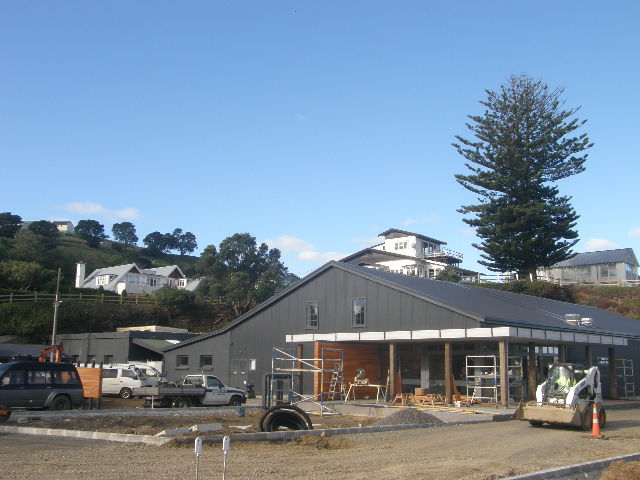

This view of the shed frontage shows a modern style entry area has been designed for public entry and also to house a sea view cafe.

The windows are original - old drawings of the original shed showed these windows in this position. A heritage architect was retained by the Navy to get the detail as right as they could for their tight budget of less than $1.5 million for the whole job.

Inside the entry is the white reception and interpretation area. The original ironwork supporting the roof is a feature.


The main part of the museum is in sharp dark contrast. Again the original roof structure is evident. When first built this area was where the mines were assembled before being put in position across the harbour entrance.

The wooden structures are being added later - within the shed envelope - to house the Navy's collection of exhibits and museum displays.


Again, this dark space is lined with the original doors that led to the areas where the mines and explosives were stored.

There are 3 mine and explosive storage areas. These have the highest historic values I understand, and their restoration will be more detailed and painstaking. You can see on the floor the original rail tracks used for the trollies that carried the mines and their makings into the assembly area.

This picture shows the roof, which is curved, around 2 feet thick of concrete, which was poured into shape and supported by rail-lines structures that you can see in the ceiling.

The doorways, windows and walls are around 2 feet thick concrete also. Designed to withstand a significant explosion.

The explosives storage areas fit against the cliff with its coastal pohutakawa. Creating interesting spaces for education and coffee away from the wind.


The whole area has many interesting places to sit and explore. Whereever possible the design has incorporated the old and original woodwork and corrugated iron work and concrete.

Somehow it all blends into the surrounding Devonport landscape.

And here's the other shed, which sits alongside Torpedo Wharf.

It's an old structure too, needed some serious love and attention.

It was the Boat Shed at Torpedo Bay.


And inside it's a magic place.

Well done Navy.

You've shown Auckland what can be done within a tight budget, working with the Historic Places Trust, to adaptively reuse your old sheds.

Fantastic.

Thursday, November 5, 2009

Queens Wharf - Let Sleeping Dogs Lie....

There's wisdom in the more considered remarks of Hamish Keith in today's NZ Herald, and also in the letter there by Architect and ideas man Stephen Smythe.

Their advice calls to mind a wise comment made to me by an experienced former councillor. He said, "a good day in council is one where a bad decision was not made..."

The Queens Wharf design brief was a bad decision because ARC wanted to turn Queens Wharf into Auckland's primary Cruise Ship Terminal - with Cruise Ships allowed on both sides. That's what killed the plan to have a great public space there.

ARC's plan - led by its Chair - should have been put out for public consultation, along with other broad ideas for the use of Queens Wharf - like emphasising its public purpose and ferry use and using its heritage buildings for other purposes - long before Auckland's design community was put to work designing a dog of a design. Trying to make a silk purse out of a dog's ear.

Government's idea of Party Central was always a good simple idea, because all it called for was some temporary renovation and structures. Put them up in time for the Rugby Event and take them down afterward. Use the time as an opportunity to experiment with ideas - as I wrote in the Herald months ago.

I have always wanted to see much more effort put into fixing the Cruise Ship terminal on Princes Wharf. Making it work better than it does now. I've seen reports which indicate that the Cruise Ship industry is not unhappy with Princes Wharf. Sure they'd like it to be better, and two terminals are always better than one, but hey - we only have a couple of these big wharves downtown.

In my opinion the Cruise Ship industry can have access to one of these - but we'll have the other one thank you very much. If there must be another cruise ship terminal, then allocate wharf space further east. Learn - again - from where Wellington is locating its new cruise ship terminal.

My objective through this whole sorry process is to ensure that the existing sheds are not lost and denigrated in a fervour of Iconic Cruise Ship terminalitis.

It has been disappointing to see politicians normally keen to save wooden hospital buildings and historic railway station buildings - all dilapidated and crumbly before careful conservation - jump so quickly to disparage and demolish Queens Wharf's extraordinary sheds. The Heritage Assessments I have read - which have yet to be shared with the public - indicate these are treasures of national importance.
The NZ Historic Places Trust’s Northern Registrar, Martin Jones, who is researching the history of the sheds and wharf, says this in his account of the role this infrastructure played: “The sheds on Queen’s Wharf are the last remaining structures associated with that huge ‘machinery’ of export and as such are an extremely important part of the country’s economic as well as social heritage.” He writes: "The history of Queen’s Wharf sheds and their place in the maritime landscape make them every bit as important as the iconic Ferry Building...”

“The Sydney Blue Gum joists and decking, riveted metal frames, and original electric lifts add character to both buildings which are striking for their modern ‘industrial’ appearance. They have considerable potential to be successfully readapted for new use both inside and out.”

Martin notes further: “The sheds are the last link to a waterfront history that shaped Auckland, but which has all but disappeared.... Cities overseas have shown what buildings like these can become with a little creativity and investment. In the right hands, the Queen’s Wharf sheds could become some of the waterfront’s most prized assets,” he says.
Show some leadership guys. Do the right thing.